Socotra: THE ISLAND WITHOUT DISTANCE
For millions of years, isolation protected Socotra from the world. Now that same distance no longer saves it: Yemen’s war, regional power struggles, ecological fragility, and cultural erosion are all competing for the future of an island that seems to have been born outside time.

On January 10, 2026, four Yemenia Airways flights lifted off from Socotra carrying 609 foreign tourists. Among them were around twenty Spaniards. The evacuation, coordinated with Saudi and Yemeni authorities, had the feel of both a diplomatic episode and a final scene: tired passengers, improvised luggage, uncertainty resolved at the last moment, an island closing behind them as though it had suddenly remembered what part of the world it belongs to.
For a few days, the place that agencies, photographers, and travelers had sold as a radiant exception—the last Eden, the extraterrestrial island, the ultimate refuge—revealed its other truth. It was not only a landscape. Not only a biological rarity. Not only a remote dream suspended between dunes, dragon’s blood trees, and turquoise sea. It was also a territory trapped inside the brutal logic of a region at war.
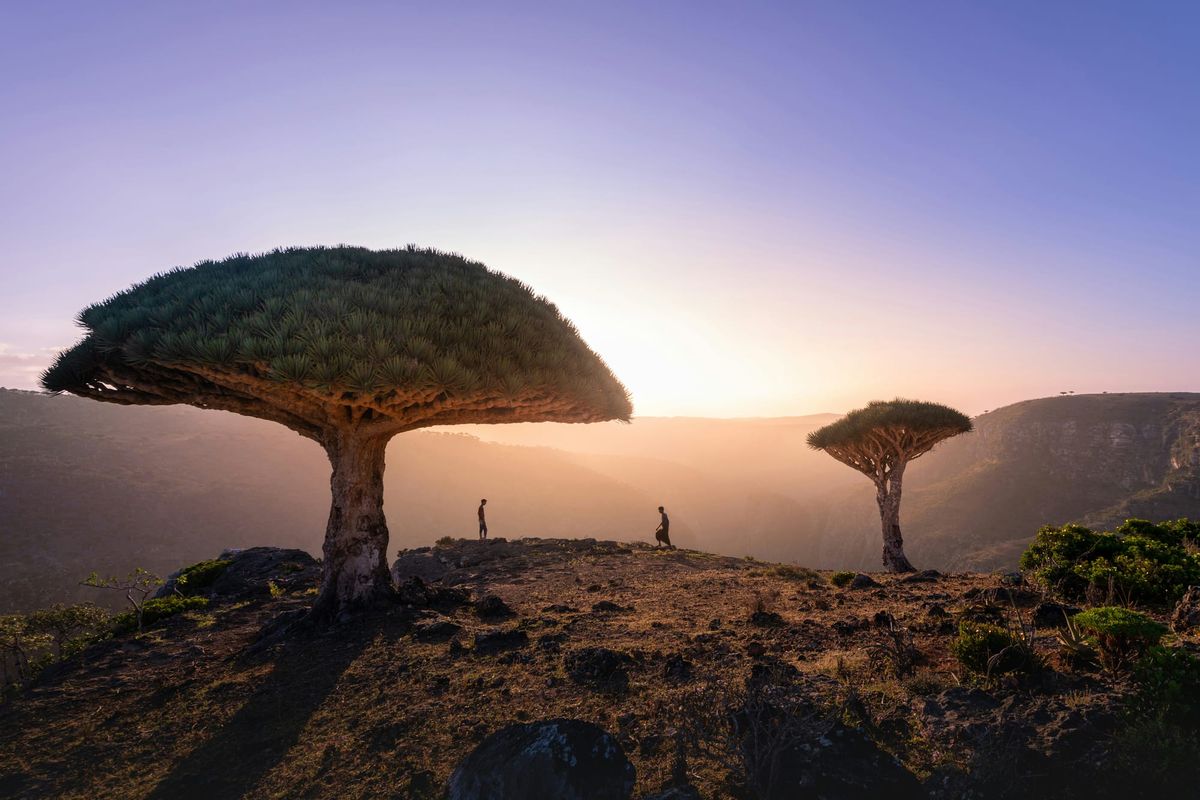
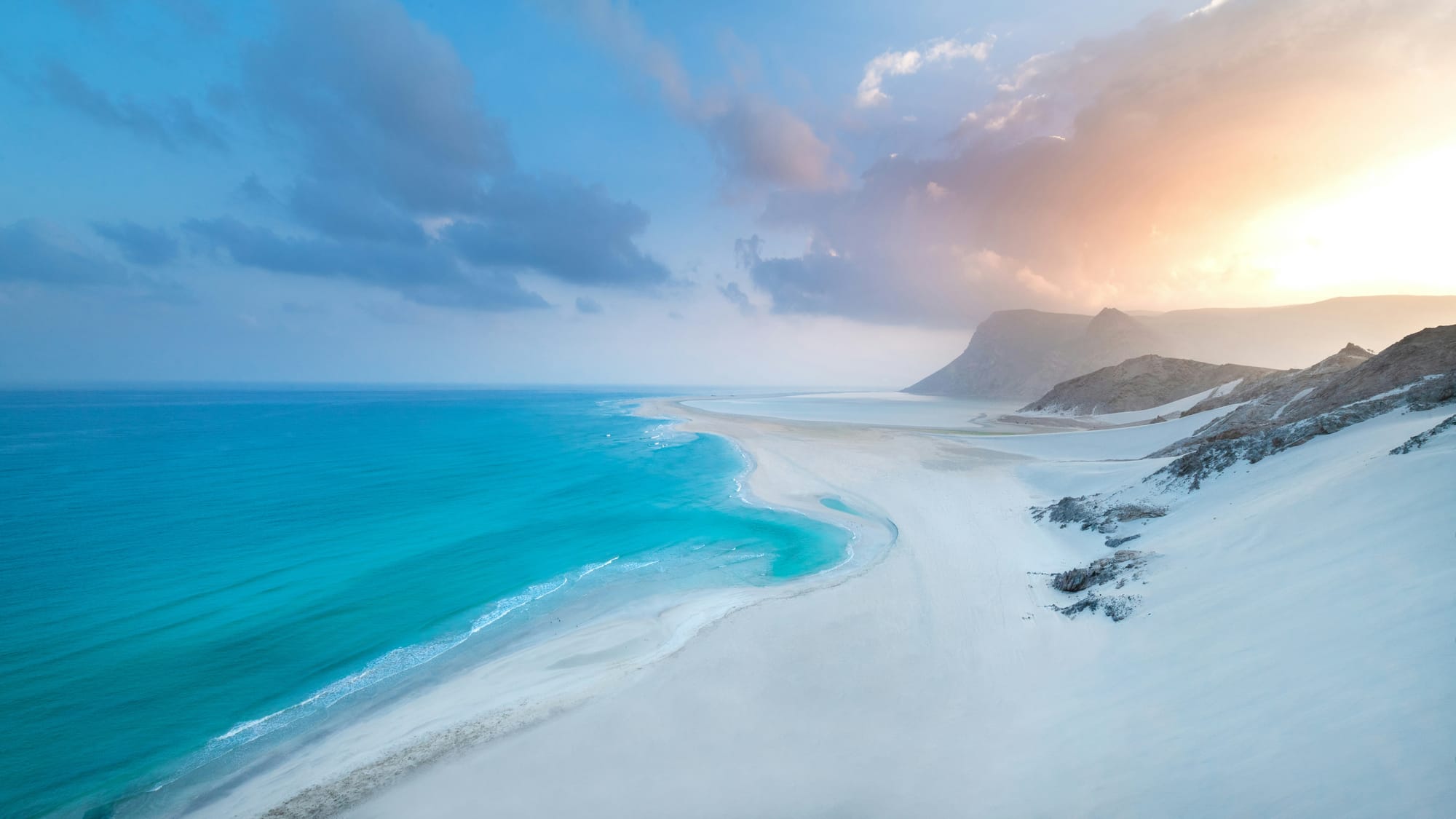
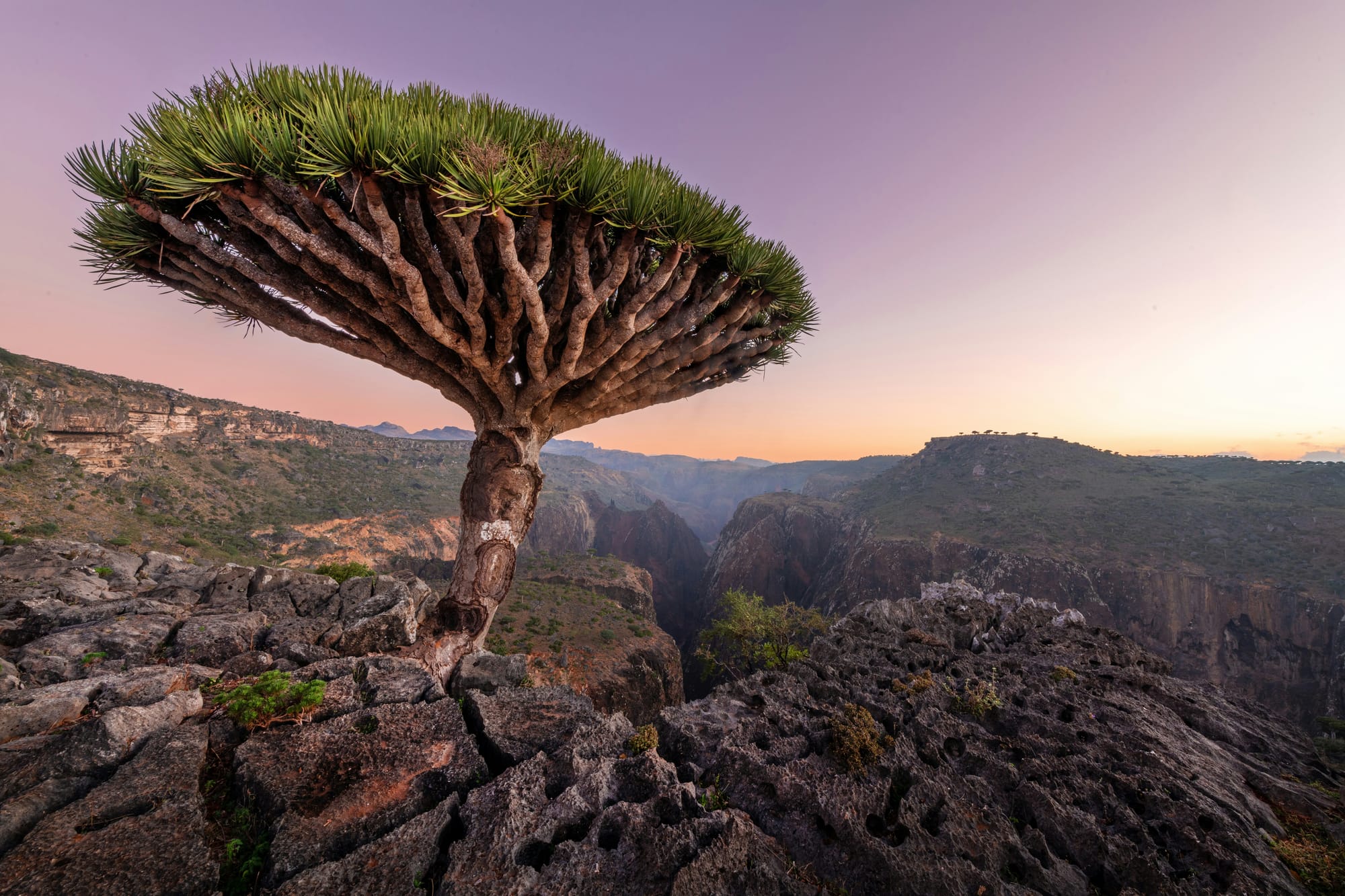
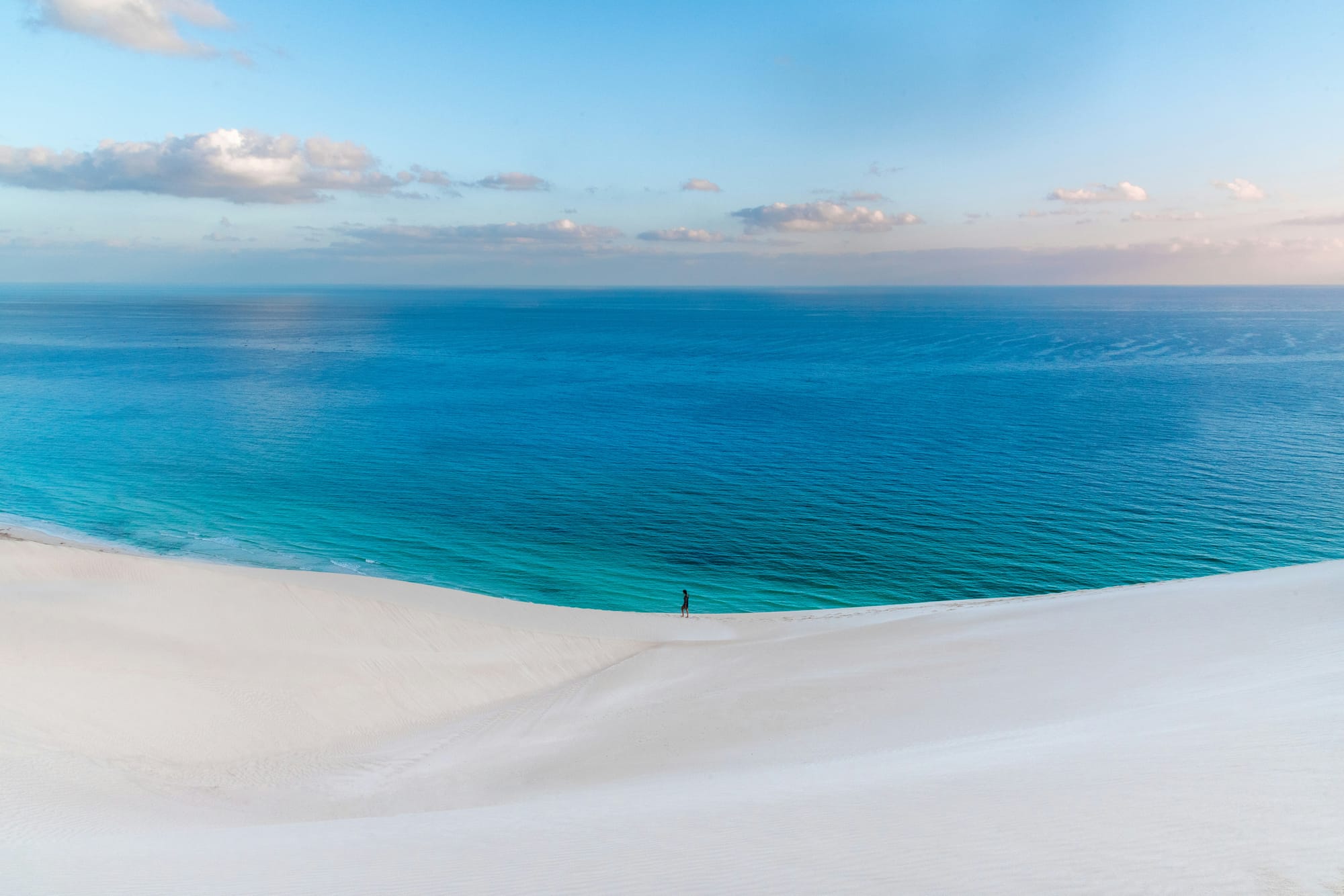
Socotra usually enters the imagination through impossibility. First come the trees: the dragon’s blood trees, with their umbrella crowns that look drafted by an illustrator from another planet; the bottle trees, swollen and defiant; the aloes, the succulents, the desert roses. Then the rest arrives: white beaches bearing hardly any mark except the wind’s; cliffs and mountains that rise abruptly above translucent water; lagoons so blue they seem to defy scale; karst caves, wadis, giant dunes pressed against black stone walls. Everything invites the belief that Socotra belongs more to myth than to geography.
And yet the story that matters is not only its beauty. It is the tension now running through it. Socotra is one of those places where the contemporary world becomes visible with unusual cruelty: conservation collides with business, sovereignty with interference, identity with homogenization, outside fascination with inner vulnerability. And all of it is happening on an island that survived for millions of years thanks to a very specific way of being alone.
The geography of a miracle
Socotra is an archipelago set between the Arabian Sea and the Gulf of Aden, in the Indian Ocean. Politically, it belongs to Yemen. Geographically, it seems to obey another logic. It lies roughly 350 kilometers from mainland Yemen and is, in physical terms, closer to the Horn of Africa than to the centers of power that are supposed to administer it. It consists of four main islands—Socotra, Abd al Kuri, Samhah, and Darsah—and several rocky islets. The largest island, also called Socotra, holds human life, most of the biodiversity, and nearly all of the legend.
At a glance: where Socotra is
➢ Archipelago in the Indian Ocean, between the Arabian Sea and the Gulf of Aden
➢ Around 350 km from mainland Yemen
➢ Politically Yemeni, geographically closer to the Horn of Africa
➢ UNESCO World Heritage Site since 2008
Its singularity did not begin with tourism or with modern science. It began much earlier, when this continental fragment broke away and was left to a regime of geological isolation, heat, dryness, monsoon winds, mountain mists, and a topography so complex that every valley, plateau, and ridge seemed capable of inventing its own survival strategy. The main island gathers narrow coastal plains, a limestone plateau riddled with caves, and mountain massifs rising beyond 1,500 meters. Within a few kilometers, the land changes visual language: from the blinding white of Arher’s dunes to the still blue of Detwah; from the Diksam plateau to the forests of Firmihin; from Homhil’s natural pools to the mineral labyrinth of Hoq.
That violent variety of landscapes is not decorative excess. It is the matrix that made one of the most extraordinary biodiversities on Earth possible.

Around 37 percent of its plant species are found nowhere else. Neither are 90 percent of its reptiles, nor 95 percent of its land snails. The archipelago also shelters exceptional marine richness: corals, coastal fish, crustaceans, mangroves, seabirds and land birds, many migratory, others strictly endemic. UNESCO inscribed it on the World Heritage List in 2008 because of that combination of diversity and endemism that makes it a fortunate anomaly, almost an evolutionary lesson unfolding in the open air.
But what technical language calls “endemism” in Socotra has a stranger, more moving density. It means, in truth, that there are forms of life that could only become fully themselves here. The island is not simply a place where rare species happen to exist. It is the only place where those species can be what they are.
The trees that hold up a legend
If Socotra has an emblem, it is the Dracaena cinnabari, the dragon’s blood tree. There is something nearly definitive about its silhouette: the trunk rising with contained gravity, the horizontal burst of branches, the dense rounded crown that seems intent on catching air itself. From a distance, the dragon’s blood trees do not resemble a conventional forest. They look like a gathering of still creatures, a vegetal assembly that has remained there since before human history.
Part of the tree’s fame comes from its red resin. That “dragon’s blood” was coveted for centuries: medicine, dye, varnish, ritual element. The ancients wrapped it in legend—wounded dragons, elephants in combat, spilled blood turned into sap. Trade in that resin moved along old routes and fed the imagination of an island bound to frankincense, myrrh, and other precious goods of the classical world. The tree is not only a botanical rarity; it is also a cultural, economic, and symbolic artifact.
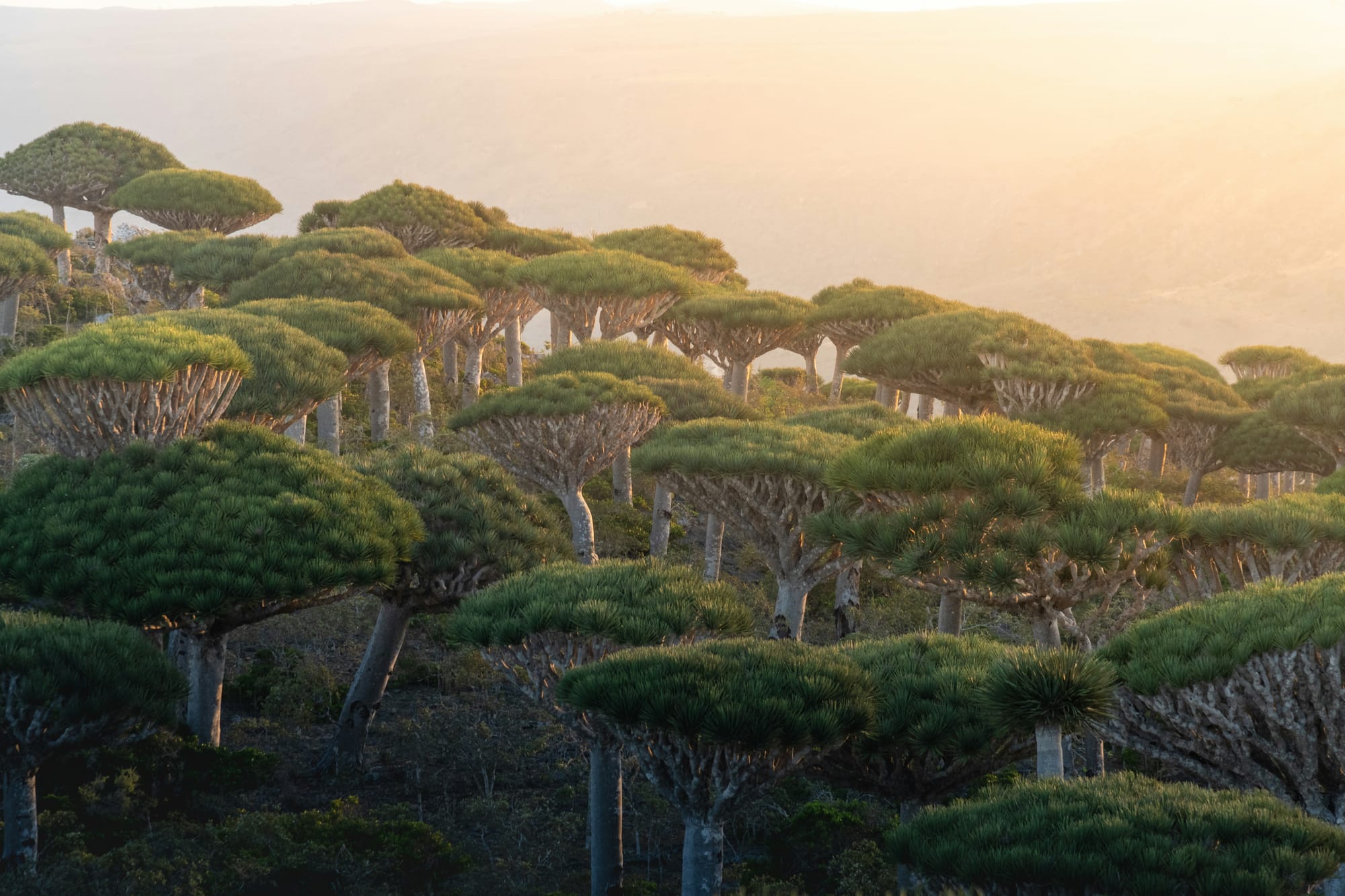
But what matters most about the dragon’s blood tree is not its exoticism. It is its function in the island’s balance. In an arid territory, its crown performs a silent task: it captures moisture from the mist and helps that water reach the soil below. In Socotra, beauty is not a luxury. It is a form of natural engineering.
And yet even this monumental tree is under threat. Not because the world has suddenly discovered its value, but because the island that made it possible no longer offers the same conditions for renewal. Young shoots suffer from grazing, especially by goats. Climate change makes the environment harsher. Cyclones strike harder. Aridity deepens. The mature specimens are still there—majestic, photogenic, almost invincible to a visitor’s eye. But the real drama is taking place lower down, where the trees of the future ought to be emerging.
Dragon’s blood tree
➢ Endemic to Socotra
➢ Red resin traded since antiquity
➢ Crown structure helps trap moisture
➢ Young trees struggle to regenerate بسبب grazing and climate stress
A landscape can still look eternal while beginning to fail from within.
A culture that is endemic too
Outside fascination with Socotra often gets trapped in its vegetal forms, in its untouched beaches, in the idea of a natural laboratory somehow beyond civilization. But the island is not a museum without inhabitants. It is a living society. Between roughly 50,000 and 60,000 people, according to the various estimates in the source material, inhabit the archipelago. They are the Socotris, and their presence changes the meaning of the place completely.
They speak Soqotri, a Semitic language of their own, oral for centuries and distinct from Arabic. It is not a picturesque dialect or a philological curiosity. It is one of the island’s great reservoirs of memory. In its rhythm, its poetic forms, its stories carried from generation to generation, survive a worldview, a relationship with landscape, and an identity that cannot be reduced to Yemen’s political map. Children learn the language at home before entering school and, with it, the official language of the state.
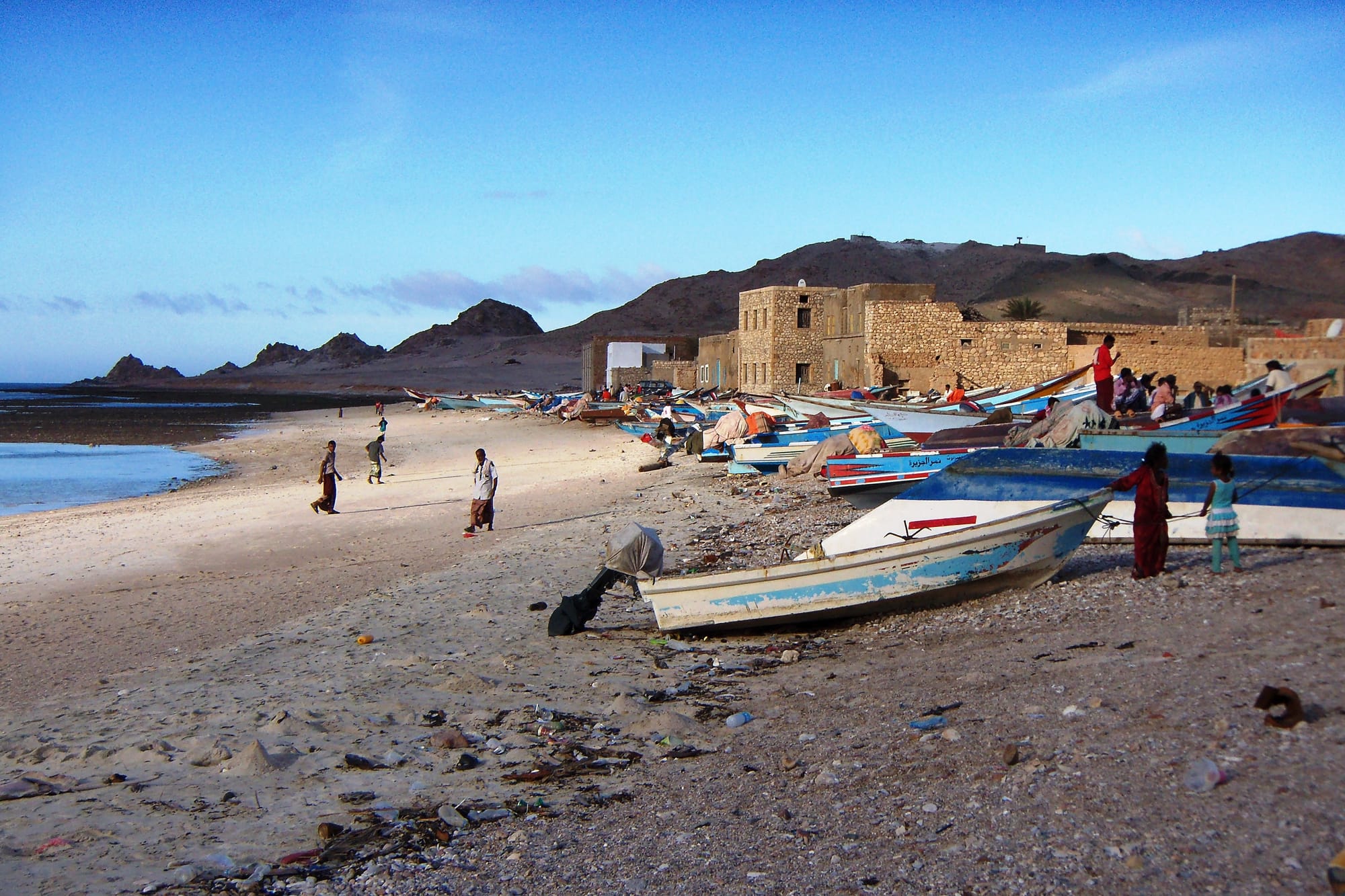
Everyday life in Socotra has long been tied to fishing, herding, and subsistence agriculture. On the coasts, settlements live facing the sea and, at the same time, as if wary of it: boats, nets, fish markets, coral-stone houses, days shaped by the catch. Inland, goats and cattle remain an economic and cultural foundation. Families know the land’s cycles, the medicinal uses of plants, the unwritten rules for not breaking the balance their survival depends upon. In some areas, activities have long been governed by traditional agreements, communal decisions, and the authority of elders.
None of that fits neatly inside the caricature of a paradise island.
Because Socotra is not merely admirable. It is also hard. For a long time, much of its population has lived with sharply limited services: without reliable running water, without enough paved roads, with intermittent electricity, with uneven access to telecommunications, healthcare, or education. Hadiboh, the capital, is not a postcard display but a small, disorderly town of dust roads and a fish market that tells the island’s real story better than any brochure: basic economy, informality, negotiation, survival.
That matters now that tourism sells the island as a stage set for purity. For the Socotris, the island is not fantasy. It is an entire life lived under conditions that are often precarious.

The isolation that protected, the isolation that condemns
For centuries, Socotra lived thanks to its remoteness. But that same remoteness has a brutal reverse side: the ease with which it can be cut off completely when the surrounding region catches fire.
Yemen’s war, which began in 2014 and has dragged on through shifting phases, actors, and fronts, devastated the country and fragmented its territory. Although Socotra remained relatively removed from the main battlefield, it was never truly outside the war. Geographic distance did not immunize it. It merely altered the way violence reached it.
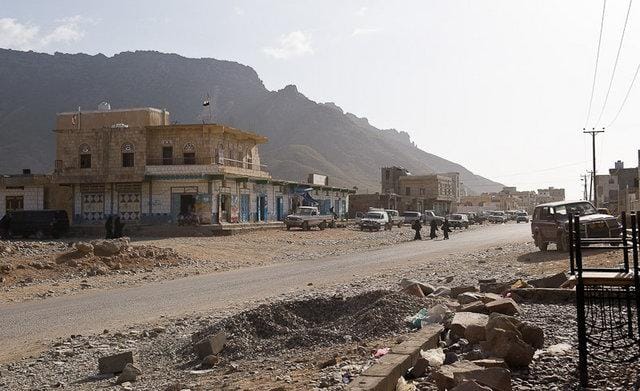
It did not receive mass bombing on the scale of other regions. Other things arrived instead: rising costs of living, broken supply chains, institutional fragility, power struggles, indirect militarization, external dependence, uncertainty in air access, political control by actors far from the local population. In short, the familiar consequences of war when it seeps into the periphery—not always as visible explosion, but as the slow deterioration of living conditions and of the ability to decide over one’s own territory.
Timeline: how war reached Socotra
➢ 2014 — Yemen’s war begins
➢ 2018 — UAE deploys forces to Socotra
➢ 2020 — Southern Transitional Council consolidates de facto control
➢ Late 2025 / early 2026 — flight disruption strands foreign tourists
➢ 2026 — evacuation exposes the island’s dependence on outside powers
In 2026, when hundreds of tourists were stranded by flight suspensions amid tensions between Saudi Arabia and the United Arab Emirates, the episode was read abroad as a bizarre anecdote about extreme travelers. For the island, it was much more than that. It was proof that its connection to the outside world depends on extremely fragile external balances. What for the tourist was a suspended adventure can, for the inhabitant, be a permanent logistical sentence: pricier fuel, fewer transport options, less access to resources, greater dependence.
In Socotra, isolation is an ecological blessing and a political problem. It preserved biodiversity, yes, but it also made state neglect easier, basic services more fragile, and vulnerability to any actor arriving with money, infrastructure, or military protection far greater.
The coveted island
Socotra’s location explains much of its contemporary fate. It sits at one of the most sensitive maritime junctions between the Persian Gulf, the Red Sea, and the Indian Ocean. It does not take much geostrategic imagination to see why it matters to regional powers. It is a small enclave with disproportionate value: whoever holds influence in Socotra holds a privileged window onto one of the most decisive arteries of global trade.
Since 2020, the island has been de facto controlled by the Southern Transitional Council, the southern Yemeni separatist movement backed by the United Arab Emirates. That reality did not descend from nowhere. It was built through war, through the weakening of Yemen’s internationally recognized government, through Emirati troop deployments from 2018 onward, through support for southern separatist actors, and through a gradual replacement of effective sovereignties. On the archipelago, the flags of former South Yemen have replaced, in many places, the symbols of unified Yemen. Politics, as ever, is fought in colors too.
What matters is that in Socotra, geopolitics has often arrived wearing the face of aid. The Emirates financed infrastructure, rebuilt spaces, improved certain services, and projected an influence many locals interpreted ambivalently: as necessary assistance in an island long neglected, but also as political, administrative, and symbolic penetration. Saudi Arabia, for its part, has also maintained a presence at different moments under the argument of upholding Yemeni legitimacy or supporting reconstruction. Behind both narratives lies a competition for position, ports, routes, and regional projection.
Socotra is too small to escape that dispute and too valuable not to be absorbed by it.
The tragedy is that the island’s real needs make the moral reading more difficult. When a community needs roads, hospitals, schools, water, or telecoms, aid never arrives in the abstract. It arrives with flags, interests, and conditions. And in a territory with weak institutional power, almost every material improvement risks becoming a form of dependence.
Conservation is also a form of sovereignty
Warnings about Socotra’s environmental deterioration do not belong to the realm of romantic exaggeration. The various voices present in the source material—local experts, environmental activists, figures linked to UNESCO or to heritage protection—converge on one point: the island is under mounting pressure.
They describe unlicensed urban development in protected spaces. They describe projects that run against the norms meant to govern a World Heritage site. They describe overfishing, trawling harmful to reefs and marine life, coral theft and trade, the introduction of exotic species, uncontrolled grazing, and commercial dealing in endemic specimens. UNESCO has sent monitoring missions and documented serious concern. The IUCN has repeatedly stressed that isolated island ecosystems are especially vulnerable when conflict, weak governance, and resource exploitation coincide.


All of that might sound abstract if not for the fact that Socotra is precisely the kind of place where any alteration multiplies its effects. A road does not only connect. It fragments habitat. An invasive species does not merely arrive. It can overturn balances built over millennia. A fish-processing plant does not only buy production. It may push fishing toward practices incompatible with ecological renewal. Growing tourism does not only bring money. It also brings waste, pressure on water, more movement, greater infrastructural demand, and more temptation to build where building should not happen.
Even garbage, mentioned in multiple testimonies, acquires symbolic value here. On an island celebrated for primordial purity, plastic bottles along winding roads or accumulated refuse around settlements are not only a management problem. They are proof of a change of era. The world has arrived—but not necessarily with the tools required to live alongside the island’s delicacy.
Protecting Socotra does not mean freezing it into an ecological postcard. It means recognizing that the environment is not a backdrop separate from social and political life. It means accepting that conservation requires governance, resources, local legitimacy, and clear limits on what kind of development will be allowed.
On an island like this, conservation is also a question of who gets to decide.
The temptation of the last paradise
There is something deeply contemporary in the desire to go to Socotra. It is not only tourism. It is the search for a purity the rest of the planet seems to have lost. The island promises real disconnection, skies without interference, beaches without hotels, mountains without cable cars, roads without signal, silence. In an age saturated with images and access, Socotra sells a rare good: the feeling that something still exists that has not been fully touched.
That is why its magnetism is so powerful. Photographers, biologists, naturalists, adventurers, content creators, and specialized travelers have turned the island into an object of desire. Its visual power is undeniable: a lone human figure dwarfed among dragon’s blood trees; Arher’s dunes facing black mountain and turquoise sea; Detwah flattened into mirrorlight; fishermen at Qalansiyah; a Socotri woman in traditional dress; a cave opening like a mineral yawn; wind tilting trees and shaping sand. Everything looks built for a cover story.
And there lies the danger.
What is at stake beyond nature
➢ Language
➢ Oral memory
➢ Rural livelihoods
➢ Local control over development
➢ Cultural continuity under external pressure
The local economy needs income. Tourism can provide it. In fact, the model that makes the most sense for an island like Socotra is one of small groups, camping, local guides, limited infrastructure, strict respect for landscape and flora, and direct participation by local communities. That is the ideal of responsible ecotourism, and the source material includes operators, routes, and travel forms that move in that direction.
But ecotourism is not automatically innocent. It can also become an elegant alibi for monetizing a territory’s exceptionality without asking how much it can bear. Simply making such a fragile place visible multiplies the desire to reach it. And desire requires more flights, more access, more logistics, more services, more footprint. There is no paradise that does not begin to change when it becomes a market category.

Socotra lives exactly on that edge. Its appeal depends on not resembling any other destination. But the more appealing it becomes, the more forces gather to push it toward recognizable forms of exploitation.
The island risks dying of what makes it desirable.
A language under pressure, an identity in dispute
Socotra’s erosion is not only ecological. It is cultural too. Soqotri, the island’s mother tongue, was preserved for centuries largely because of isolation. That same isolation, however, left the community without enough tools of documentation, recognition, and institutional support. For a very long time it remained overwhelmingly oral, sustained by collective memory, poetry, song, storytelling, and everyday speech.
Now that balance is changing.

War, displacement, uneven technological opening, the growing presence of outside actors, and the expansion of rival networks of power have altered the archipelago’s daily life. Multiple testimonies in the source material warn of rapid mixing with incoming populations, the growing dominance of Arabic, the lack of accessible and affordable internet across much of the island, the absence of resources to produce written or educational material, and the sense that modernization is arriving without a clear strategy for cultural protection. The language that survived centuries of isolation may weaken precisely when the island becomes more connected.
That is another of Socotra’s silent dramas: what disappears does not always make noise. Sometimes it vanishes the way languages vanish—through disuse, disadvantage, lack of transmission, the creeping sense that what is one’s own no longer serves the world that is coming.
And yet there is resistance too. The creation of initiatives to document and study Soqotri, the insistence on its recognition, the pride of its speakers, the persistence of oral forms, the determination of intellectuals and younger islanders to preserve what is theirs all suggest that the island is not passively witnessing its own transformation. Socotra is not an object. It is a subject arguing with itself over what can be opened and what cannot, what can be modernized and what cannot be lost without ceasing to be itself.
The illusion of the untouched
There is a way of looking at Socotra that reduces it to a virgin stage, almost prehuman. The impulse is understandable. The island creates precisely that impression. But it is also incomplete, and in the end unfair.
Nothing in Socotra is untouched in the naïve sense of the word. The island has history, trade, memory of ancient routes, layers of religion, traces of empires, British presence, Soviet residue, contemporary disputes, migration, oral tradition, poverty, adaptation, fatigue. Along its coasts came traders, explorers, conquerors, missionaries, fishermen, nomads. Its sap, incense, myrrh, and aloe circulated long before the word ecotourism existed. Its people have negotiated for centuries with climate, isolation, and those who came from outside in search of something.

What Socotra does still preserve—and this is what makes it exceptional—is a certain density of world. A sense that things are still connected to one another in a way that, elsewhere, has already broken apart. Language to territory. Subsistence to landscape. Myth to plant. Coast to village. Mountain to mist. Poverty to dignity. Survival to memory.
That is why the threat hanging over the island cannot be measured only in degraded hectares or invasive species. It goes deeper. It has to do with the possible dissolution of that whole web.
If Socotra is turned into a strategic platform, an aspirational destination for the tourism of rarity, or a sum of infrastructures imposed from outside, it will not only have lost biodiversity. It will have lost an entire way of being in the world.
What Socotra asks of the century
That may be why this island matters far beyond itself. Because its conflict is not exotic. It is radically contemporary. Socotra’s great question is the great question of many fragile places on Earth: how to open without surrendering, how to improve the material conditions of the population without destroying what makes the territory singular, how to protect local life from geopolitical and economic greed, how to accept the future without handing over the soul.
There is no easy answer. Stasis may condemn the population to remain trapped in old deprivation. Development without limits may devastate the ecosystem and hollow out the culture. Conservation understood as postcard aesthetics can become almost as violent as extraction if it ignores the people who live there. And sovereignty, in a context of war and fractured statehood, is a complicated word, sometimes nearly aspirational.
Socotra demands something else: a slower, humbler, more difficult intelligence. One that understands that not every territory can be subjected to the same model of progress. One that grasps that in certain geographies every material decision has ecological, cultural, and political consequences at once. One that accepts that a place’s exceptionality does not give the world the right to consume it.
Perhaps that is why the most honest image of Socotra is not its empty beaches or its forests of dragon’s blood trees, but its status as a delicate frontier. Not a frontier between two countries, but between two tempos. On one side, the long time of evolution, mist, stone, oral language, herds, fishing, and slow adaptation. On the other, the ferocious time of the twenty-first century: regional war, competition over routes, flights, algorithms of tourist desire, infrastructures that arrive promising future and may leave ruin behind.
Socotra stands exactly there, in the middle.
Coda: under the dragon’s blood tree
On the high plateaus, where mist sometimes tangles itself in the crowns of the dragon’s blood trees, the landscape still carries an ancient authority. There is no city noise, no luminous sign, no artifice capable of diminishing the impression of standing before a form of life that has learned how to endure. The trees do not grow with the arrogance of those in abundant forests. They open sideways, as if they know that in the driest places survival depends on another virtue: gathering the minimum, holding shade, storing moisture, waiting.

Socotra resembles that.
It survived because it learned to live from scarcity: from distance, from wind, from mist, from memory, from a language that remained unwritten for centuries, from communities capable of drawing life out of difficult ground without wholly breaking it. Now it is no longer enough for the island to resist nature. It has to resist the world.
And that is perhaps the deepest reason this story matters. Because what is being decided in Socotra is not only the fate of a strange and beautiful island in the Indian Ocean. Something larger and more uncomfortable is also being decided there: whether our age is still capable of approaching an irreplaceable place without devouring it; whether it can admire without turning everything into market, every rarity into content, every fragility into opportunity.
Socotra’s future does not depend only on its trees, dunes, or reefs. It depends on whether the century that discovered it too late is still capable of granting it the one thing that kept it alive for millions of years: the right distance.