Basilica of Saint Peter: THE TOMB THAT HOLDS UP THE WORLD

Beneath the high altar of Christianity’s most famous basilica lies not a metaphor, but a grave. On top of a Roman necropolis, an unstable slope, and a subsoil made of tombs, fill, and galleries, the Church raised the greatest material assertion of its own continuity.

Share
Basilica of Saint Peter: THE TOMB THAT HOLDS UP THE WORLD
audio-thumbnail
Mozart Requiem In D Minor K 626 Requiem
0:00
/416.28

The most important thing about Saint Peter’s is not what one sees upon entering.

A visitor lifts his head and is struck first by scale: the immense nave, the skin of marble, the glow of bronze, the vault that seems to absorb the air, the dome hanging over the crossing like a law of physics suspended by decree. Everything drives upward. Everything is designed to make the eye rise. But what matters most is not above. It is not in the lantern. It is not in the gold mosaics. It is not in the muscular theatricality of Bernini’s baldachin, nor in the curve of Michelangelo’s dome, nor even in that distinctly Roman art of turning stone into a stage for power. What matters most is below.

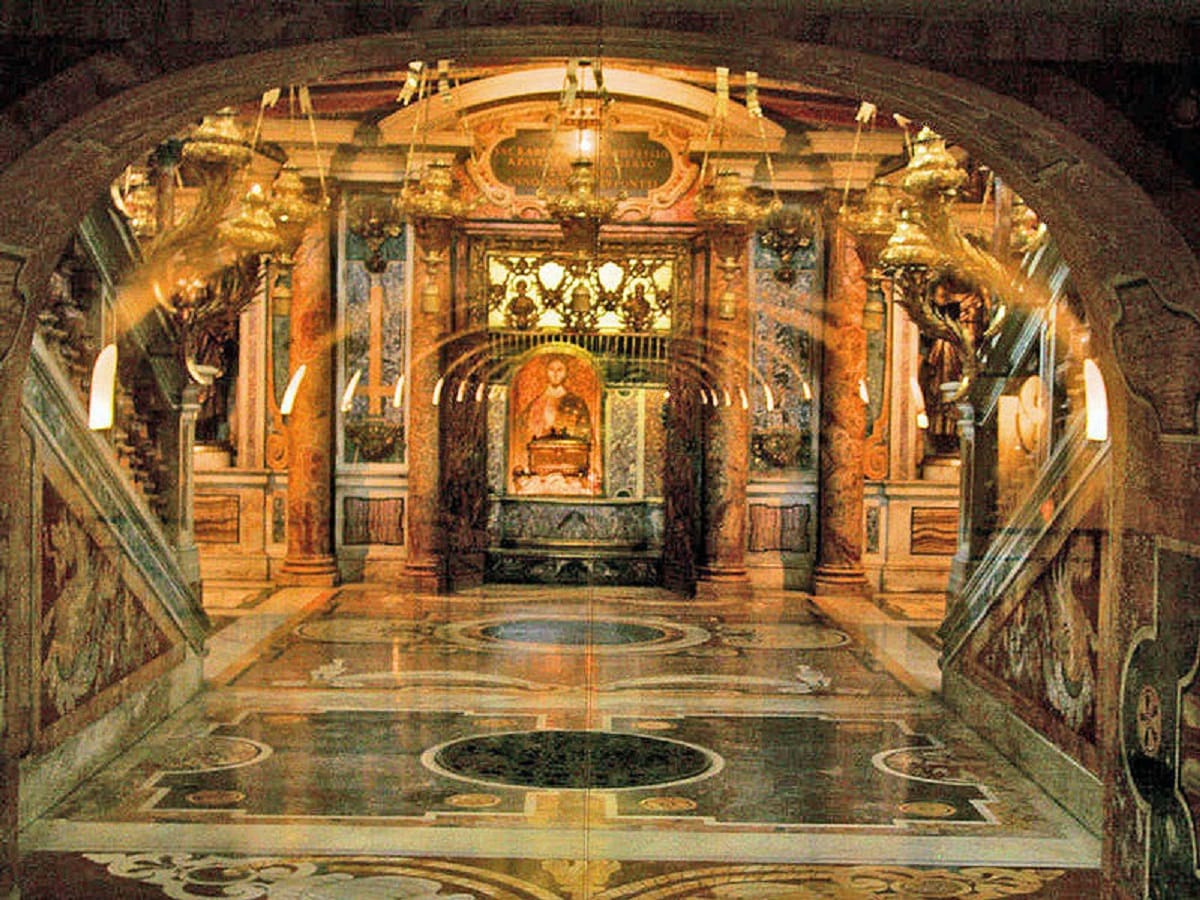
Below the marble is a lower level. Below that level is another. Beneath the grottoes, the altars, the revetments, the layers of memory, and the centuries of embellishment, there is a tomb. Or, more precisely, the stubborn memory of a tomb. A burial hollow on the southern slope of the Vatican Hill, near the place where tradition situates Peter’s martyrdom, in the area of Nero’s circus. That point—humble, uncertain in some details, yet central for nearly two thousand years—has governed one of the most extraordinary architectural enterprises in Western history.

That is Saint Peter’s essential paradox. The building that best embodies the monumentality of the Church of Rome did not begin in fullness, but in fragility. Not on a summit, but in a wound in the earth. Not from an abstract and triumphant rock, but from a concrete grave that had to be protected, encased, monumentalized, and yet never displaced. The basilica is not only a temple. It is a solution. A gigantic answer to a question that has run through seventeen centuries: how to support an immense architecture without destroying the funerary, historical, and symbolic foundation that legitimizes it.
Low-angle view inside Saint Peter’s Basilica showing the dome springing from the four colossal piers above the high altar.
The basilica’s visual splendor begins as a structural necessity: the dome, the piers, the mass, the controlled thrust.

A founding paradox

Christian tradition identified this place as the burial site of Peter, the Galilean fisherman who became an apostle, was martyred in Rome, and, for the Catholic Church, became the city’s first bishop and first pope. Very early on, the tomb became a focus of devotion. Long before the Renaissance basilica, long before the baldachin, the colonnade, the square, and the dome, there was already memory here. Not at first a grand sanctuary, but something more modest and, in a sense, more powerful: a marked place, venerated and remembered.

The later history of the site can be read as a long series of enclosures. An aedicule over the grave. A monument over the aedicule. An altar over the monument. A basilica over the altar. Another basilica over the first. A dome above them all. Each age added a layer, but none dared move the center. That is Saint Peter’s singularity: its magnificence did not replace its origin. It became condemned to orbit it.
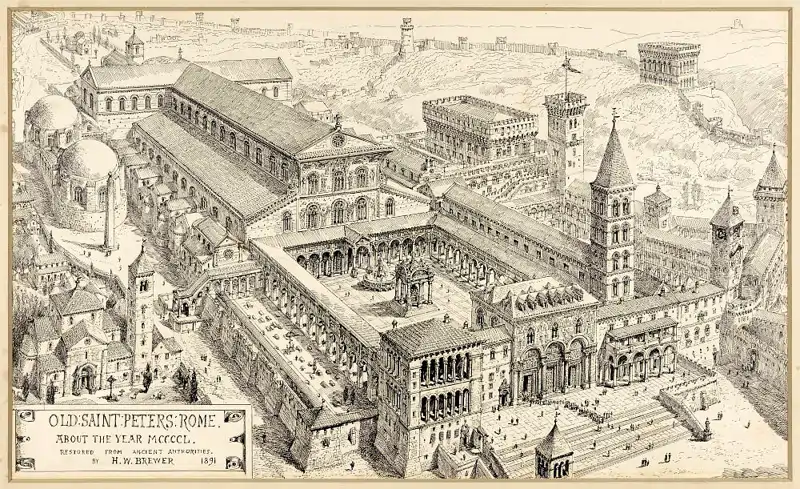
Saint Peter’s was not simply built on a holy place. It required the ground itself to be remade

Which is why the building’s real raw material is not only travertine, bronze, or marble. It is also impossibility. Saint Peter’s begins with an unspoken prohibition: the center cannot be touched.


Constantine and the decision to build where one should not

When Emperor Constantine ordered the first basilica in the fourth century, it was already obvious that the chosen site posed a formidable problem. Vatican Hill did not offer a compliant plot. It was no noble esplanade, no summit prepared to receive a great structure. It was a slope. A place occupied by tombs, mausoleums, funerary roads, and irregular constructions. A site used for generations as a necropolis. A terrain of gradients, cuts, fill, and voids. In short, a ground closer to inconvenience than promise.

And yet Constantine wanted to build there, exactly there.

That “exactly” matters. It is the core of everything that follows. The Constantinian basilica was not merely an act of imperial patronage, nor only a political victory for Christianity as it moved from persecution to protection. It was also a topographical declaration. An assertion that the place venerated as Peter’s tomb should become the center of a colossal building even if the terrain resisted.

What Constantine had to do to build here

➢ cut into the hill
➢ bury part of the necropolis
➢ create artificial fill
➢ build retaining structures to stabilize the platform

The operation was immense. Part of the hill had to be cut back, while other sections had to be filled in to create a stable platform. Parts of the necropolis had to be demolished, others buried beneath vast quantities of earth, and retaining walls had to be built to provide a surface large enough to carry the basilica. This was not ornamental work. It was a brutal and precise intervention into the hill’s own relief. A remaking of the landscape on a monumental scale in order to tame a site that, in strictly constructive terms, did not invite grandeur.

The exact measure of the effort varies depending on the reconstruction, but the general truth is clear: moving earth mattered as much as raising walls. The project was not simply to erect a church, but to manufacture the ground that would make that church possible. In a sense, Saint Peter’s began as a geological work.

And that decision yields a first essential conclusion: if Constantine accepted such effort, it was because he was not willing to move the sacred point to a more convenient location. The tomb mattered more than practicality. Spiritual foundation dictated material conditions. And that subordination of engineering to memory is the building’s true first stone.


The buried necropolis

Beneath Saint Peter’s there is a city of the dead.

The twentieth-century excavations initiated under Pius XII brought to light a Roman necropolis of remarkable richness and complexity. Pagan mausoleums, Christian tombs, mosaics, stucco, inscriptions, narrow streets, traces of families, imperial freedmen, cults, private lives, griefs, affections, and funerary customs emerged beneath the most imposing temple of Christendom. The find was as revealing for its archaeological value as for its symbolic force: the monumental heart of Catholicism literally rested on a buried city.
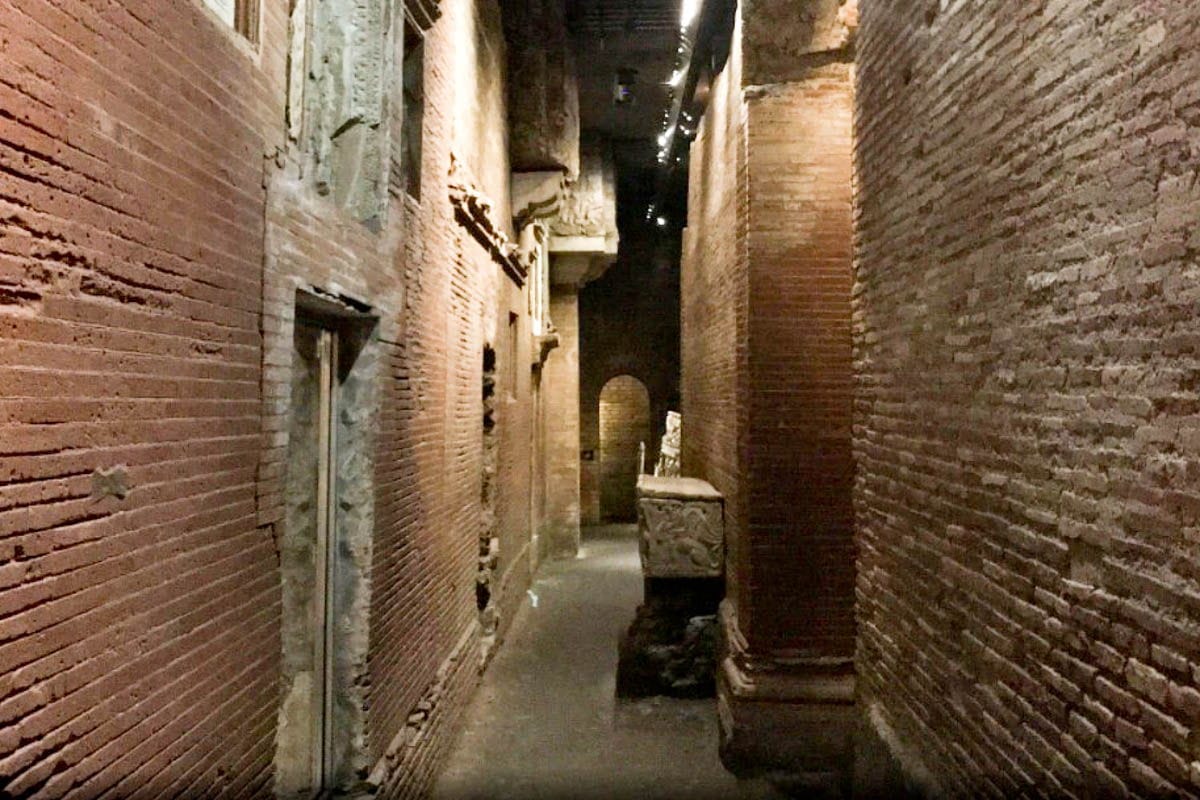
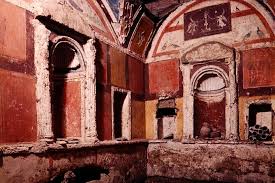
The word necropolis usually evokes silence, immobility, a kind of mineral archive of the past. But in the Vatican case it says more. It reveals the material density of history. It shows that the place where the Church chose to fix its center was already crowded with memory, prior occupation, inherited structures. Christianity did not found itself here on emptiness. It founded itself on remains. On dead neighbors. On a funerary geography in which Peter’s tomb did not float alone, but was embedded in a Roman world that surrounded it and, over time, became its involuntary landscape.

So the first great basilica did not merely cover a grave: it buried an underground city in order to support itself. Constantine’s intervention was partly conquest, partly accidental preservation. By destroying part of the necropolis to build the basilica, he also ensured that another part would be sealed and protected for centuries.

💡
The Church did not build on a void. It built on remains.

It is an irony of long duration. The building that seemed destined to eclipse the underground ultimately became its guardian.


The tomb as vertical axis

At Saint Peter’s everything is ordered by an obsessive vertical.

Below, the tomb. Above it, the Trophy of Gaius, that small funerary monument of the second century recalled by the Roman presbyter Gaius when he spoke of the “trophies” of the apostles at the Vatican and on the Ostian Way. Above that primitive memory, Constantine’s monumental casing. Then Gregory the Great’s altar. Later that of Callixtus II. Then Clement VIII’s altar. And above all of that, Bernini’s baldachin, the dome, the lantern, the cross.

The sequence is not only historical. It is spatial. Saint Peter’s functions like an axis driven into the earth and launched toward the sky. And in that axis the essential thing is not the height attained, but the fidelity with which successive generations preserved the exact vertical alignment between tomb and altar. That alignment explains why the basilica’s architecture, despite its turns, changes of plan, stylistic debates, and structural corrections, has never abandoned a simple principle: the heart of the building must remain suspended directly above Peter.

The basilica’s vertical logic
Dome
Baldachin
High altar
Tomb of Peter
Roman necropolis

Saint Peter’s is often described as a proclamation of the triumphant Church. It is that, certainly. But first it is an architecture of alignment. An exact machine for preserving continuity. The point is not merely to embellish a holy place, but to prevent time from dislodging it from the center.


The Renaissance: ambition enters the scene

When Julius II decided in 1506 to demolish the old Constantinian basilica gradually and build a new one, the question acquired an unprecedented scale. It was no longer only about sheltering apostolic memory, but about materially remaking the principal temple of Christendom according to the political, artistic, and spiritual ambition of Renaissance Rome.

Bramante conceived a centralized, grand structure in the form of a Greek cross, crowned by a monumental dome. The idea matched the architectural language of his age and the desire to produce a work without precedent, a synthesis of papal power and classical harmony. But Saint Peter’s was not a neutral site on which an architect could freely unfold an ideal geometry. It was a place already occupied by inheritance. And that inheritance imposed material and symbolic limits.

In other words, the Renaissance could dream, but it had to dream on top of a tomb.
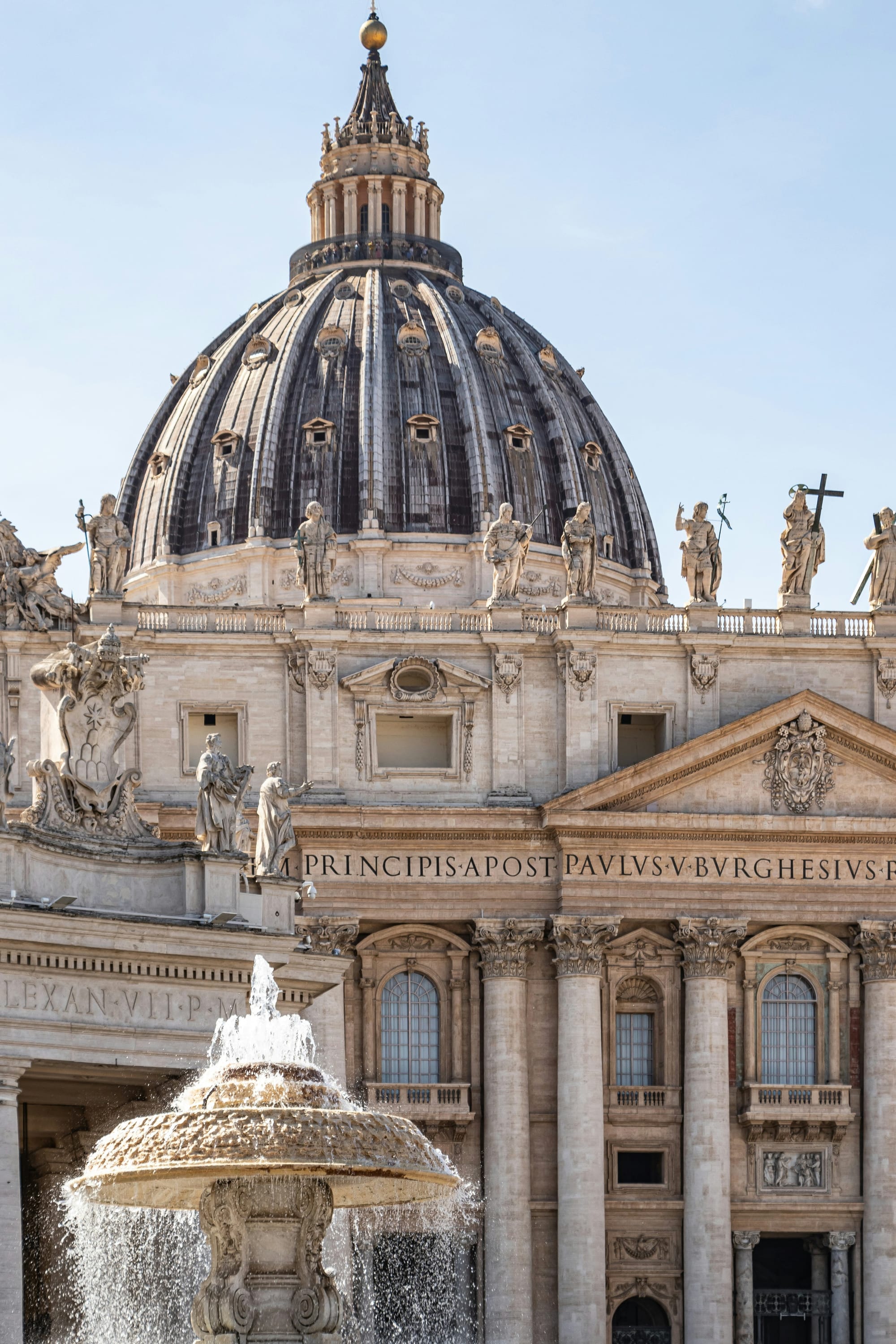
The dome is not only a symbol. It is a problem solved in stone.

There lies the true constructive drama of Saint Peter’s. The project was not simply to make a building both beautiful and enormous. It was to make it beautiful and enormous over a problematic subsoil without losing the sacred center. The tension between those two demands ran through every phase of the project and explains much of its complexity.

Bramante, Raphael, Sangallo, Peruzzi, Michelangelo, della Porta, Maderno, Bernini: the long list of illustrious names is often presented as a succession of geniuses. It is that. But it can also be read as the record of a difficulty no individual intelligence fully solved and that each inherited. Every architect received an unfinished work and an intact problem: how to monumentalize without collapsing.


Michelangelo, or the intelligence of mass

Michelangelo enters the history of Saint Peter’s like a man entering a battle already decades underway. When he took over the works in 1547, the project had passed through multiple hands, revisions, and accumulations of complexity. His achievement would not consist only in beautifying it, but in returning to it a severe clarity.

His great intuition was to understand that, at Saint Peter’s, formal grandeur depended on extreme structural discipline. He simplified, reorganized, reinforced. He recovered the project’s centralizing energy and conceived the dome not as an isolated gesture of magnificence, but as the culmination of a system. His proposal for a double-shell structure sought to lighten the load and distribute it more effectively; his redesign of the supports answered to an idea that at Saint Peter’s allows no sentimentality: beauty must survive gravity.
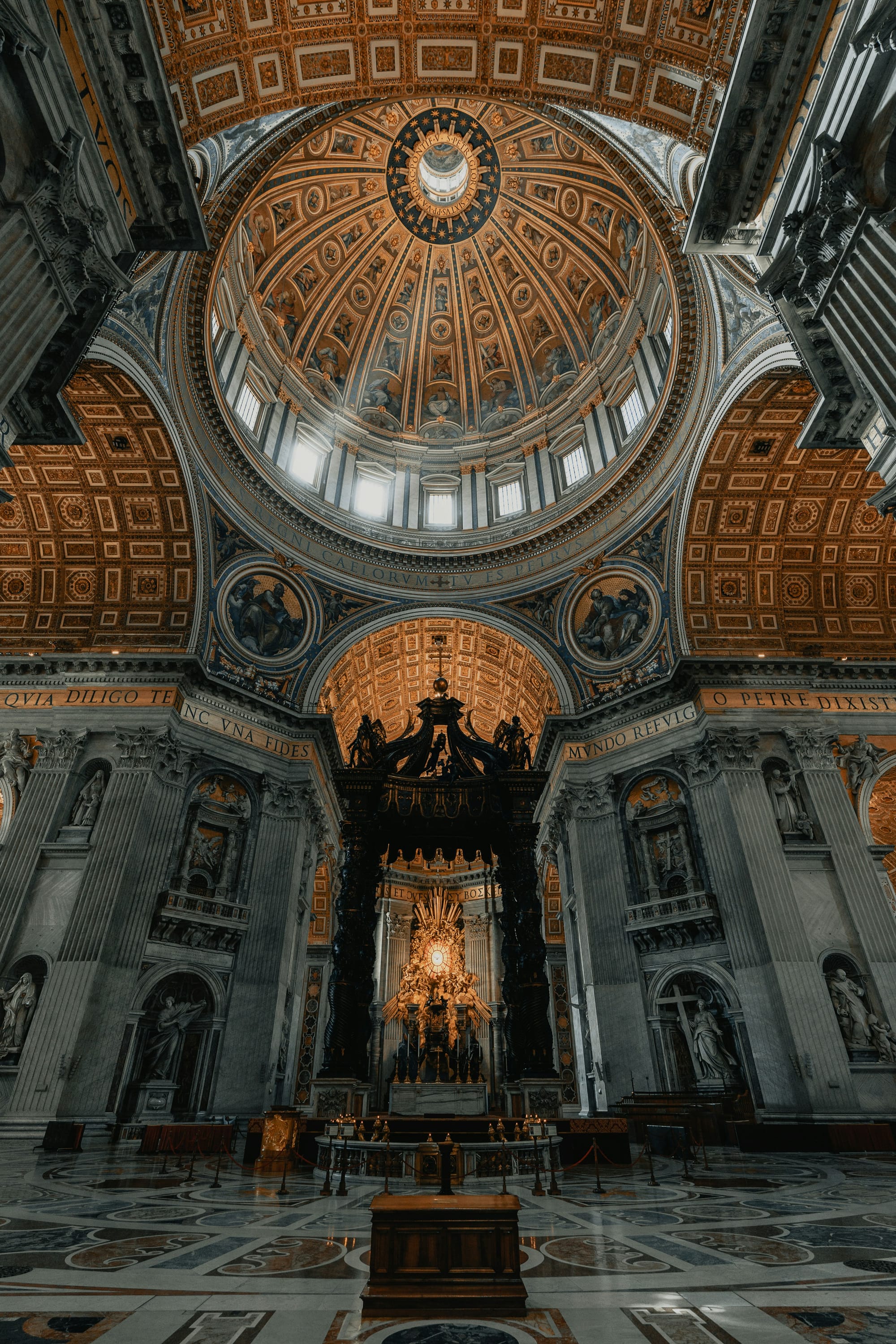
At Saint Peter’s, spiritual elevation depends on oversized mass.

The dome, with its interior diameter of 42 meters, was not only an aesthetic feat. It was a potential threat. An enormous mass destined to exert immense lateral thrust on its support system. Which is why the response could not be delicate. The solution was overdimensioning.

The four piers supporting the dome remain among the places where the building’s structural truth appears most clearly. They are colossal interior bodies. So large that the eye almost accepts them as landscape, as if they belonged to the temple’s natural order. But their existence answers to a naked necessity: to absorb the dome’s thrust and transmit it to the ground without failure. They are the least mystical and most honest part of the basilica. They do not speak of elevation, but of resistance.

Michelangelo understood something essential: at Saint Peter’s, monumentality could not seem light through innocence, only through calculation. Lightness had to be an illusion built upon an immense quantity of stone.


The scale of the building, the scale of the fear

Some buildings display their balance. Saint Peter’s displays its capacity to endure.

One senses this in the scale of its supports, in the thickness of the drum, in the robustness of its reinforcing system, in the relation between the mass of the whole and the impossible delicacy it tries to suggest. The basilica wishes to appear as triumph, light, ascent, yet at its base it speaks architecture’s oldest language: counteract, contain, redirect loads, secure stability.

The paradox is beautiful. The most emblematic building of the Catholic faith must express itself in almost physical, almost brutal terms. Its spiritual rhetoric depends on unsparing material discipline. The glory of the dome rests on an apparatus of containment. The beauty of the interior space stands on a technical fear that weight might discover a route to ruin.

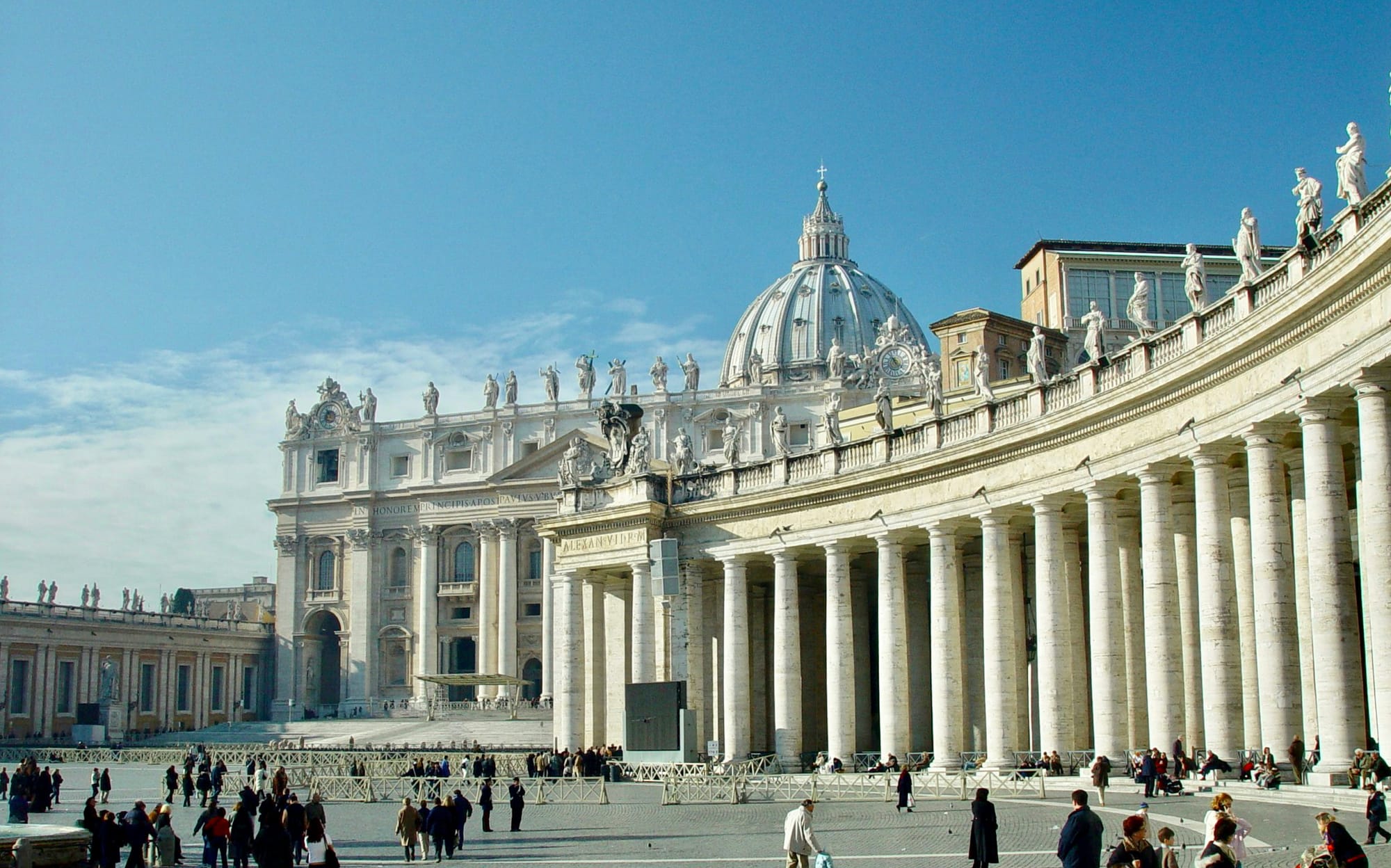
That is why the springing of the dome matters so much visually. That is why the drum’s buttresses say more about the basilica than many frescoes. That is why looking at Saint Peter’s from outside, from a point where the musculature of the drum and the way the structure gathers and presses become legible, allows one to understand what devotional contemplation often softens: this church is also a struggle.


Maderno and the altered balance

The story does not end with Michelangelo. Nor does it grow calmer.

Carlo Maderno’s intervention in the seventeenth century, by lengthening the nave and giving the basilica its definitive Latin-cross form, resolved liturgical and functional problems, but it also altered the equilibrium of the centralized plan. Saint Peter’s gained processional depth and longitudinal solemnity; in exchange, it lost some of the geometric purity imagined by Bramante and intensified by Michelangelo. Above all, it inherited new tensions.

The dome began to show cracks. Not immediately as catastrophe, but as warning. A reminder that even a work conceived with extraordinary intelligence can suffer when time, modification, and material begin to speak to one another. By the eighteenth century, Saint Peter’s had already become a universal symbol, but it was also obliged to face an uncomfortable truth: majesty does not immunize against deterioration.


The invisible chains

It had to be tied.

That sentence alone tells a central part of Saint Peter’s drama. The dome, the emblem of the building, developed historical fissures that demanded consolidation. Internal iron chains were installed to contain the thrust and increase the structure’s cohesion. Later came other interventions: studies, repairs to the drum, roof renewals, partial reconstructions of damaged radial buttresses, steel frames to redistribute stresses at the drum’s windows, new restoration campaigns, and continuous monitoring.

For readers who want the structural layer

➢ historical cracks in the dome
➢ iron chains installed to contain thrust
➢ later reinforcement of the drum
➢ ongoing structural monitoring

Visitors seldom think of any of this when they look up. And yet the great icon of the basilica has endured for centuries thanks to a network of discreet corrections. Saint Peter’s monumental image depends on reinforcements almost no one sees. There is something profoundly modern in this condition: stability as maintenance, not as initial miracle. The basilica is not a perfect object frozen in time. It is a living work that has needed to be watched, studied, and braced so that it may go on appearing eternal.

Every great building has a technical backstage. At Saint Peter’s that backstage is part of the work’s meaning. Because here the need to preserve does not affect an empty museum, but an active temple, a living symbol, a place through which thousands pass every day and whose visual authority requires that fragility remain unseen.


Archaeology as descent

The excavations sponsored by Pius XII beginning in 1939 restored to Saint Peter’s an almost novelistic dimension. The initial motive was practical and funerary enough: to adapt the grottoes in response to the burial wishes of Pius XI. But the discovery of Roman structures changed the scale of the undertaking completely. What began as a limited intervention ended as one of the twentieth century’s most delicate and significant archaeological operations inside the Vatican.

The basilica had to be excavated from below without compromising the basilica above. One had to descend layer by layer where every level was charged with history, devotion, and technical danger. One had to investigate a site carrying the weight of centuries of construction. It was science, yes, but science advancing with the constant awareness that it was working beneath a living mountain of stone.

To search for Peter, the Vatican had to descend beneath its own monument.

What emerged was astonishing: mausoleums, funerary streets, mosaics, niches, red walls, graffiti, spaces that seemed to preserve a subterranean Rome beneath papal Rome. And at the center of that discovery, the area associated with Peter. The so-called Trophy of Gaius. The wall of graffiti. The marble-lined niche. The bones. The signs of ancient transfer. The possibility that the humble grave had at some point been protected, slightly displaced, or enclosed in moments of danger.

The story contains episodes worthy of a grand saga: the Vatican’s initial silence, Pius XII’s caution, the role of Ludwig Kaas, the secret transfer of bones, the monsignor’s death carrying a crucial detail with him, the later emergence of Margherita Guarducci, the deciphering of inscriptions, Venerando Correnti’s anthropological studies, the disputes, the doubts, the controversies, the papal announcements. But what matters most is not the color of the story. It is the deep structure it reveals: in order to look for Peter, the Church had to pierce the material heart of the Vatican. It descended beneath its own monument to verify the body on which it had built its narrative.


The convincing, not the absolute

Saint Peter’s does not offer the comfort of definitive proof. It offers something more interesting.

Pius XII declared in 1950 that the apostle’s tomb had been found, while distinguishing that topographical certainty from the absolute identification of the relics. Paul VI, in 1968, went further and spoke of a convincing identification of the remains. The language matters. This is not mathematical demonstration, but grounded conviction. Not naked certainty, but a convergence of tradition, archaeology, epigraphy, and bone analysis.

The remains examined belonged to a robust elderly male from the first century, compatible in broad terms with Petrine tradition. There were indications of veneration: purple cloth, gold thread, an intact niche from Constantinian times. There was also a detail of powerful suggestiveness: the absence of the bones of the feet, interpreted by some as consistent with an upside-down crucifixion. At the same time, the history of the investigation was full of caution, dispute, and gray zones.

💡
Saint Peter’s does not rest on one kind of truth. It rests on persistence.

And yet perhaps Saint Peter’s strength lies precisely there: in its refusal to depend on only one kind of truth. The building rests not merely on scientific proof of a set of bones, nor only on inherited faith, nor only on institutional power. It rests on a sum of persistence. The continuity of veneration. The alignment of altars. Constantine’s stubbornness. Gaius’s testimony. The graffiti. The Trophy. The excavations. The architectural decisions no one would have made unless the place had long been regarded as central.

In that sense the basilica is a material argument. It does not by itself prove that Peter is there, but it proves with overwhelming eloquence that for centuries Rome acted as if Peter were there and built accordingly.


The basilica as a machine of legitimacy

That makes Saint Peter’s more than an architectural wonder. It makes it a machine of legitimacy.

Every enduring institution requires a foundation. Some place it in law. Others in revolution. Others in dynasty. The Church of Rome placed it in a tomb. Not in an abstract symbol, but in the body—or the bodily memory—of a specific man, Simon bar-Jonah, the fisherman transformed into the symbolic rock of the Church. On that tomb it built the material seat of its apostolic continuity. It made architecture speak where genealogy needed to be made visible.

Which is why Saint Peter’s should not be read only as a building of worship. It should also be read as an organization of space in the service of a historical claim: here lies the origin, here it still remains, here we build above it without departing from it. The basilica turns that sentence into stone.

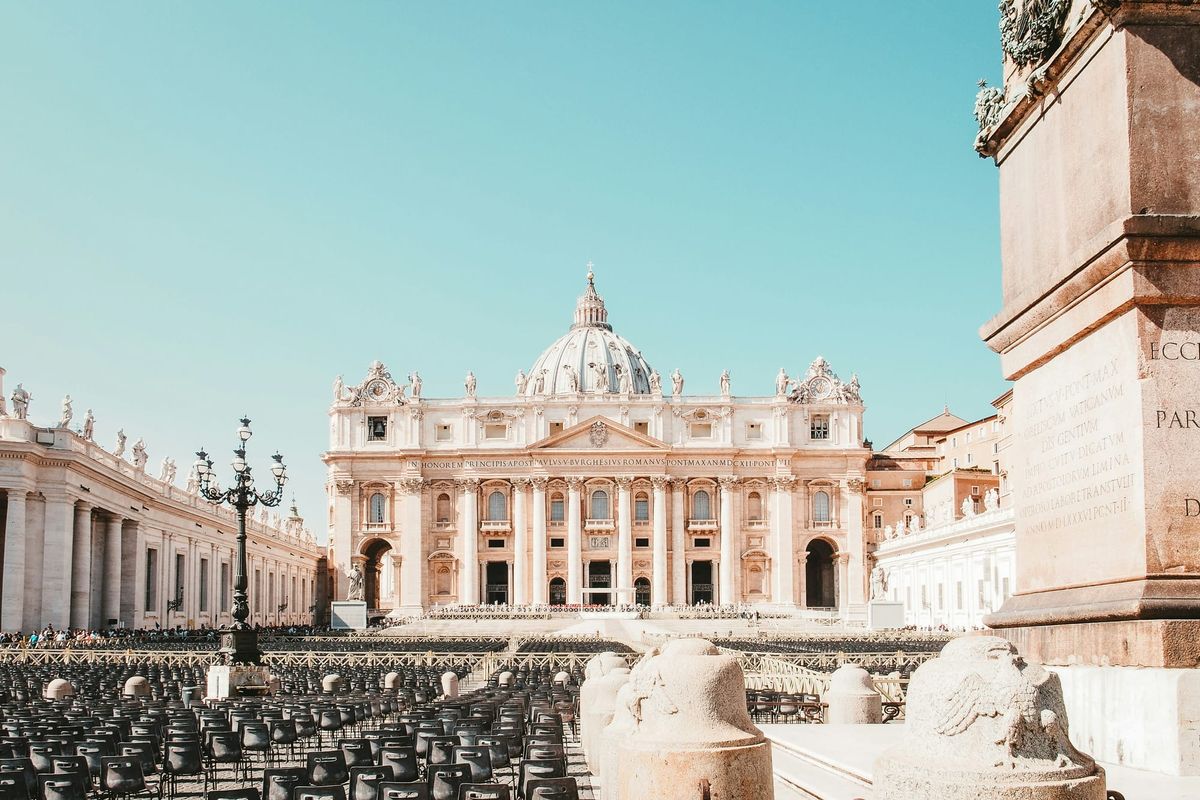
Bernini’s baldachin, for example, is not only a Baroque marvel. It is also an immense act of marking the center. A visual sign that transforms the tomb’s vertical into a focus of universal authority. Michelangelo’s dome is not only a gesture of Renaissance grandeur: it is the culmination of that same vertical, the celestial translation of a buried origin. Even Bernini’s square, with its elliptical arms opening to the world, can be read as an exterior extension of the same logic: the entire world summoned around an exact point that does not move.


A structure inhabited by multitudes

But Saint Peter’s would be a dead object if it looked only toward the past. It does not. The building lives under constant pressure.

Solemn liturgies, pilgrimages, jubilees, state visits, funeral processions, papal ceremonies, permanent tourist flows: added to the building’s monumental load is the dynamic load of crowds. Saint Peter’s is preserved not in a vacuum, but in use. Structural stability must coexist with massive circulation. The underground necropolis must be protected while thousands walk, pray, gaze, or simply take photographs above.

Contemporary numbers help illuminate the tension. In ordinary conditions, thousands of visitors can be present inside the temple at once; in extraordinary moments, concentrations multiply almost beyond measure. Jubilees, papal funerals, mass ceremonies turn the basilica and its surroundings into a zone where the management of human weight, evacuation, security, and circulation is not administrative detail, but part of the system’s survival.

The basilica carries not only stone, but bodies, movement, and ritual pressure.

Hence recent renewals in evacuation plans, ramps and logistical solutions, new lighting systems in the necropolis, careful interventions to preserve humidity and temperature in the lower levels, and continuous structural monitoring. Saint Peter’s still demands operational intelligence because it remains, all at once, sanctuary, museum, global symbol, and urban machine.


The living subsoil

There is something especially revealing in the fact that the necropolis continues to be treated as a delicate environment. Not as a discovery once and for all stabilized, but as a living underground whose conservation requires constant attention. The light cannot produce too much heat. The humidity cannot vary without control. The movement of visitors must be measured. Archaeological intervention cannot compromise the stability above. All of this forms an almost perfect image of Saint Peter’s heart: a building where every action upon the past reverberates in the present, and every need of the present is forced to respect the past.

Few architectures concentrate this double obligation so intensely. Protect what lies below without weakening what rises above. Keep standing the great visual machine of Catholicism without violating the tomb and necropolis on which it rests. There lies its strangeness. In being at once a summit of historical engineering and an architecture held hostage by its own origin.


The crack as truth

If Saint Peter’s teaches anything, looked at without automatic reverence, it is that great powers also depend on scaffolding.

They depended on it in construction and depend on it in preservation. They depended on calculations, chains, buttresses, reinforcements, workers, excavators, sanpietrini, restorers, architects, mosaicists, monitoring systems, maintenance crews, minute decisions made outside the visitor’s field of vision. The image of the building as a perfect block conceals a far richer truth: its permanence has always been a task, not a gift.

That makes Saint Peter’s more human, not less grand. Because authentic grandeur lies not in the absence of fragility, but in the ability to administer it without betraying the core of meaning. The basilica has endured not because it was simple, but because it learned how to correct itself. Not because it was spared risk, but because generation after generation worked to neutralize that risk. Not because history left it untouched, but because history kept working on it without ever displacing its center.


A lesson in stone

There are buildings that summarize an age. Saint Peter’s summarizes a civilization.

It summarizes its relationship to the dead, to memory, to power, to technique, and to representation. It summarizes the will to turn a sepulcher into a foundation and a material difficulty into an argument for continuity. It also summarizes an uncomfortable and deeply modern truth: every authority must learn to manage its own instability.

The Church of Rome could have built elsewhere, on ground more rational, more stable in structural terms, less exposed to contradiction. It did not. It wanted to build over Peter. And that fidelity produced a marvel, yes, but also an unceasing tension. A tension between tomb and dome. Between humble origin and imperial casing. Between funerary subsoil and the summit of Christian monumentality. Between matter that sinks and form that aspires to rise.

That tension is Saint Peter’s deepest beauty. Not the docile beauty of what has been resolved, but the dramatic beauty of what has been sustained.


The dead man who does not move

In the square, the Egyptian obelisk that once stood by the circus of Caligula and Nero still marks the space like a mineral witness to martyrdom. Inside, the baldachin still raises its bronze above the altar. Overhead, Michelangelo’s dome still dominates Rome as if it were a second celestial vault. And below, in the disciplined darkness of the grottoes and the necropolis, remains the point that makes everything else intelligible.

Saint Peter’s appears to speak of elevation. In truth, it speaks of fidelity.

Fidelity to a place. Fidelity to a vertical line. Fidelity to a tomb that had to remain where it was even as everything around it changed in scale, style, political regime, artistic language, and historical epoch. For seventeen centuries emperors, popes, architects, laborers, archaeologists, and restorers have worked under one silent rule: one may enlarge, encase, monumentalize, repair, tie, excavate, illuminate, monitor; the one thing one may not do is move the center.

That center is not an abstraction. It is a dead man.

And perhaps there is no more precise, more severe, or more beautiful definition of Saint Peter’s than this: the most powerful basilica in Christendom is, in the end, the immense labor of a civilization determined not to move the dead man holding up its world.