Nuremberg: THE CITY THAT JUDGED ITS OWN SHADOW
Nuremberg turned the stagecraft of fanaticism into a laboratory of international justice. Between medieval walls, stone grandstands and the severity of Courtroom 600, the twentieth century left here both its most visible wound and one of its most serious attempts at repair.


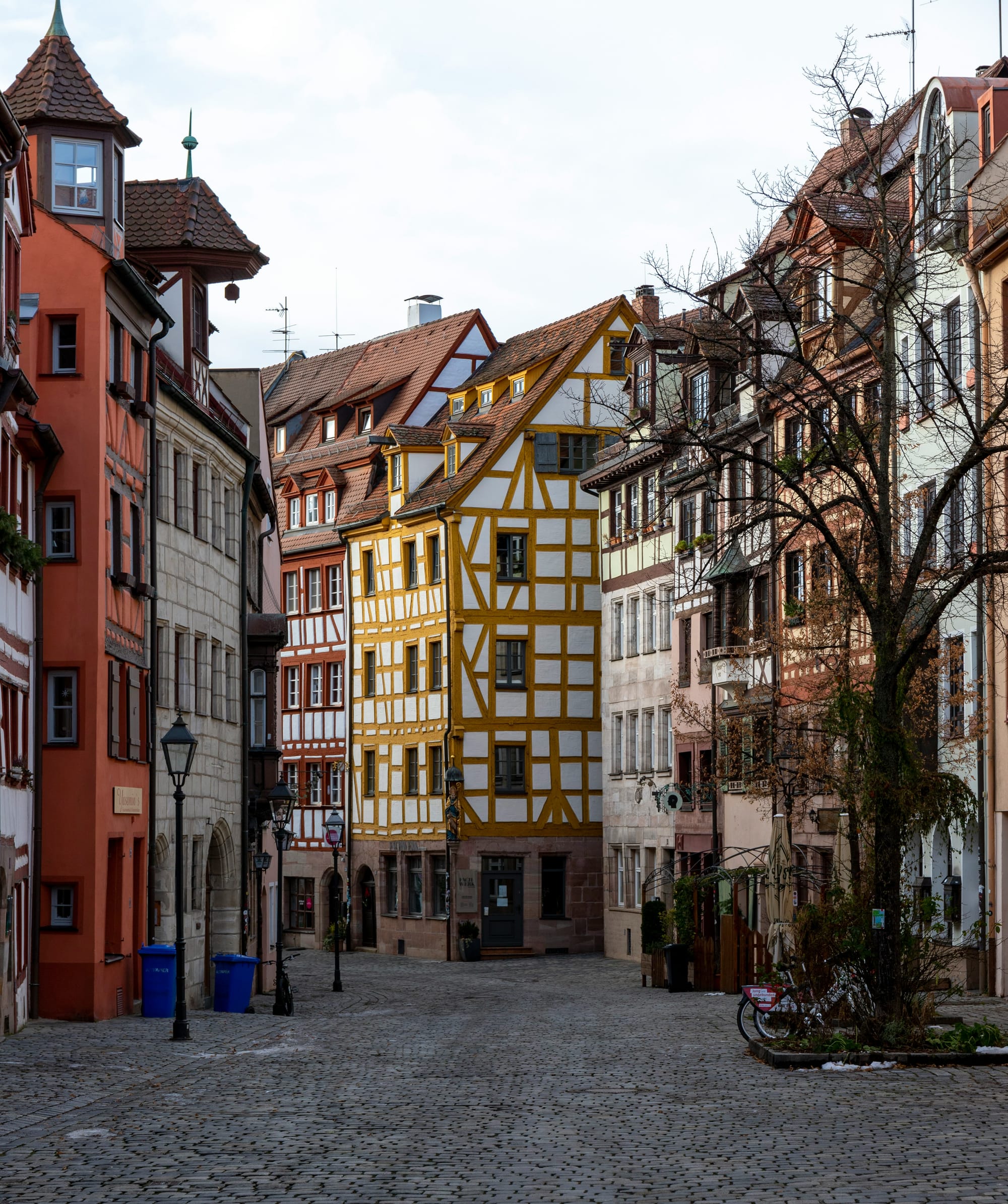
In Nuremberg, the distance between a battlement and a dock is not measured in meters, but in civilization. It is enough to climb to the Imperial Castle to understand that this city was, long before it became one of the twentieth century’s wounds, a promise of historical continuity. From above, the old town unfolds like a meticulously composed miniature: red roofs pressed close together, Gothic spires, stone bridges, towers still watching over the skyline, and the Pegnitz running through it all with a deceptive calm, as though time here had learned to bend back upon itself without ever breaking.
But Nuremberg does not take long to undo that first impression. As one moves south, the landscape changes its language, its scale and almost its moral register. Stone ceases to protect and begins to impose itself; architecture abandons the human measure and becomes an instrument of intimidation. There, on the former Nazi Party rally grounds, the horizon is no longer made of bell towers and walls, but of outsized surfaces, wounded terraces and ruins that still retain something of their old vocation for domination. The Zeppelinfeld remains like an open scar: not only the physical remnant of a political stage set, but proof that there was once a time when architecture was used to transform a crowd into faith, obedience and spectacle.
Then comes the Palace of Justice, and with it another tone, another temperature, another form of authority. In Courtroom 600 the wood softens the echo, compels the voice downward and restores language to its exact weight. There are no torches now, no mass choreographies, no exaltation. There are documents, witnesses, simultaneous translations, dense silences, individual responsibility. Where power had once presented itself as collective destiny, a radical question began to take shape: what happens when the law decides to confront the crimes of the state? Few cities allow one, in the space of a single day, to travel from political myth to law, from the liturgy of fanaticism to the always incomplete yet decisive labor of justice.
A city before horror
Long before its name became bound to torchlit parades, racial laws and defendants’ benches, Nuremberg was already a city invested with authority. Not merely an important city, but one of those rare European places where power seems to have settled layer upon layer until it became indistinguishable from the stone itself. A Free Imperial City of the Holy Roman Empire, frequent host of imperial diets and residences, guardian for centuries of the empire’s insignia, Nuremberg did not simply occupy a place on the German map: it occupied a place in Germany’s historical imagination. The Imperial Castle dominating the city’s silhouette was not only a monument; it was a visible assertion of legitimacy, continuity and rank.
That past made the city into something more than a medieval postcard of towers, walls and reddish roofs. It turned it into a petrified narrative. In its narrow streets, in the severity of its churches, in the solidity of its gates and in the austere language of its fortifications, there survived an idea of Germany that predated even the modern state: an idea of political lineage, symbolic centrality, authority sanctioned by history. Nuremberg was not only beautiful. It was useful to anyone seeking to appropriate the past and present himself as its natural heir.
And that was precisely what National Socialism understood. Hitler did not choose the city because he needed to invent a symbol, but because he knew how to recognize one that already existed and place it in his service. Nuremberg offered something no regime can manufacture from scratch, however vast its propaganda: historical depth. Its walls suggested permanence; its towers, ancient vigilance; its imperial past, an almost sacred continuity. In that mineral solemnity, Nazism thought it had found the perfect stage set in which to disguise itself as destiny. It did not want to look like a brutal rupture born of violence and resentment, but like the supposed logical culmination of a long, glorious and unified German story.
That is why, before it became the theatrical capital of fanaticism, Nuremberg was first a city plundered on the symbolic plane. Nazism did not create it: it occupied it in the realm of the imagination. It appropriated its prestige, its historical weight, its atmosphere of legitimate antiquity. And in doing so, it transformed a complex, plural and secular past into scenery for a totalitarian political fiction. There lies one of the city’s deepest paradoxes: that its earlier greatness was precisely what made it vulnerable to being used as an altar of delirium.
The theft of the symbol
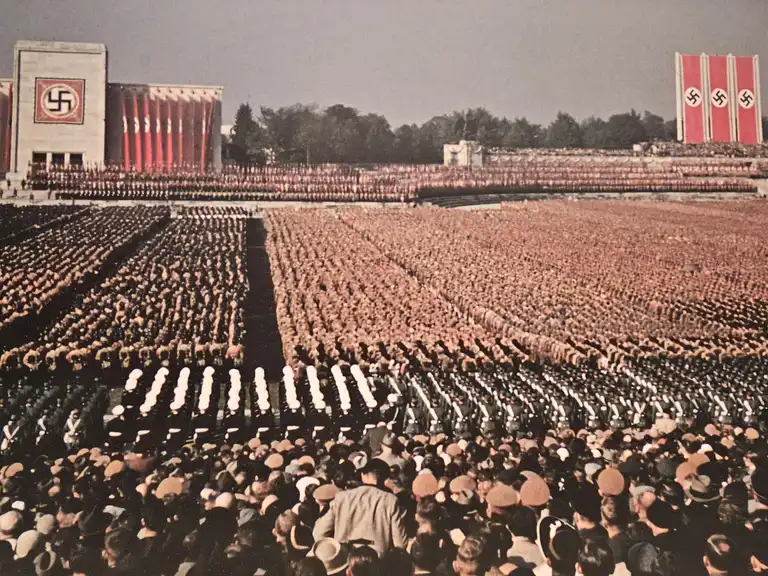
The regime understood very early that totalitarianism cannot be sustained by police, censorship and fear alone. It also requires liturgy. It requires organized emotion, beauty in the service of power, settings capable of turning obedience into a shared experience. In 1933, when Hitler proclaimed Nuremberg the “City of the Reich Party Rallies,” he was not merely choosing a venue for annual meetings: he was consecrating a vast political theater. From then until 1938, the Nazi rallies held there were conceived as ceremonies of collective self-worship, immense performances of force designed to impress both those who took part in them and those who watched from outside.
There was nothing in those gatherings resembling debate, deliberation or dissent. They were not congresses in the political sense of the word, but liturgies of adhesion. Everything was calculated: the parades, the flags, the lighting, the routes, the arrangement of bodies, the synchronization of movements, even the waiting before Hitler’s appearance. Every gesture sought to produce a precise emotion: the sensation of belonging to something immense, orderly, invincible. Nazism understood that a crowd could not only be mobilized; it could be staged. And in Nuremberg it turned that intuition into one of its masterpieces.
The old imperial city, with its historical density and symbolic prestige, served as the backdrop to an ideological operation far more ambitious than propaganda alone. The aim was to present the Third Reich not as a violent eruption born of crisis, resentment and the demolition of democracy, but as the supposedly natural culmination of German history. The message was as simple as it was effective: we are not here to break with the past; we are here to embody it. The regime thus appropriated the city’s imperial memory to disguise as continuity what was in fact a radical, ferocious and exclusionary mutation.
Under that logic, Nuremberg ceased to be a city with a past and became a city at the service of a narrative. What mattered was no longer what it had been in all its complexity—its commercial tradition, its artisanal vitality, its historical contradictions—but what it could represent for the Reich’s political fiction. Nazism did not want merely to occupy the city; it wanted to rewrite it, to empty it of ambiguity and turn it into a useful allegory. It wanted to make it visual proof that Germany was not descending into barbarism, but supposedly returning to its destiny. That was the beginning of one of the most disturbing processes in Nuremberg’s history: the moment when a real city was replaced by its ideological version.
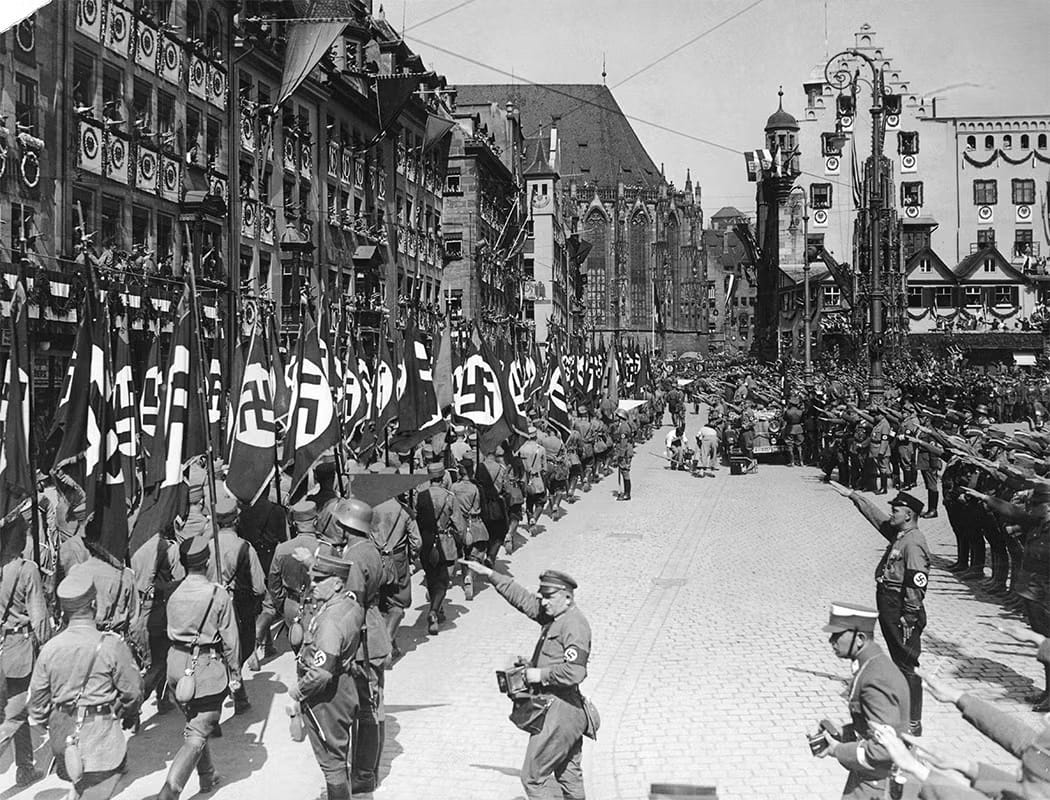
The regime occupied a symbol in Nuremberg.
The architecture of fanaticism
Architecture was the decisive instrument of that political fiction. Nazism understood something essential: to appear eternal, it was not enough to seize power; one had to build it a landscape. In the southeast of Nuremberg, the Party rally grounds unfolded as a geography of gigantism, conceived not only to host massive gatherings but to produce a specific emotion. The Great Road stretched its monumental axis for nearly two kilometers; the unfinished and oversized Kongresshalle deliberately evoked the imperial grandeur of Rome; and the Zeppelinfeld, perhaps the most emblematic space of the entire complex, offered the ideal setting for transforming politics into mass spectacle. This was not urban planning. It was ideological stagecraft on a colossal scale.
In that landscape, Albert Speer put stone at the service of awe. Nothing was designed for the individual, and nearly everything was intended to diminish him. The tribunes did not invite one to look; they imposed a direction of vision. The terraces did not welcome; they commanded. The symmetries, the straight lines, the obsessive repetition of volumes and the mineral hardness of the materials formed an aesthetic of submission. The mass was meant to feel itself part of a higher body, perfectly aligned, without fissures or deviation. Each attendee was, in the end, a replaceable element within a larger composition. Architecture ceased to serve human life and instead demanded discipline, silence and obedience from it.
This was perhaps Nazism’s most unsettling triumph in Nuremberg: making space itself seem to radiate authority. A visitor did not simply enter a venue, but a choreography that preceded any event. Everything was arranged to make him feel small before a force that was immense, inevitable, almost sacred. The aim was not only to impress, but to transform emotion into allegiance. Monumentality functioned as a pedagogy of power: it taught obedience before a single speech had even begun.
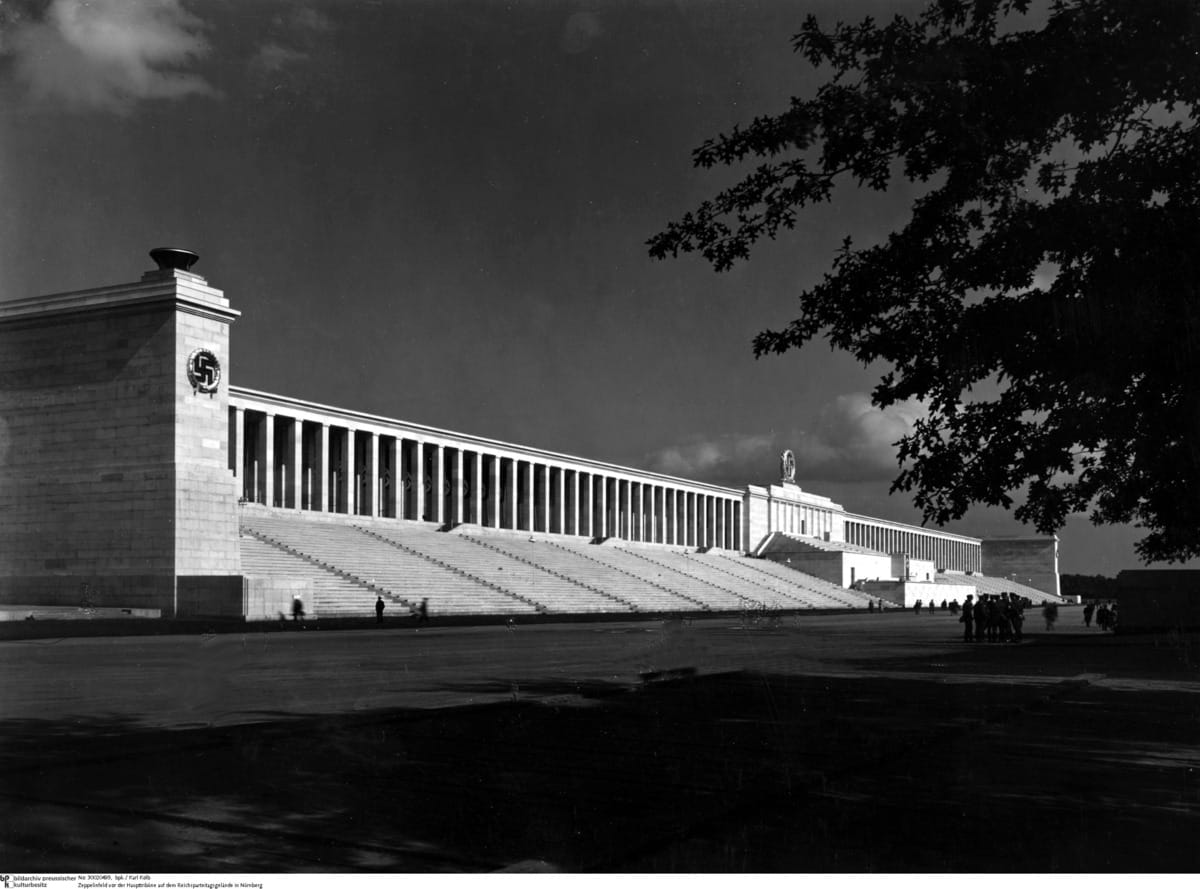
Architecture, which for centuries had served to protect, inhabit or celebrate, here underwent a moral change of function. It no longer offered shelter or beauty in the classical sense, nor even civic grandeur. It offered submission. It turned stone into a technology of obedience and space into an emotional machine in the service of fanaticism. In Nuremberg, Nazism did not merely erect buildings: it erected a way of seeing, marching and belonging. That is why its ruins remain more than material remnants. They are the visible skeleton of a totalitarian ambition.
When politics becomes spectacle
In that oversized setting, politics ceased to be a practice of government and became a choreography of masses. Endless parades, standards waving with ceremonial precision, torches cutting furrows of fire through the night, immaculate uniforms, human columns advancing with near-mechanical synchrony: everything was designed to produce an image before an idea, an emotion before a thought. In Nuremberg, Nazism did not seek to persuade; it sought to dazzle. The crowd was no longer merely an audience, nor a political subject either: it became part of the décor, living matter within a total staging in which every body occupied a precise place in the story of power.
To read de rest of the article, join ETERNAL PULSE.