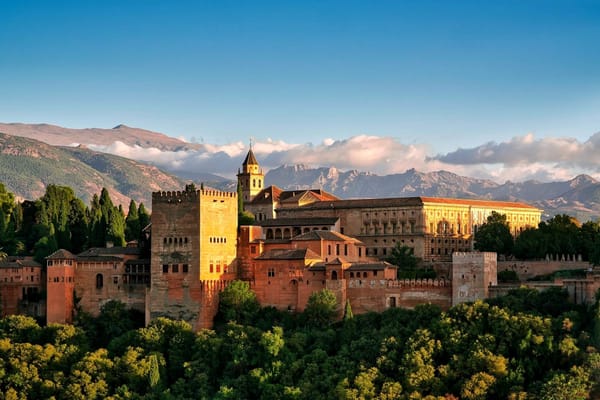
Mosque-Cathedral of Córdoba: THE WOUND IN THE FOREST
The Mosque–Cathedral of Córdoba is not merely a crossroads of creeds, but the visible scar of a conquest. At the heart of the great Umayyad oratory, a Christian nave forever split the sacred logic of the space.


For years, the Mosque–Cathedral of Córdoba has been told as a gentle parable of coexistence: a place where religions do not collide, but overlap with the delicacy of layers of time; a monument in which history seems to have sanded down its violence until it became beauty. That reading, as seductive as it is reassuring, has ended up prevailing in brochures, institutional speeches, and tourist narratives. Yet it takes only a lingering stay in the building, a slow walk through it with attentive eyes, for that version to begin to crack. What Córdoba places before the visitor is not the serene image of a fusion, but the material testimony of an intervention. Not full harmony, but friction turned to stone.
Because the Mosque–Cathedral is not simply a space where two artistic traditions coexist under one roof: it is, first and foremost, the scene of an imposition inscribed in architecture. At the heart of the greatest Umayyad oratory in the West, where for centuries the forest of columns had ordered the space in a hypnotic, horizontal rhythm, a Renaissance nave was inserted as an assertion of dominion. It was not added at the edge, nor respectfully laid upon the perimeter: it forced its way into the center, interrupting one spatial logic in order to impose another. What we contemplate today in astonishment is not a mere sum of styles, nor a retrospective reconciliation of creeds. It is the visible scar of a conquest, the trace of an operation that did not seek to converse with the building, but to occupy it from within. And perhaps that is why it continues to fascinate so deeply: because its beauty does not cancel the wound, but makes it endure.
A deceptively serene threshold
By midmorning, when the light falls obliquely over the Patio of the Orange Trees and the murmur of visitors loses its solemnity and becomes almost an everyday hum, the Mosque–Cathedral still knows how to feign calm. Nothing in that first approach immediately announces the historical violence it holds within. The trees arranged in rows, the serene outline of the water, the stone warmed by the Andalusian sun, the precise shadow of the galleries on the ground: everything seems designed to lead the visitor toward a peaceful, almost meditative experience. The courtyard functions as a prelude to balance. Once it was a space for ablutions and purification; today it is also an emotional vestibule, an antechamber that softens the entrance and disposes the mind to contemplation. One might say that the building, before revealing itself, wants to reassure.
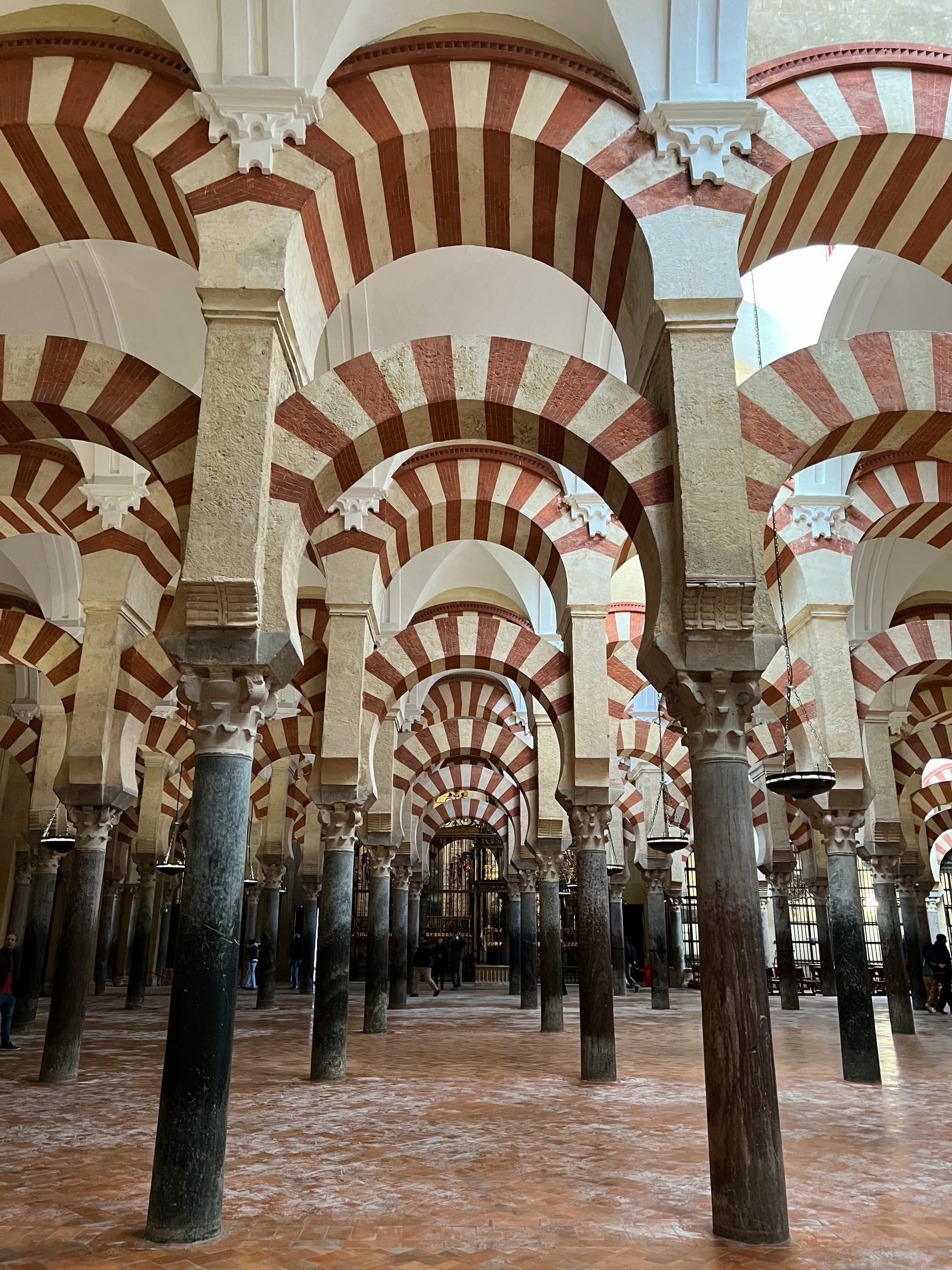
That effect is no minor thing. The Mosque–Cathedral does not give itself all at once, like so many monumental architectures that seek to overwhelm the visitor from the first impact. It allows itself to be discovered gradually. One must cross the threshold, adjust to the half-light, let the eye abandon the logic of the exterior and learn another way of seeing. Then the hypostyle hall appears, and what impresses is not grandiloquence but rhythm. Not brutal height, but repetition. Not a culminating point, but continuity. Column after column, voussoir after voussoir, arch after arch, the space seems to extend itself without needing to proclaim it. Architecture here does not move toward a visible climax; it unfolds like a cadence. More than imposing a direction, it creates an atmosphere. More than enclosing the visitor, it absorbs them. One does not feel one has entered a nave, but rather a kind of mineral forest where stone, multiplied to the point of vertigo, produces a strange form of infinity.
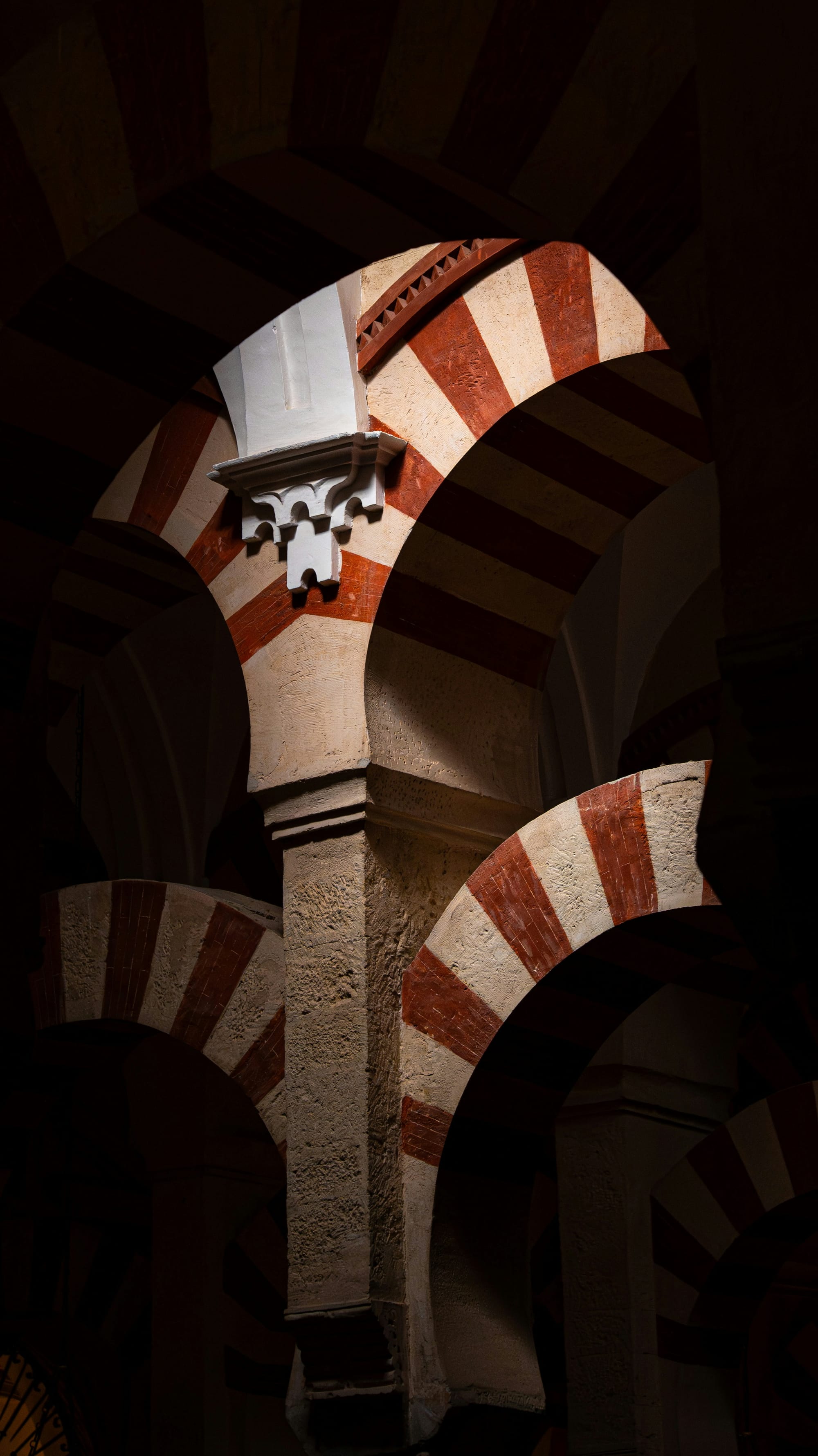
That is perhaps the building’s first great lesson: its ability to move without resorting to frontal theatricality. The great Gothic cathedrals of Europe usually inspire awe through elevation, through the vertical violence of their scale, through that will to fling the gaze upward as if heaven began right there. Córdoba works differently. Here emotion is born of repetition, modulation, the hypnosis generated by a system that seems never to run out. The bicolored arches do not merely decorate: they mark the pulse of the space. The columns do not merely support: they construct a visual music. Light does not burst in; it glides. It advances horizontally, caresses the stone, filters through the alignments, and gradually draws an interior in which the sacred appears not as an explosion, but as breathing.
But precisely because that order seems so perfect, so self-sufficient in its logic, the later rupture becomes even more brutal. And therein lies one of the monument’s most disturbing experiences: the moment when the system ceases to sustain itself and something bursts into it like an alien law. One need not know the building’s chronology, nor have read a single page of art history, to perceive it. The body senses it before reason does. Something changes in the temperature of the space, in the height of the gaze, in the way light falls upon the stone. Where until an instant earlier everything seemed organized by a horizontal, continuous, almost infinite rhythm, there suddenly appears a greater void, a vertical opening, a mass that no longer keeps time, but imposes.
The transition is not discreet. It is not a nuance, nor an elegant variation within the same language. It is an interruption. Where the forest of columns suggested continuity, the Christian transept introduces hierarchy. Where the hypostyle hall dissolved the prominence of any specific point, the new nave concentrates, orders, commands. Light ceases to move laterally between arches and supports and instead plunges from above, harsher, more emphatic, as if the space had changed theology as well. We are no longer in an enclosure built through modular repetition, but in one governed by centrality, elevation, and liturgical focus. The stone, which once seemed to multiply with rhythmic humility, becomes monumental. The void ceases to be continuity and becomes a stage.
That contrast is the building’s true emotional knot. Because what erupts into the center of the old mosque is not only another aesthetic, but another way of understanding power and the sacred. The cathedral transept, whose construction began in 1523, was not a mere ornamental addition, nor a peripheral intervention, nor a reversible reform. It was an incision into the very heart of the Umayyad oratory. A work that pierced the mosque’s spatial continuity in order to graft into it the triumphant language of Renaissance and late Gothic Christianity. It did not occupy a margin: it occupied the center. It did not converse with the previous system: it fractured it in order to impose its own.
And perhaps it is that physical, immediate sensation of rupture that makes the visit so powerful. Because before debates arise over coexistence, appropriation, or historical narrative, the building has already spoken. It does so through scale, through light, through matter. It says it silently, but with indisputable clarity: here a continuity was interrupted. Here an architecture was forced to house within itself another logic, another rite, another sovereignty. What the visitor crosses is not merely a succession of admirable spaces, but the visible frontier between two ways of ordering the world. And that frontier, in Córdoba, was not drawn with metaphors, but with stone.
The myth of layers and the reality of power
The history of the Mosque–Cathedral of Córdoba has often been told as a succession of strata, almost as if the building were a geological formation rather than a human work. First, the Visigothic substratum. Then, the great Umayyad mosque. Later, the Christian cathedral. The image is effective because it simplifies: it turns centuries of conflict, appropriation, continuity, and rupture into an orderly sequence of superimposed layers, as if time had deposited cultures on the same site with the neutral patience of sedimentation. But that metaphor, as comfortable as it is misleading, ultimately erases what is essential. Córdoba cannot be explained by accumulation alone. It is explained, above all, by intervention.
Because in this building history did not fall from the sky or settle gently upon what came before: it acted. Each transformation responded to a political, religious, and symbolic decision. Each new phase was not simply an added layer, but a position taken toward what had been inherited. In Córdoba there was continuity, yes, but also domination. There was preservation, but not necessarily respect in the contemporary sense of the term. And above all, there was a very precise awareness of the value of sacred place as a stage of legitimacy. To occupy a space already charged with memory was not only a practical matter; it was a way of inscribing power into a prior spiritual geography. Sometimes to destroy was to rule. At other times, more subtly, to preserve and rewrite was also to rule.
That nuance is decisive. The monument’s greatness lies not only in its beauty or in the variety of its forms, but in the fact that it makes visible a more uncomfortable historical mechanism: that of civilizations inheriting, absorbing, and transforming the symbols of a previous order in order to affirm their own. The Mosque–Cathedral is not the innocent result of several periods sharing the same space, but the trace of several powers that understood that to govern also means appropriating the prestige of others. Sacred space is not abandoned; it is occupied. A building is not always erased; sometimes it is subdued and redirected. And in precisely that operation lies much of the political force of the complex.
Basilica of San Vicente or episcopal complex?
➢ For decades, the idea of a Visigothic basilica of San Vicente as the direct antecedent of the mosque was popular.
➢ Félix Hernández's excavations uncovered highly significant Late Antique remains.
➢ Subsequent research has complicated the narrative: several specialists see it instead as a large episcopal complex, and the debate remains open.
➢ This uncertainty does not weaken the building; rather, it makes it more historically accurate.
Beneath the monument’s floor, moreover, that complexity does not diminish: it multiplies. For a long time, the most widespread narrative held that the mosque had been built over the Visigothic basilica of San Vicente, as if the present building could be explained through a clean and perfectly identifiable line of succession. That story, repeated frequently in manuals, guidebooks, and heritage discourse, offered a clear genealogy: a Visigothic church first, a mosque next, a cathedral afterward. But Córdoba’s subsoil has proved less docile than the narrative.
The excavations undertaken in the twentieth century by Félix Hernández brought to light late antique remains of enormous interest: walls, mosaics, pavements, structures that evidenced the existence of an important prior Christian complex. Yet subsequent archaeological research has introduced a degree of doubt that, far from impoverishing the building’s history, makes it more rigorous and more fascinating. Some specialists maintain that those remains do not conclusively identify a basilica in the strict and traditional sense in which San Vicente has been popularized, but rather a broad episcopal complex, a web of religious and representational buildings linked to ecclesiastical power in late antique Córdoba. The debate, therefore, is not closed. And that matters.
It matters because it forces us to mistrust narratives that are too perfect. It matters because it reminds us that even the monument’s foundations are traversed by interpretation, by scholarly dispute, by the need—at once ancient and contemporary—to fix an origin. And above all, it matters because it restores the building’s true density. Rather than a linear legend, the subsoil of the Mosque–Cathedral is a field of questions. A space where archaeology, memory, and the politics of narrative intersect without ever yielding a fully pacified version.
That uncertainty, in fact, enlarges the monument. It tears it away from the comfortable territory of the closed symbol and returns it to the more demanding sphere of living history. Córdoba refuses to be reduced to a fable of orderly replacements or to the neat chronology of a handbook. Even at its deepest level, where one might wish to find an inaugural and unquestionable truth, what appears is something more complex and therefore truer: a disputed ground, a fragmented memory, an origin that cannot be pronounced without qualification. As if the building, from its very foundations, refused to cooperate with any narrative that is too clean. As if it wished to remind us that history is rarely deposited in silent layers. More often, it erupts, decides, and leaves marks.
The invention of an umayyad space
The history of the Mosque of Córdoba begins long before it became a universal monument: it begins as a declaration of survival. In the late eighth century, when ʿAbd al-Raḥmān I, the last great fugitive of the Umayyad dynasty, managed to escape the Abbasid massacre and reestablish his power in al-Andalus, he understood that to govern was not only to conquer territory, but to endow it with symbols. Córdoba had to be more than an administrative capital. It had to become a seat of legitimacy, a western mirror of Umayyad memory. And for that, a palace or a court would not suffice: there had to be a building capable of translating a political ambition into stone. From the outset, the congregational mosque was that translation.
To raise it beside the Guadalquivir, in the city’s political heart, was not a simple act of devotion nor a mechanical response to the growth of the Muslim community. It was an operation of representation. Where other architectures ordered the life of civil power, the new mosque was to order the spiritual and symbolic horizon of the nascent emirate as well. The temple did not merely receive Friday prayer: it fixed a center. It gathered the community, gave visible form to authority, and turned urban space into a geography of command. In that sense, the original mosque was not merely a religious work; it was, from the very beginning, a manifesto of sovereignty.
And yet the most extraordinary thing about the building lies not only in the intention that drove it, but in the architectural solution it produced. The mosque of ʿAbd al-Raḥmān I solved, in appearance, a practical problem: the reuse of Roman and Visigothic columns of unequal height made it necessary to find a formula that would raise the roof without sacrificing structural stability. From that necessity was born the celebrated superposition of arches: the horseshoe arch below, as support; the semicircular arch above, as elevation. But what might have remained a clever technical device became something much deeper: a new experience of space. The double arcade did not merely hold up the roof; it produced rhythm. The alternation of red and pale voussoirs did not merely resolve a structure; it generated visual vibration. The repetition of the module did not merely order the aisles; it founded an atmosphere.
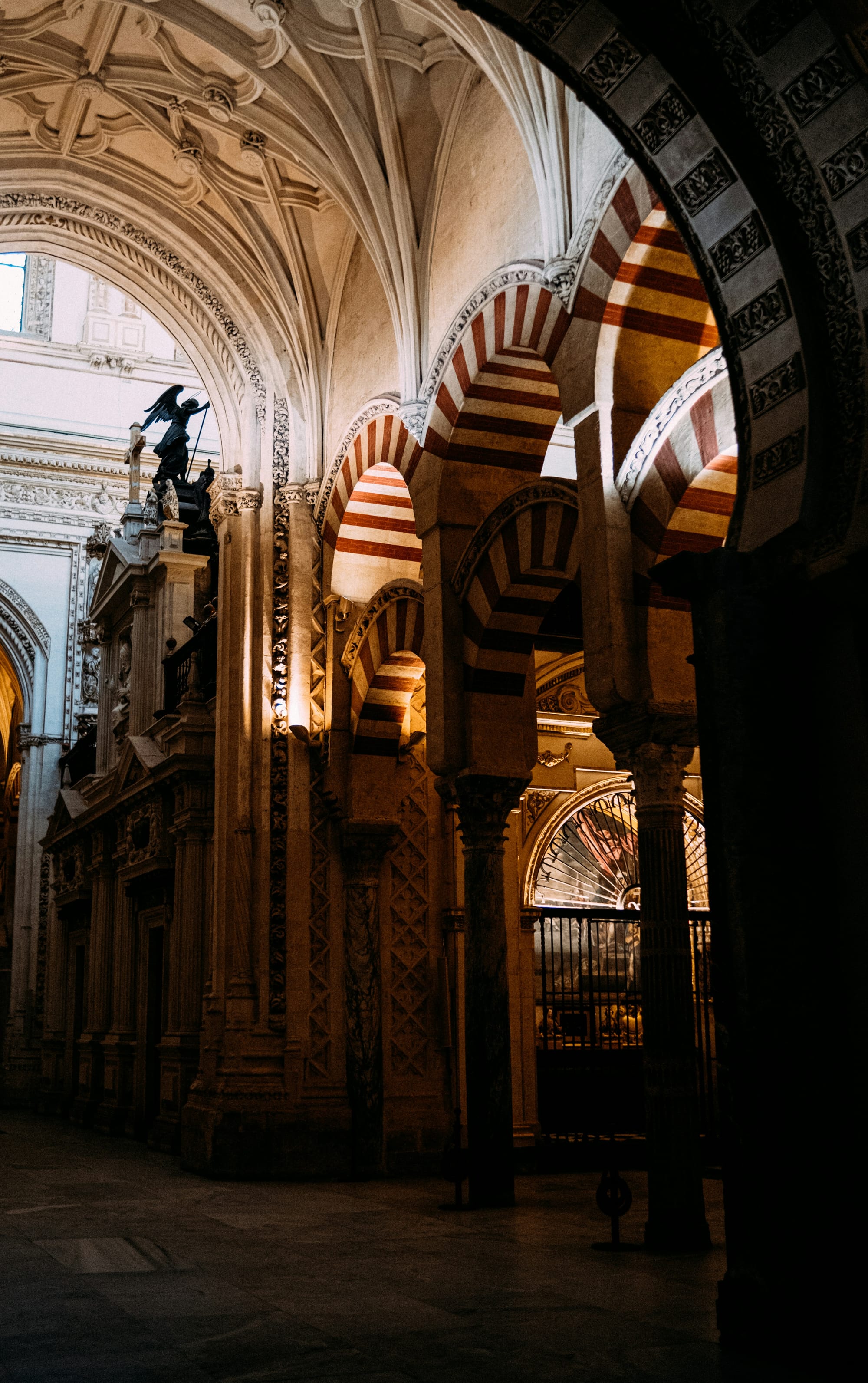
Therein lies one of Córdoba’s great singularities. The mosque did not impose the sacred through naked gigantism or frontal monumentality. It did so through multiplication. Through series, echo, continuity. Marble, jasper, granite, brick, limestone: diverse materials, some reused, others cut for the work, began to work together under a logic of repetition that turned the interior into an almost musical architecture. It was not a space meant to be dominated at a glance, but to be traversed. It offered not a closed image, but a progressive experience. The farther one advanced, the more its end seemed to recede. The oratory was understood not as an isolated volume, but as a visual field, a rhythmic extension, a spatial grammar destined to transcend the local scale and fix one of the most influential inventions in western Islamic architecture.
But the mosque’s greatness did not spring from a single will or an inaugural instant. Córdoba was built as imperial capitals are built: through the accumulation of ambition. Each enlargement did not correct the previous one, but prolonged it, stretched it, or surpassed it, so that the building grew like an expanding memory. In the ninth century, ʿAbd al-Raḥmān II responded to the city’s growth by extending the prayer hall southward. The gesture did not alter the essential language of the whole; it confirmed it. The mosque was no longer a fortunate experiment, but a system capable of reproducing itself without losing identity. Later, ʿAbd al-Raḥmān III, now on the horizon of the Caliphate, reinforced the façade facing the courtyard and raised the great minaret that remains today partially concealed within the Christian bell tower. That minaret did not merely summon the faithful to prayer: it announced to the world that Córdoba had become the capital of a new center of Islamic power in the West.
With al-Ḥakam II, the building reached its moment of greatest subtlety and splendor. If the preceding phases had consolidated its scale, his brought the mosque to a higher form of refinement. He enlarged the oratory, enriched the maqsura, and turned the mihrab into one of the most dazzling works of the medieval Mediterranean. There, in that small octagonal chamber covered by a dome, surrounded by marble, vegetal carving, and inscriptions, Córdoba achieved an aesthetic summit that still unsettles today. The Byzantine-derived mosaics, executed with a luminosity that seems to emanate from the material itself, do not merely ornament: they transform stone into radiance. Gold does not fall across the surface as added luxury, but seems to awaken from within, as if architecture had found a way to illuminate itself. At that point, the mosque ceased to be only a vast enclosure for prayer and became an affirmation of culture, of political sophistication, of competitive dialogue with the great centers of the Mediterranean.
The final intervention by Almanzor, at the end of the tenth century, took the building to another scale, perhaps less refined decoratively, but decisive spatially. Unable to grow farther south because of the river’s proximity, the mosque expanded eastward. That enlargement altered the ensemble’s classical axis, decentered the mihrab, and produced a slight asymmetry that still forms part of its personality. Above all, however, it turned the precinct into an immense organism, almost overflowing with its own magnitude. What had until then been a great temple became a truly imperial machine of space. Córdoba no longer housed only the principal mosque of a powerful city; it housed a construction that expressed, in its scale and continuity, the universal claim of the caliphate.
At the end of that sequence of enlargements, the mosque had ceased to be a local building, tied only to a need for worship or a concrete political juncture. It had become something far more exceptional: an architecture capable of condensing an idea of civilization. In its columns, in its arches, in its horizontal light, in the refined tension between repetition and splendor, a recognizable, expansive, imperial language had been fixed. Umayyad Córdoba did not merely build a great mosque. It invented a space. And in inventing it, it left in stone a form of authority that still, centuries after being interrupted, continues to breathe within the monument.
The mihrab: what still endures
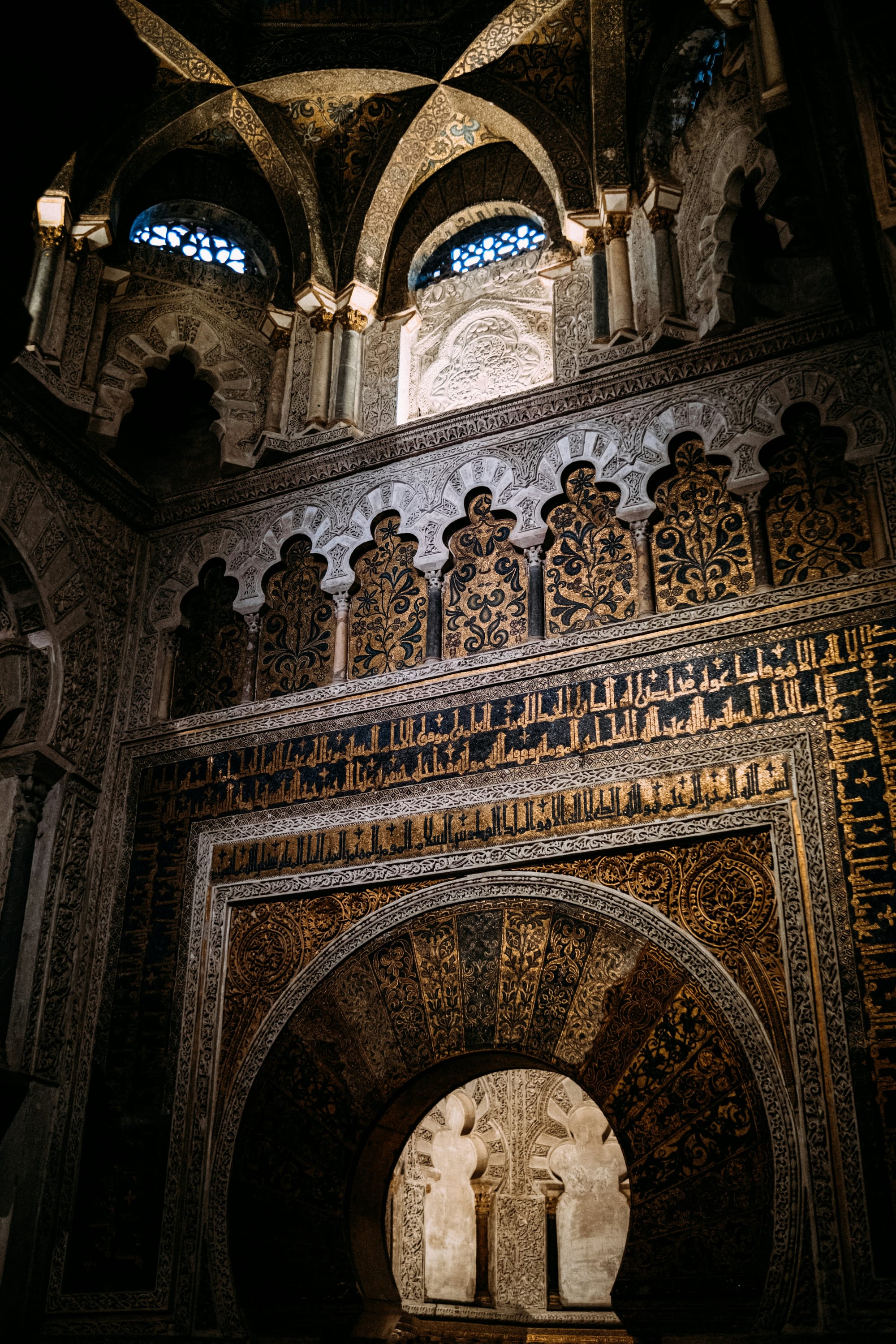
If there is a place inside the Mosque–Cathedral where time seems to have lost, at least in part, its ability to disfigure, that place is the mihrab. There the Umayyad past does not appear as echo or decorative remnant, but as presence. Everything in that enclave produces the sensation of an improbable, almost miraculous continuity: as if, amid centuries of appropriations, reforms, consecrations, and reinterpretations, the symbolic heart of the old oratory had managed to survive without being entirely dislodged. Not intact in any naïve sense—no historic space is—but with an original force still recognizable, still active.
The experience of the mihrab is, above all, an experience of concentration. After the hypnotic repetition of the forest of columns, after the almost infinite expansion of the hypostyle hall, the space condenses. The gaze ceases to wander and fixes itself. The building, which until then had seemed constructed to dilate perception, folds in upon itself and directs all its intelligence toward one point. There is here no monumentality understood as overwhelming bulk, no need to impose itself by scale. The mihrab’s authority is born of another kind of mastery: precision. Each element seems calculated to intensify the center. Light, the ribs of the vaults, the sequence of arches, the gleam of mosaics, the dense calligraphy of the inscriptions, the richness of marble and vegetal carving compose an architecture that does not seek to impress through excess, but through exactness.
It is that exactness that makes the mihrab one of the most extraordinary works of the medieval Mediterranean. It is not a simple niche opened in the qibla wall, as in other mosques, but a small octagonal chamber, a space that opens like a reliquary of sacred orientation. Its shell-shaped covering, its Byzantine-derived mosaics, the Qur’anic writing running across the surface as if the word itself upheld the stone—all this contributes to a sensation of theological and aesthetic fullness. Here ornament does not merely cover the space: it activates it. It does not beautify it from the outside: it makes it vibrate from within. Gold does not seem added, but lit. Calligraphy does not merely inform: it orders the gaze. The vegetal decoration is not mere embellishment: it suggests a form of contained infinity, a spiritual expansion enclosed within a minimal chamber.
That is why the mihrab, by itself, refutes readings of the monument that are too comfortable. Faced with this nucleus of Umayyad sophistication, the gentle tale of “the fusion of cultures” begins to fall short. Not because it is entirely false, but because it is insufficient to explain the building’s uneven intensity. The Mosque–Cathedral is not hybrid in any homogeneous way. Not all its zones partake of the same degree of continuity or the same type of historical tension. There are places where the passing of centuries produced a certain accommodation between uses and forms. But there are others—and the mihrab is the clearest example—where the past has not been wholly absorbed into the later narrative and still appears with an almost irreducible sharpness.
Around that privileged enclosure, one understands that the building cannot be read as a uniform harmony, as if each age had conversed with the previous one on equivalent terms. No. There are parts where continuity breathes. There are parts where rupture still hurts. The mihrab belongs to the former: it is the fragment where the Umayyad logic still expresses itself fully, where architecture preserves its original voice, and where the visitor can glimpse, with minimal interference, the spatial and spiritual intelligence that founded the mosque. Perhaps that is why it moves so deeply. Because in a monument traversed by conquest and intervention, that small nucleus still speaks from before the wound.
Conquest without demolition
Fernando III’s entry into Córdoba in 1236 did not signify the building’s end, but the beginning of another existence. The former mosque was purified, consecrated for Christian worship, and placed under the invocation of Saint Mary, but what was truly decisive was not that liturgical change, but the way it was carried out. The victorious power did not choose to raze the Umayyad oratory and raise an entirely new temple in its place. And that decision, which at first glance might be read as an act of restraint or even respect, contains a far greater complexity. Because to preserve can also be a form of conquest. Sometimes, to dominate another’s sacred space does not require destroying it, but occupying it, reorienting it, and forcing it to serve another narrative.
That is what happened in Córdoba. Unlike other cities where a change of sovereignty brought immediate substitution, here the building remained standing and began a slow metamorphosis. The mosque did not disappear: it was absorbed. Its scale, prestige, and material power were too evident to be treated as simple architectural booty. The new Christian authority understood that this space, precisely because of its magnificence, could become an extraordinary machine of legitimation. To pray within it, process within it, bury the powerful along its perimeter, celebrate Christian liturgy there, was also a way of declaring that the new order had not merely defeated the city, but had inherited its symbolic center.
For centuries, that appropriation advanced gradually, almost tactically. There was no immediate will toward total refoundation, but rather a pragmatic adaptation of the old oratory to the needs of the new worship. Altars were installed, spaces were delimited, funerary chapels began to appear along the perimeter, new liturgical uses and new devotional hierarchies were introduced. The old prayer hall began to be inhabited by another religion without yet wholly losing its original form. That process, precisely because of its slowness, is more revealing than sudden demolition. It speaks of functional colonization, of patient occupation that gradually modifies the meaning of a place without immediately annulling its anatomy.
And in that second life of the building there is, moreover, a fascinating paradox. Many of the earliest Christian interventions did not entirely deny the grandeur of the inherited frame, but learned to coexist with it, even to make use of its visual prestige. The old main chapel of Villaviciosa, the Royal Chapel, the later Sagrario, the gradual enclosure of the Patio of the Orange Trees, the many chapels opened within the precinct’s limits: all of this composes a landscape of successive insertions that do not yet destroy the monument’s general logic, though they do begin to displace it. In some of these episodes, Mudéjar art functions as a language of transition, almost as proof that the victorious culture not only dominates, but also incorporates and reformulates elements of the defeated world.
That long period of adaptation says much about the nature of conquest in Córdoba. It was not immediate substitution, but progressive appropriation. The building changed faith before it changed form entirely. And that distance between function and structure is one of the keys to its historical complexity. For a prolonged period, the mosque remained visible within the cathedral in formation. Or rather, the cathedral began as still, to a large extent, an occupied mosque. There was no harmony in that, but neither was there total erasure. There was an unequal coexistence between inherited container and imposed use, between material permanence and symbolic mutation.
Perhaps that is why this phase is so important for understanding the monument. Because it shows that historical violence is not always expressed through immediate destruction. Sometimes it adopts slower, more intelligent, more effective forms. To preserve the building was also a way of subduing it. Keeping it standing allowed the new power to install itself inside it, domesticate it little by little, and eventually present it as part of its own continuity. Before the great perforation of the sixteenth century, there was this other operation, less spectacular but equally decisive: turning the religious heart of al-Andalus into a Christian space without demolishing it, allowing conquest to advance first upon use, then upon rite, then upon memory. The stone remained the same. The meaning did not.
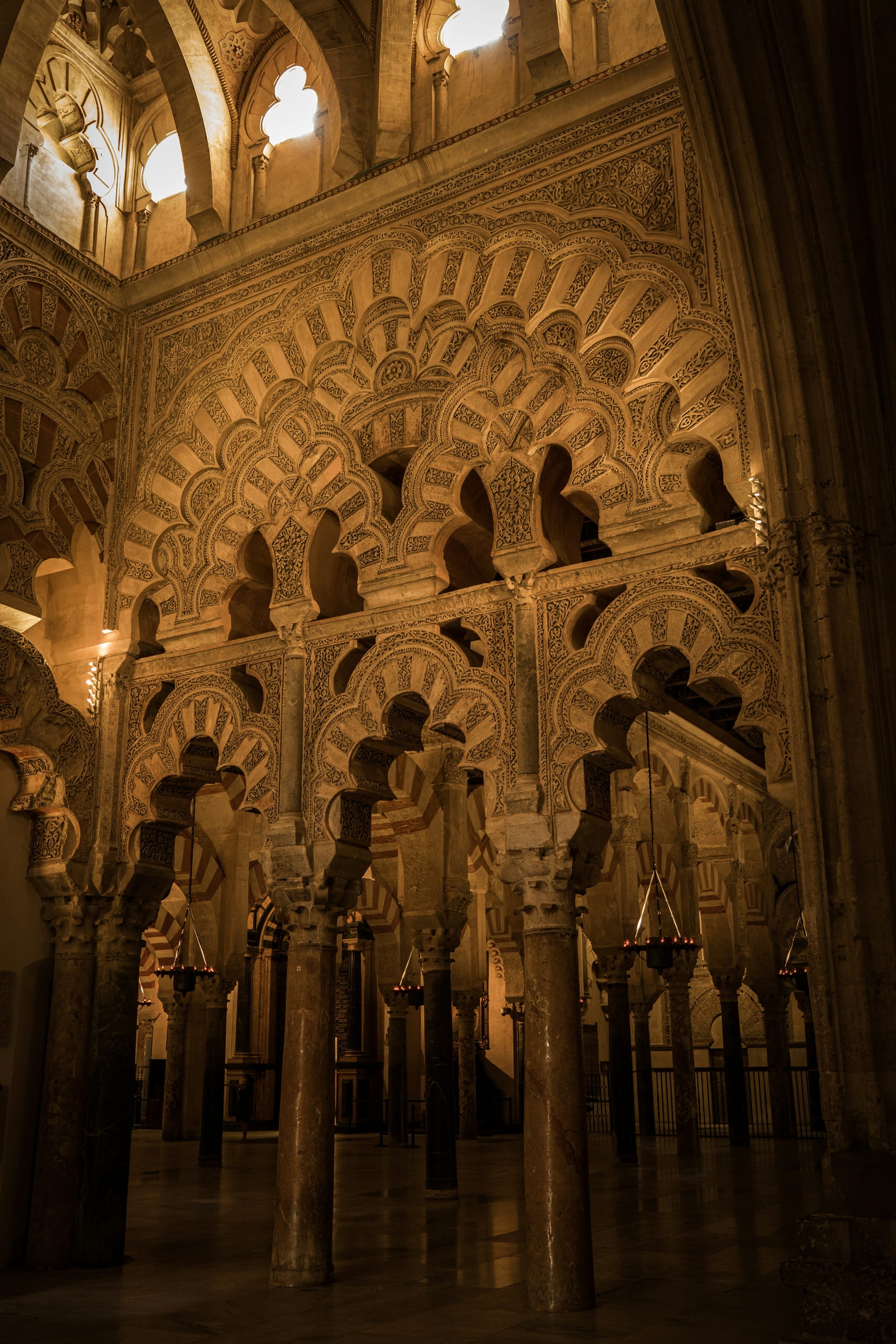
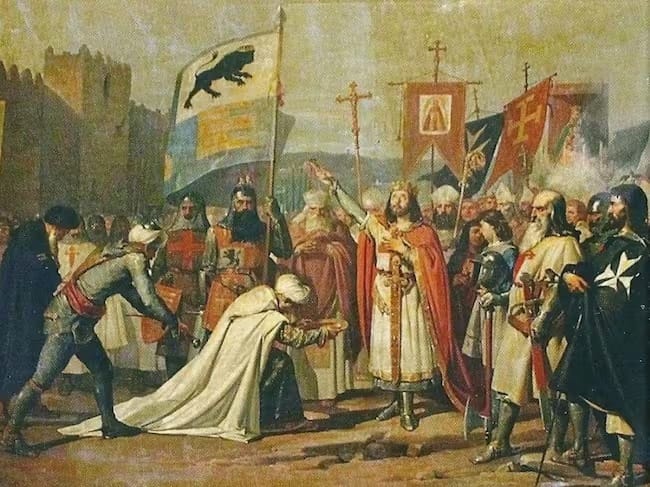
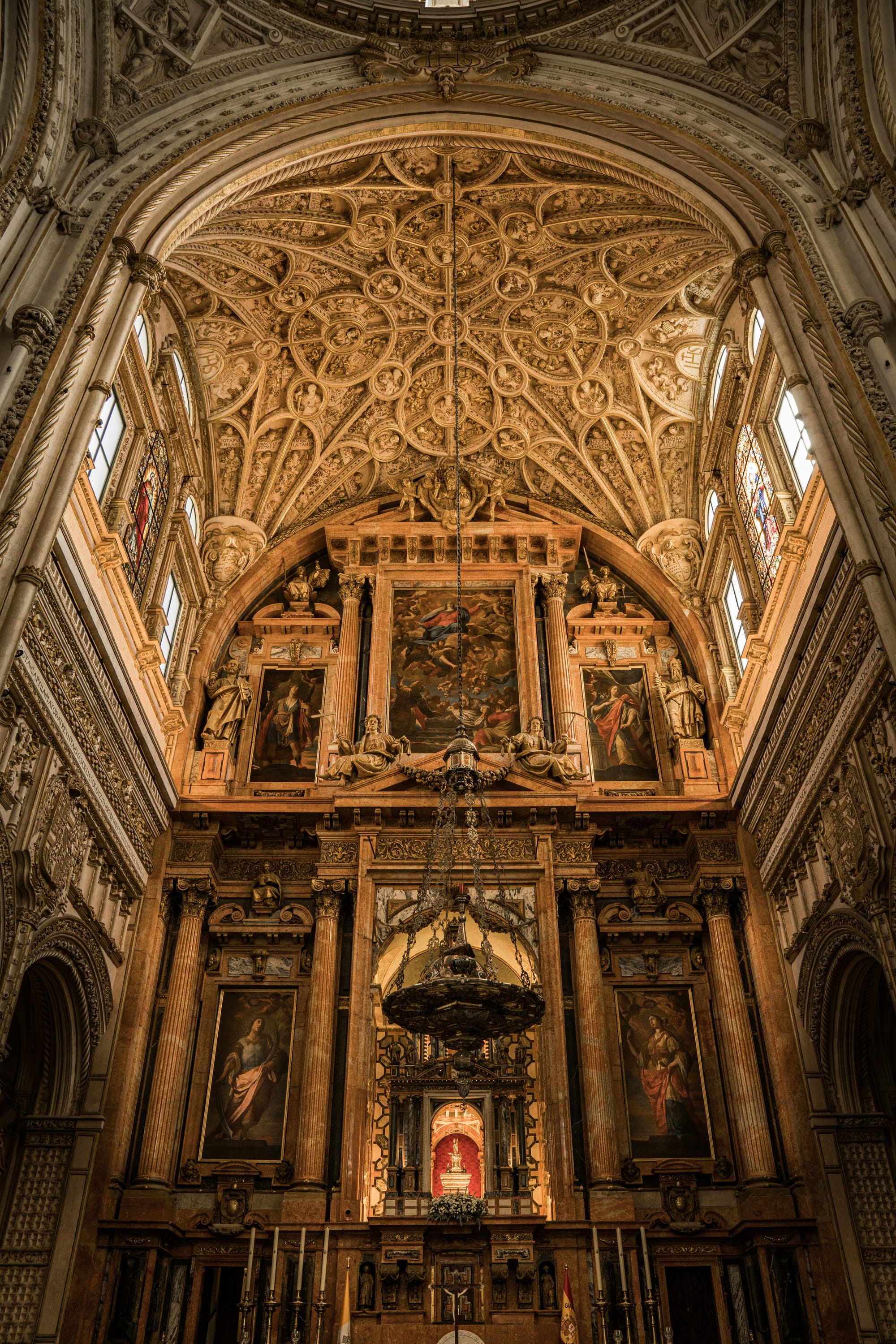
Before the great breakthrough of the 16th century, Christian occupation advanced through adaptation, insertion, and displacement.
The XVI century and the great perforation
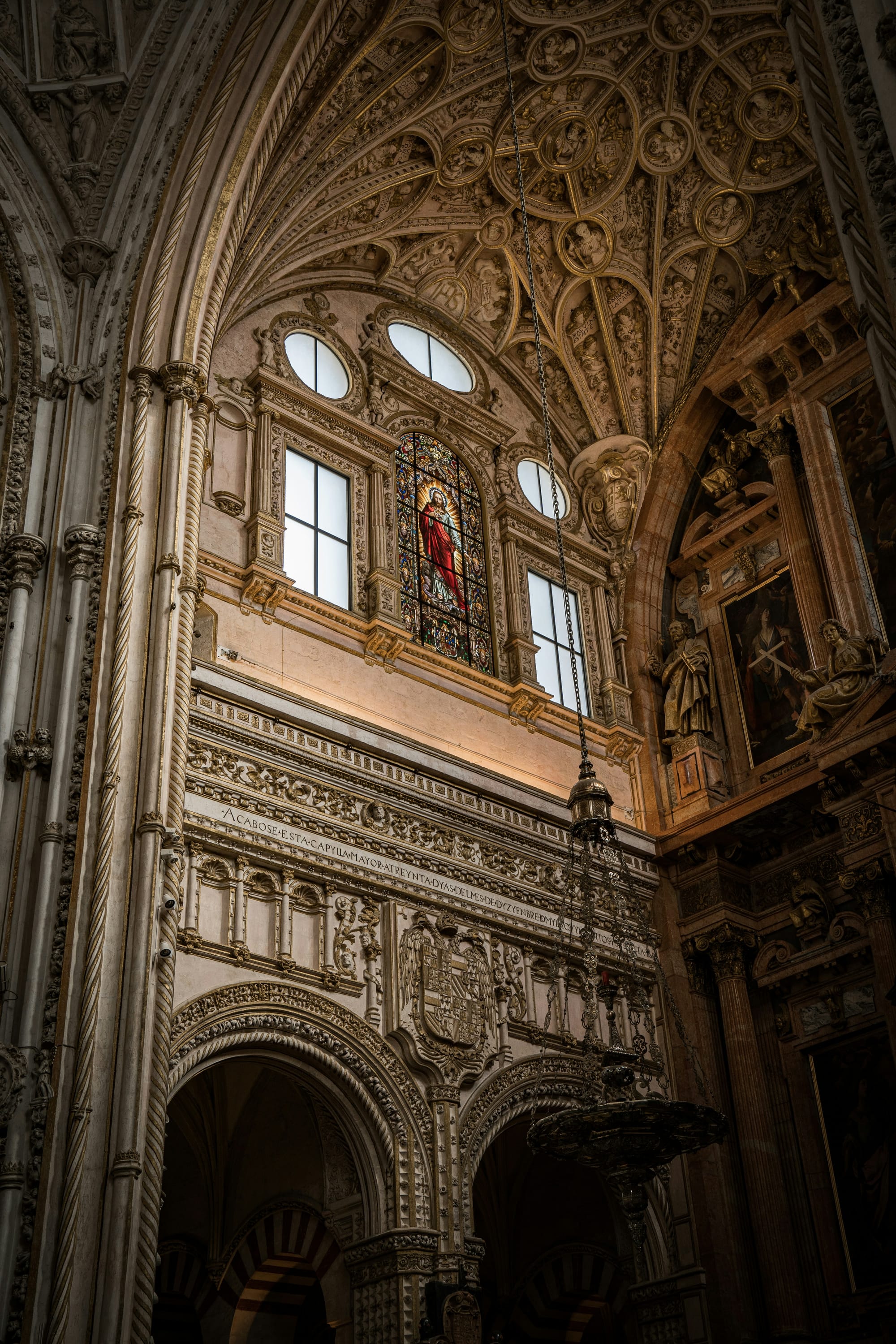
But the true turning point came in the sixteenth century. Until then, the building’s Christian transformation had advanced gradually, through successive adaptations that altered its use without completely dismantling the inherited spatial logic. In 1523, however, that relationship changed in nature. The cathedral chapter obtained imperial authorization to raise, in the very center of the former mosque, a new main chapel and a great cathedral transept. It was no longer a matter of occupying the building, of colonizing it liturgically, or of sowing chapels around its perimeter. It was a matter of intervening in its heart. Of opening it. Of imposing upon the core of the Umayyad oratory another architecture, taller, more emphatic, more hierarchical, designed to make visible another theology and another order of power.
With that operation, conquest ceased to be merely functional and became spatial. Where the hypostyle hall had organized the interior through repetition, continuity, and an almost hypnotic horizontality, the new Christian fabric introduced an opposite principle: axis, focus, ascent, centrality. The forest of columns, which until then had dissolved any absolute prominence in favor of a rhythmic extension of space, was interrupted by an architecture that demanded direction, claimed a center, subordinated the journey to the dominant presence of the altar. The old mosque had been conceived as an experience of infinite modulation; the Christian transept imposed upon it a syntax of concentration. Where before space had expanded, now it halted. Where before the eye wandered, now it obeyed.
That is why one must mistrust an old temptation: that of presenting this intervention as a kind of exemplary dialogue between styles, a happy synthesis of the Islamic legacy and the monumental Christianity of the Renaissance. The image is seductive, even comforting, because it transforms a decision of power into a narrative of cultural blending. But the reality of the building, when carefully traversed, is harsher. What happened in the sixteenth century was a surgical intervention of enormous spatial violence. Not because it razed everything that came before, but precisely because it chose to pierce it at its most sensitive point. The new nave did not merely add itself to the whole: it fractured the logic that governed it. It did not prolong the Umayyad system, nor reinterpret it from within a higher harmony. It interrupted it in order to impose another.
The difference is not merely stylistic; it is structural. The mosque ordered the void through an equalizing rhythm, a repetition of columns and arches that turned space into a continuous, almost abstract field in which sacrality did not depend on dramatic impact, but on extension and cadence. The cathedral inserted into its interior, by contrast, responds to an architecture of hierarchies: principal nave, liturgical axis, transept, elevation, high altar, choir. It is the passage from a distributed spatiality to a concentrated one; from a religion of rhythm to a religion of emphasis; from an order that spills horizontally to one that rises and organizes from a center. What visually appears as contrast was, historically, an unequivocal assertion of domination.
— Charles V, attributed quote
Perhaps that is why the phrase attributed to Charles V has survived with such force against the wearing away of time. “You have destroyed something unique in the world, and put in its place something that can be seen everywhere.” Beyond its fame, what makes it so precise is that it identifies the true nature of the loss. The emperor was not lamenting an ornamental detail, a vanished jewel, or a particularly exquisite decoration. What he was recognizing was the partial destruction of an irreproducible spatial singularity. The unique thing was not only the bicolored arches, nor the refinement of the surfaces, nor the building’s fame as a wonder of the world. The unique thing was its way of organizing the void, of turning repetition into grandeur, of raising a monument without resorting to the conventional rhetoric of monumentality.
The phrase remains legible in the monument’s own body. It is enough to walk through the Mosque–Cathedral to understand that Charles V’s observation belongs not only to historical anecdote, but to the physical experience of the place. The eruption of the transept is still felt as a discontinuity, an abrupt change in breathing. Not because the Christian work lacks quality—it has plenty—but because it responds to a logic that could exist elsewhere, whereas the logic of Córdoba’s hypostyle hall was radically exceptional. In that sense, the imperial lament does not oppose beauty to ugliness, nor quality to clumsiness. It opposes singularity to conventionality. Invention to inherited prestige. An architecture that had created its own law to another that, however splendid, belonged to a more familiar and widely shared vocabulary.
Therein, precisely, lies the wound. Not in the fact that a cathedral was built inside a mosque, but in the fact that to do so it was necessary to break the deepest logic of the building that contained it. The sixteenth century did not merely add a new layer to the monument’s history. It introduced a rupture into its grammar. From that moment on, Córdoba ceased to be merely the great mosque occupied by Christianity and became something even more complex and more unsettling: an architecture split at its center, a space where two conceptions of the sacred no longer merely overlapped, but stood opposed in stone.
Architecture as a political question
It is at that point, precisely, that the Mosque–Cathedral of Córdoba ceases to be only an exceptional monument and begins to behave like a question. Not an aesthetic question, nor even only a historical one, but a political question in the deepest sense of the term: who occupies space, who redefines it, who manages to impose in stone their version of legitimacy. Because preserving a building in order to transform it from within is not a neutral gesture. Nor is it necessarily proof of tolerance. Sometimes it constitutes a more complex—and perhaps more enduring—form of domination. The defeated party’s work is not entirely erased; it is incorporated, subdued, forced to speak another language.
Córdoba embodies that logic with unusual clarity. Here victory did not consist merely in substituting one cult for another, nor in raising a new architecture upon the ruins of the old, but in appropriating the prestige of the inherited building and putting it at the service of a new sovereignty. The operation is subtle and brutal at once. Subtle, because it understands the symbolic value of what it preserves. Brutal, because that preservation does not imply equality, but subordination. The sacred space of the other does not disappear: it comes to be administered by another power, narrated by another authority, oriented toward another liturgy. Material permanence, in that context, does not soften conquest; it makes it more sophisticated.
That is why the Cordoban answer cannot be contained within the complacent cliché of coexistence. Coexistence, when it existed in the city, was a concrete historical reality, subject to unstable balances, legal hierarchies, social tensions, and very different moments over time. It was not a natural state nor a paradise of symmetries. And the building, certainly, does not speak of a spontaneous harmony among civilizations. It speaks of something more uncomfortable and more precise: successive hegemonies. Of powers that do not dissolve into one another, but relieve, appropriate, correct, and impose themselves upon what they inherit with varying degrees of intensity.
The Mosque–Cathedral does not simply fuse two religious universes: it contains them in an unstable equilibrium in which each occupies a different position with respect to memory and power. There are parts of the monument where one culture encapsulates another. Others where it covers it without annulling it. Others where it leaves it visible but subordinated. Others, finally, where it pierces it to affirm its own primacy. That variety of gestures—preserving, inserting, enveloping, resignifying, displacing—turns the building into a material lesson in political history. It is not only a matter of seeing which styles coexist, but of understanding which relations of force made them possible.
Seen that way, architecture ceases to be a backdrop and becomes a document. Every wall, every chapel, every altered axis, every conserved or violated stretch speaks of a determined relation to the past. Córdoba does not merely preserve memory: it organizes it. It decides which part of the building is exalted, which is liturgized, which is musealized, which is integrated into an official continuity, and which is relegated to aesthetic admiration. And in that process, more than an interpretation of heritage is at stake. Control of the narrative is at stake.
Perhaps that is why the Mosque–Cathedral continues to provoke a debate that never quite exhausts itself. Because it forces us not only to ask what it was, but what it means today to inherit a work born of a different sovereignty and later turned into the emblem of another. Few buildings show so clearly that architecture does not merely represent power: it administers it through time. In Córdoba, stone has forgotten none of its conquests. It contains them all. And in so doing, it turns the visit into something more than an experience of beauty: it makes it a silent confrontation with the history of how powers inscribe themselves, replace one another, and aspire to become eternal.
The courtyard, the tower and the shift in narrative
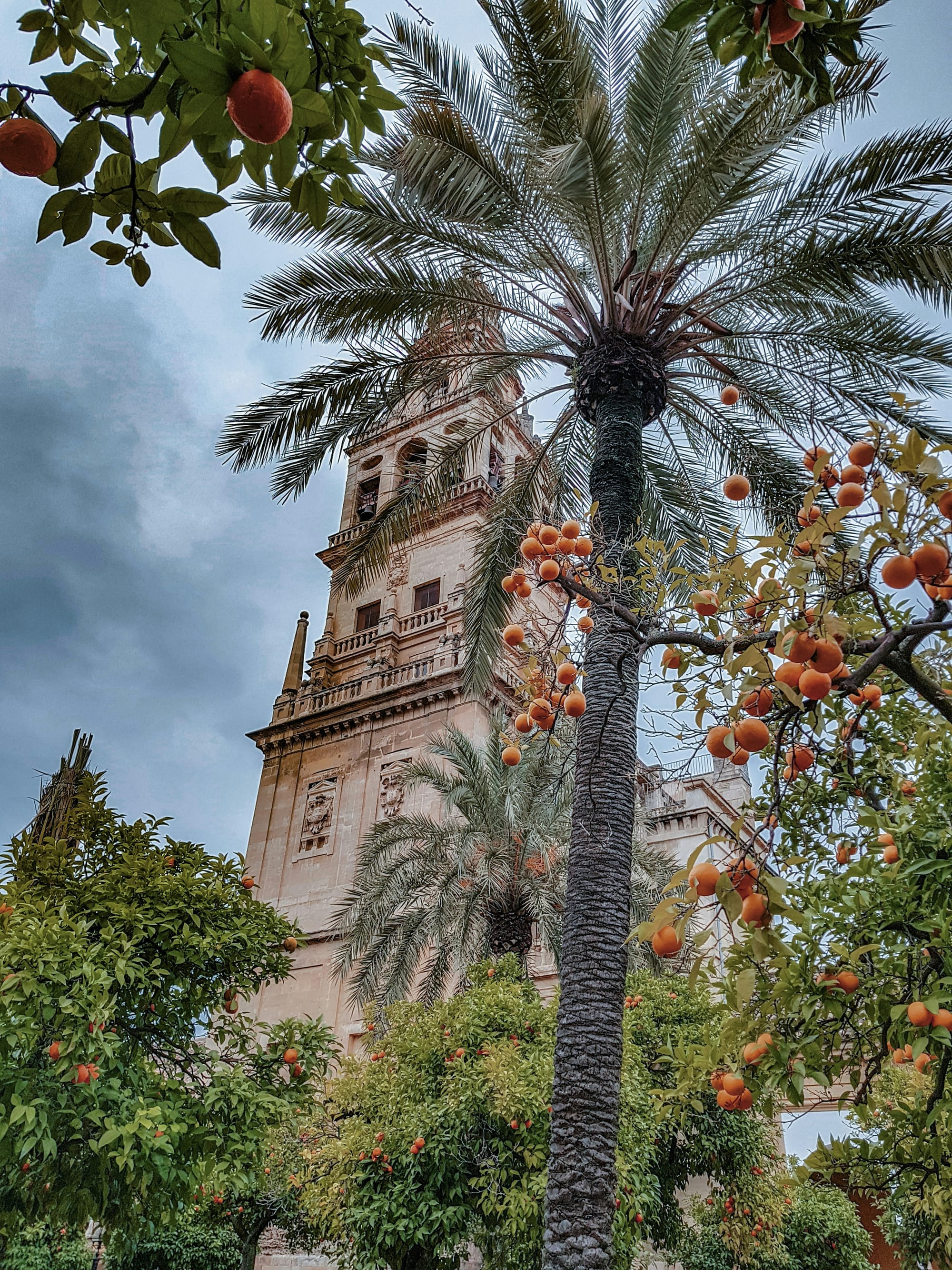
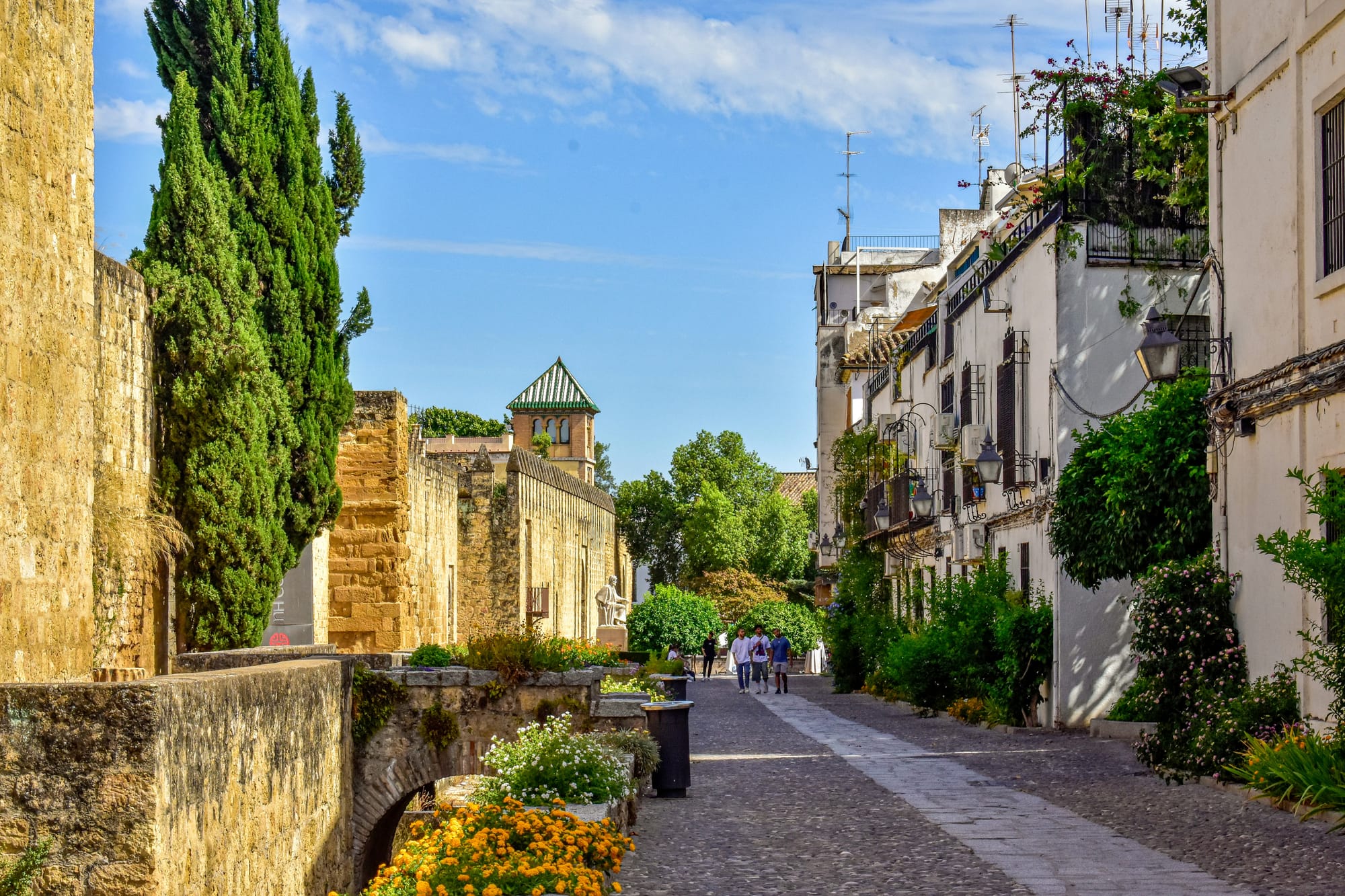
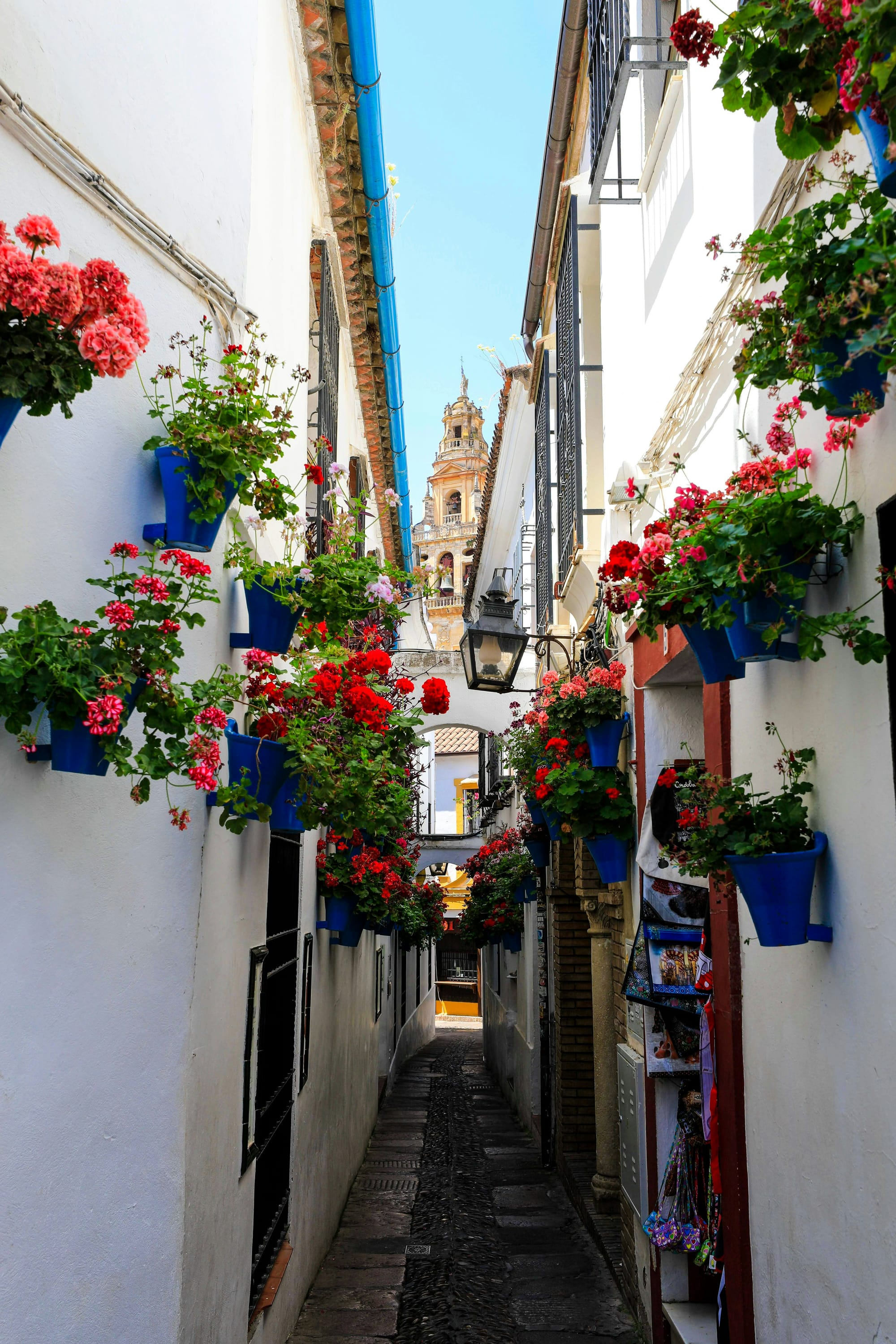
Courtyard, tower, water, stone: in Cordoba, what remains also changes its story.
That transformation of meaning is perceived not only inside the building. It also unfolds, more silently but just as eloquently, in its transitional spaces and outward signs. The Patio of the Orange Trees is one of them. Today the visitor crosses it like a luminous antechamber, a place of visual rest before entering the temple’s half-light. Everything in it seems to suggest order, freshness, and contained ceremony: the regular rows of trees, the murmur of water, the softened geometry of the galleries, the open clarity of the sky above. And yet that serenity, too, is historical and therefore constructed.
In the Islamic period, the courtyard was not a mere access point nor an ornamental garden. It was the mosque’s sahn: the setting for ablutions, yes, but also a space for gathering, teaching, administration, and public life. There water did not fulfill only an aesthetic function. It was rite, preparation, purification. It formed part of a spiritual choreography preceding prayer. The courtyard was therefore an extension of the temple, not a simple preamble. An active space, traversed by religious practice and by the urban life of Andalusi Córdoba.
After the Christian conquest, that same enclosure did not disappear, but it began to say something else. It was incorporated into cathedral ceremonial and, over time, acquired the physiognomy we now associate with it: an ordered, disciplined, almost processional garden in which orange trees, palms, cypresses, and fountains compose an image of harmony that appears natural, though it is not. Water remained, but ceased to belong to the narrative of ablution and entered another symbolic system. It kept flowing, though under another liturgy. And in that sense the courtyard perfectly summarizes the monument’s logic: here almost nothing disappears entirely, but almost everything changes meaning.
Because in a building like the Mosque–Cathedral no permanence is innocent. Every element that survives does so under a new administration of meaning. Material continuity does not guarantee historical continuity. On the contrary: sometimes that very continuity makes transformation more effective. What remains can be rewritten, resignified, absorbed into another narrative without ceasing to seem ancient. The Patio of the Orange Trees does not hide its Islamic past, but it no longer belongs only to it. It preserves that past and, at the same time, domesticates it within a later reading. That is why it is much more than a beautiful entrance: it is a lesson in how power does not always destroy what came before, but learns to frame it within a new symbolic order.
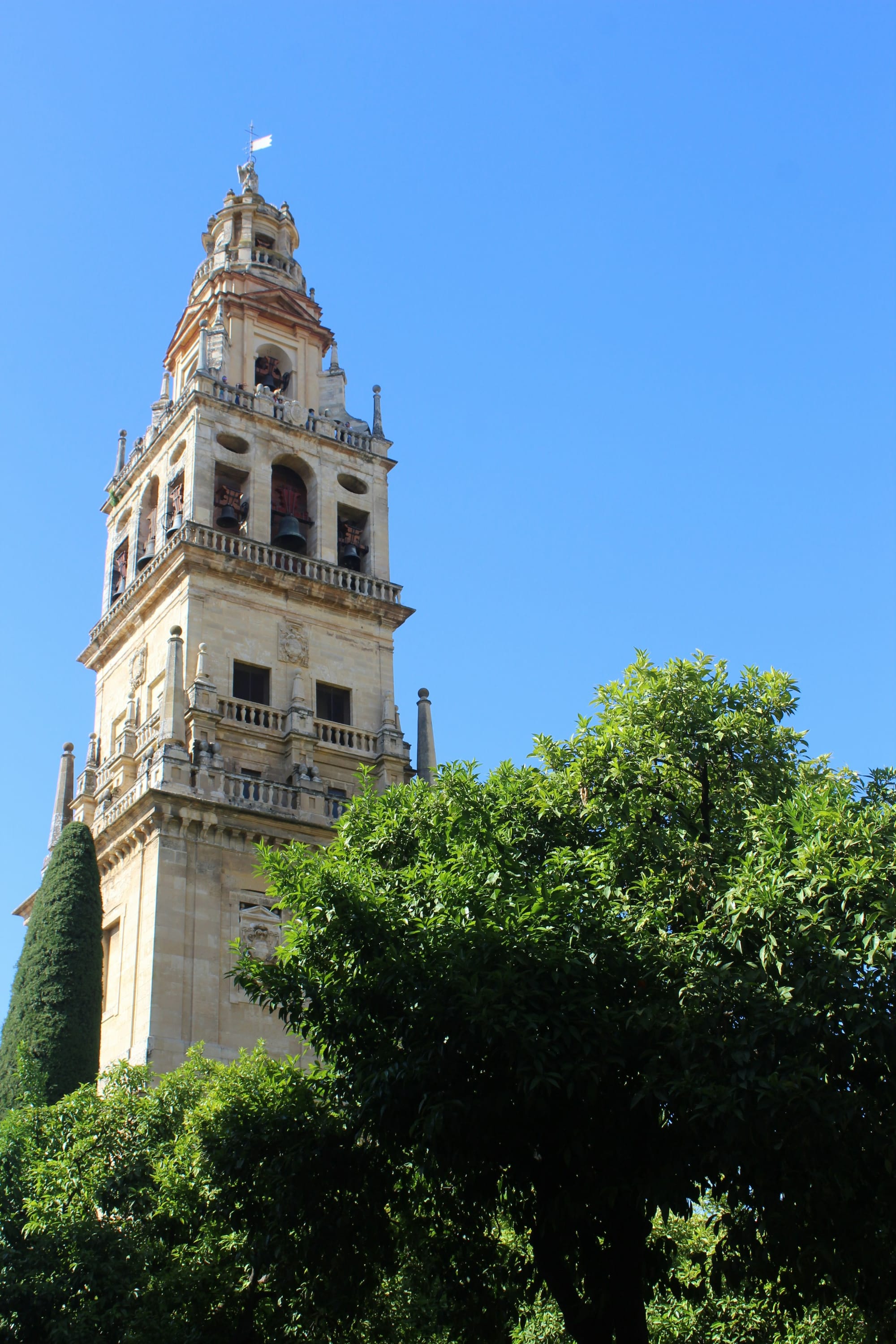
Something similar occurs with the tower, perhaps the clearest emblem of this directed superposition. The great caliphal minaret, raised in the time of ʿAbd al-Raḥmān III as a sign of Umayyad authority and the city’s vertical landmark, was not entirely erased after the Christianization of the complex. Nor did it remain visible in its original form. It was enveloped. The Renaissance bell tower absorbed it, preserved part of it, and concealed it at the same time. From outside, Córdoba sees a Christian tower. Inside that tower, however, the anatomy of the old minaret survives.
The image is almost too perfect for this building: a new form covering an earlier one without annihilating it entirely. Christian architecture does not completely replace Islamic architecture; it covers, incorporates, and subordinates it. What was once an emblem of the caliphate becomes the internal structure of a cathedral bell tower. The Islamic call to prayer disappears, but its support remains, trapped in another envelope, as if history had decided not to destroy the past, but to enclose it within a later victory.
Few material metaphors describe the Mosque–Cathedral as a whole more accurately. Because the same thing occurs at the scale of the entire monument: one civilization covers another, transforms it, reinterprets it, and yet does not quite manage to erase its skeleton. The tower shows this with nearly didactic clarity. It is enough to think of it in these terms to understand that this monument is not composed only of successive styles, but of narratives competing to dominate the same matter. From the street, the city thinks it sees one thing. Inside the stone, another persists. And between the two, as throughout Córdoba, the building’s most uncomfortable truth still beats: history does not always substitute; sometimes it envelops.
The XXI century: who gets to tell the monument
In the twenty-first century, the dispute surrounding the Mosque–Cathedral is no longer expressed through traumatic works, demolitions, or major campaigns of construction. It is fought in another way, less visible but no less decisive: in the realm of management, ownership, language, and narrative. Because monuments are not only preserved; they are also interpreted. And whoever interprets them, to a great extent, orders their meaning. The ecclesiastical institution claims its uninterrupted custodianship since 1236, emphasizes the continuity of worship, and presents the building as a living temple as well as a patrimonial good of universal reach. That argument has a solidity that cannot be dismissed lightly. Liturgical continuity has indeed been one of the reasons the building did not become ruin, relic, or mere museum piece. Continuity of use has also been a form of preservation.
But precisely because the monument remains alive, the discussion surrounding it remains open. And therein lies one of its most contemporary tensions. The issue is no longer only who cares for it, but who has the authority to define what it is, how it should be named, and how its past ought to be explained to the millions who walk through it each year. The question of ownership, registration, the public naming of the complex, the hierarchy granted to some memories over others—all this has brought back to the foreground a deeper question running through the building’s entire history: who possesses the power to fix the meaning of the stone?
The dispute is no longer constructive; it's narrative.
In few places is that narrative battle so visible. The Mosque–Cathedral is not only one of Europe’s great monuments; it is also a machine for producing narrative. Every explanatory panel, every brochure, every guided tour, every institutional designation participates, to a greater or lesser extent, in constructing a version of the building. Is it presented above all as a cathedral? As a mosque? As a dual monument? As a site of Christian continuity? As a palimpsest of civilizations? None of these formulas is innocent. Each emphasizes one inheritance and tones down another. Each orders the place’s memory differently.
The scale of the site’s tourism only intensifies that struggle. In 2024, the Mosque–Cathedral reached its all-time record of visitors, with more than 2.18 million people crossing its doors. That figure speaks not only of the monument’s magnetism, but of the enormous symbolic responsibility borne by whoever manages and explains it. Because when a building receives such a global gaze, it no longer functions merely as local or national heritage: it becomes a world stage on which broader questions of identity, inheritance, religion, memory, and cultural legitimacy are debated. Córdoba does not receive only tourists. It receives interpretations in waiting.
And that is where the monument once again reveals itself as a field of forces. Few places show so clearly the tension between heritage, faith, tourism, and narrative power. The building remains a temple, but also a cultural icon, an economic engine, a legal object, and a territory of historiographical debate. Each of those dimensions claims a different form of authority. Faith invokes continuity. Heritage demands critical openness. Tourism simplifies to make the site legible. History, by contrast, complicates. And the Mosque–Cathedral lives precisely at that crossroads: between the need to be preserved, the will to be venerated, the pressure to be visually consumed, and the duty to be explained honestly.
The debate is no longer fought with chisels or buttresses, but it remains, in the end, the same debate as always. It is not only about who administers the building, but who can name it legitimately, who decides where its symbolic center lies, and who determines which past must be presented as the foundation of all the others. In Córdoba, even today, the struggle over the monument continues. Only now it takes place in registries, in discourses, in signage, in heritage pedagogy, in the dispute over one word placed before another. The wound is still there. It no longer opens in the stone, but in interpretation.
The comfortable falsehood of coexistence
And perhaps it is there that Córdoba reveals its most uncomfortable and most fertile relevance. Not only in the dazzling beauty of its monument, nor in its indisputable value as a summit of Umayyad art and a major work of European heritage, but in the way it forces us to mistrust narratives that are too polished. The Mosque–Cathedral is unsettling precisely because it resists becoming entirely a reassuring metaphor. For years, a significant part of tourist, institutional, and cultural discourse has wanted to present it as the perfect emblem of Spanish hybridity: a reconciliation of creeds made stone, a luminous synthesis of Islam and Christianity, proof that history, over the centuries, eventually smooths its edges and transforms violence into harmony.
The temptation to read it that way is understandable. Few buildings invite idealization so strongly. Its beauty seems to demand an interpretation equal to it, and few interpretations are as seductive as that of concord. Turning the Mosque–Cathedral into an allegory of coexistence allows us to admire it without conflict, to contemplate it without asking too many questions, to resolve with a kindly word—fusion, hybridity, dialogue—what was in reality a long process of conquests, appropriations, displacements, and unequal superpositions. That reading also has an obvious contemporary advantage: it offers a comfortable symbol for a sensibility that prefers bridges to fractures, syntheses to wounds, heritage celebrations to uncomfortable memories.
But the stone, if one truly listens to it, says something else. It says that history is written not only through fruitful encounters, but also through amputations. It says that beauty can be the result of unresolved tension. It says that a masterpiece is not always born from harmony, but sometimes from the clash between incompatible orders. The Mosque–Cathedral is no less admirable for that; perhaps it is more so. But its greatness does not consist in having erased conflict, but in preserving it within itself, in making it visible without the need to proclaim it. Every time the forest of columns is interrupted by the mass of the transept, every time the minaret beats within the bell tower, every time the mihrab still speaks from a partially dispossessed center, the building reminds us that coexistence here was not a serene fusion, but a succession of powers that left their marks without completely annulling those that came before.
There is something deeply contemporary in that lesson. In an age that seeks easy symbols, Córdoba insists on remaining difficult. It forces us to admit that art can be born of conflict without redeeming it. That the preservation of a building does not erase the violence of its transformation. That beauty, however intense, does not necessarily absolve the history that surrounds it. And perhaps therein lies its true value: not in offering us a complacent image of what we were, but in confronting us with a more demanding truth about how civilizations are built. Not only by raising new forms, but by appropriating old ones, inhabiting them, correcting them, covering them, and leaving in them, forever, the memory of that dispute.
Walking the contradictio
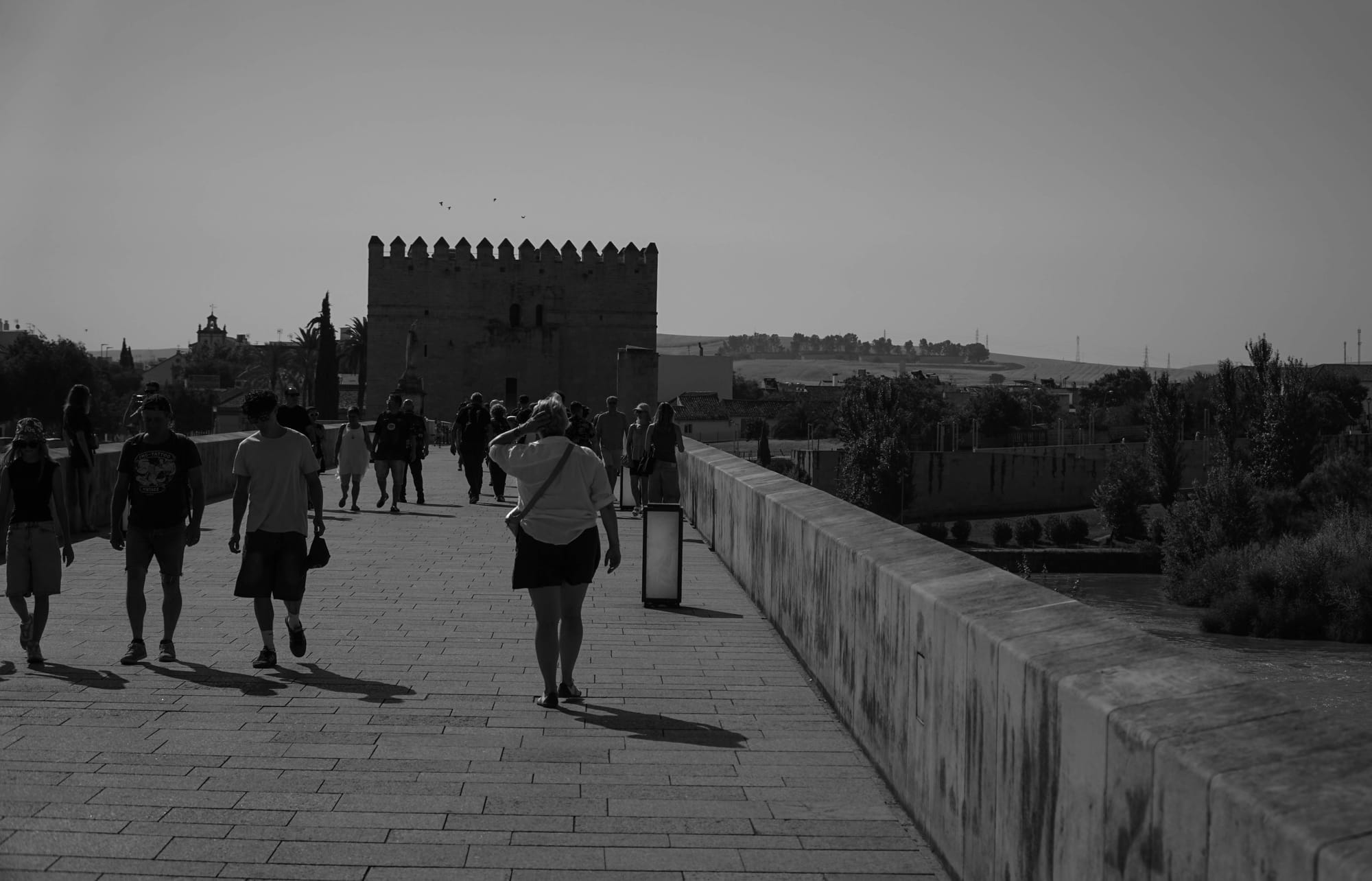
To walk through the Mosque–Cathedral of Córdoba is to submit oneself to a contradiction that the building does not soften or resolve, but compels one to experience physically. It is not only a matter of understanding a historical sequence, nor of identifying styles, dates, or interventions. It is a matter of feeling how a space can contain, at once, continuity and rupture, fascination and tearing, admiration and estrangement. Here history does not present itself as an orderly narrative: it is crossed with the body.
The journey begins in a courtyard that once served for ablutions and today functions as an antechamber, as if the building wished from the first step to remind us that spaces can change faith without ceasing to preserve part of their ancient respiration. Then comes the forest of columns, that succession of arches and supports that seems to lead not toward an end, but toward an indefinite prolongation of space. There is something almost hypnotic in that continuity, in that way of constructing the sacred not through dramatic impact, but through repetition. One advances with the impression that the building does not conclude, that there is always one more nave, one more alignment, one more stretch of rhythmic penumbra waiting ahead.
Then the mihrab appears, and with it a different concentration, a nucleus where Umayyad sacrality still seems to preserve a temperature of its own. There the building ceases to expand and gathers itself. The gaze no longer disperses: it converges. Everything at that point conveys the sense of a rare integrity, as if the monument’s original logic were still speaking in a voice that the centuries have not entirely succeeded in extinguishing. And yet that continuity does not last. Or at least, it does not last alone.
Because at a certain point in the route, before the building allows one to prepare for it fully, the Christian nave erupts. Not as a simple addition, nor as a variation within the same language, but as the appearance of another density, another ambition, another spatial authority. Taller, more compact, more emphatic, it rises in the middle of the old oratory like a chiaroscuro of power. Where the mosque breathed horizontally, the cathedral ascends. Where the forest of columns dissolved the prominence of any absolute center, the transept imposes axis, hierarchy, focus. The transition is not only visual: it is ideological. The space changes voice.
And it is precisely in that collision that the visit reaches its deepest truth. To walk through the Mosque–Cathedral is to understand that the most enduring conquest is not always the one that destroys from without, but the one that learns to install itself at the very heart of what it admires. One need not raze an architecture in order to dominate it completely; sometimes it is enough to occupy its center, alter its logic, and force it to coexist with the visible form of victory. Córdoba teaches that with extraordinary clarity. The contradiction is not at the edge of the monument. It is the monument.
The uncomfortable inheritance of the irreplaceable
Perhaps that is why Córdoba continues to trouble centuries later. Not because it is an immobile vestige of the past, nor only because it preserves a beauty capable of disarming any defense, but because it compels us to face a paradox that no complacent reading can close. In the Mosque–Cathedral we do not behold a full reconciliation, but an unfinished negotiation between unequal memories. We do not see a seamless synthesis, but a building that has learned to survive without entirely resolving the tension that inhabits it. Its greatness lies precisely in not concealing that tension. It exhibits it. It turns it into form. It leaves it suspended in stone so that every age may confront it anew.
And that is why the monument far exceeds the local history of Córdoba or even Spanish history. Beneath its magnificence pulses a much broader, almost universal question, one that traverses any victorious civilization when it encounters the exceptional work of the defeated: what is one to do with the irreplaceable when one also wishes to dominate it? To destroy it would be to lose its prestige. To preserve it intact would be to accept an alien sovereignty at the heart of one’s own narrative. To transform it, appropriate it, envelop it, resignify it: there begins that intermediate solution, so politically effective and yet so morally troubling, which Córdoba embodies with unusual clarity.
The Mosque–Cathedral does not answer that question. It could not. Great monuments do not argue: they remain. And in that remaining, this building continues to offer, all at once, all its contradictions. Its mihrab still radiates an Umayyad fullness not wholly defeated. Its Christian transept remains embedded at the center as the visible form of a hegemony that wished to install itself at the heart of conquered space. The caliphal minaret still beats, concealed inside the bell tower that encases it. The ancient water still runs beneath the later discipline of a Christian garden. Nothing has disappeared entirely. Nothing has remained the same.
That is, perhaps, Córdoba’s deepest lesson: that history, when it cannot be erased, does not always reconcile; sometimes it embeds itself. It carves itself within. It becomes a tense coexistence between what resists and what dominates, between what was central and what later claimed that center for itself. That is why millions of people continue to walk through this building every year with a mixture of fascination and bewilderment. Even when they do not know how to name it, they sense that there is something here beyond beauty. There is an uncomfortable truth, a truth that obliges one to choose between the consolation of myth and the exposure of history.
What rises on the north bank of the Guadalquivir is not, in the end, a serene metaphor of coexistence. It is something more complex, harsher, and therefore more valuable. It is proof that civilizations do not merely succeed one another: sometimes they lodge themselves inside one another, dispute the same space, and leave within it a memory that can no longer be simplified without betraying it. Córdoba still stands not because it resolved that wound, but because it preserved it. And perhaps it is precisely there, in that uncomfortable inheritance of the irreplaceable, that its true greatness resides.