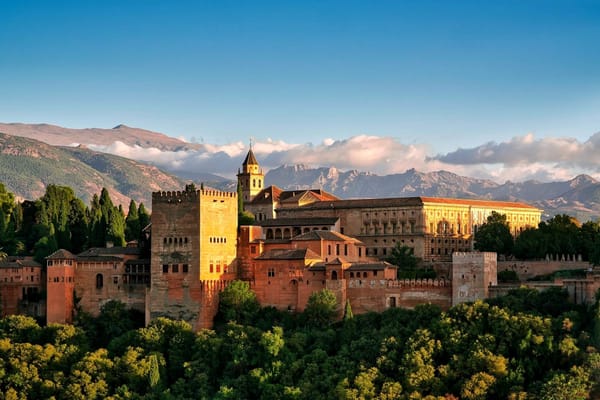
Nuremberg: THE CITY THAT JUDGED ITS OWN SHADOW
Nuremberg turned the stagecraft of fanaticism into a laboratory of international justice. Between medieval walls, stone grandstands and the severity of Courtroom 600, the twentieth century left here both its most visible wound and one of its most serious attempts at repair.


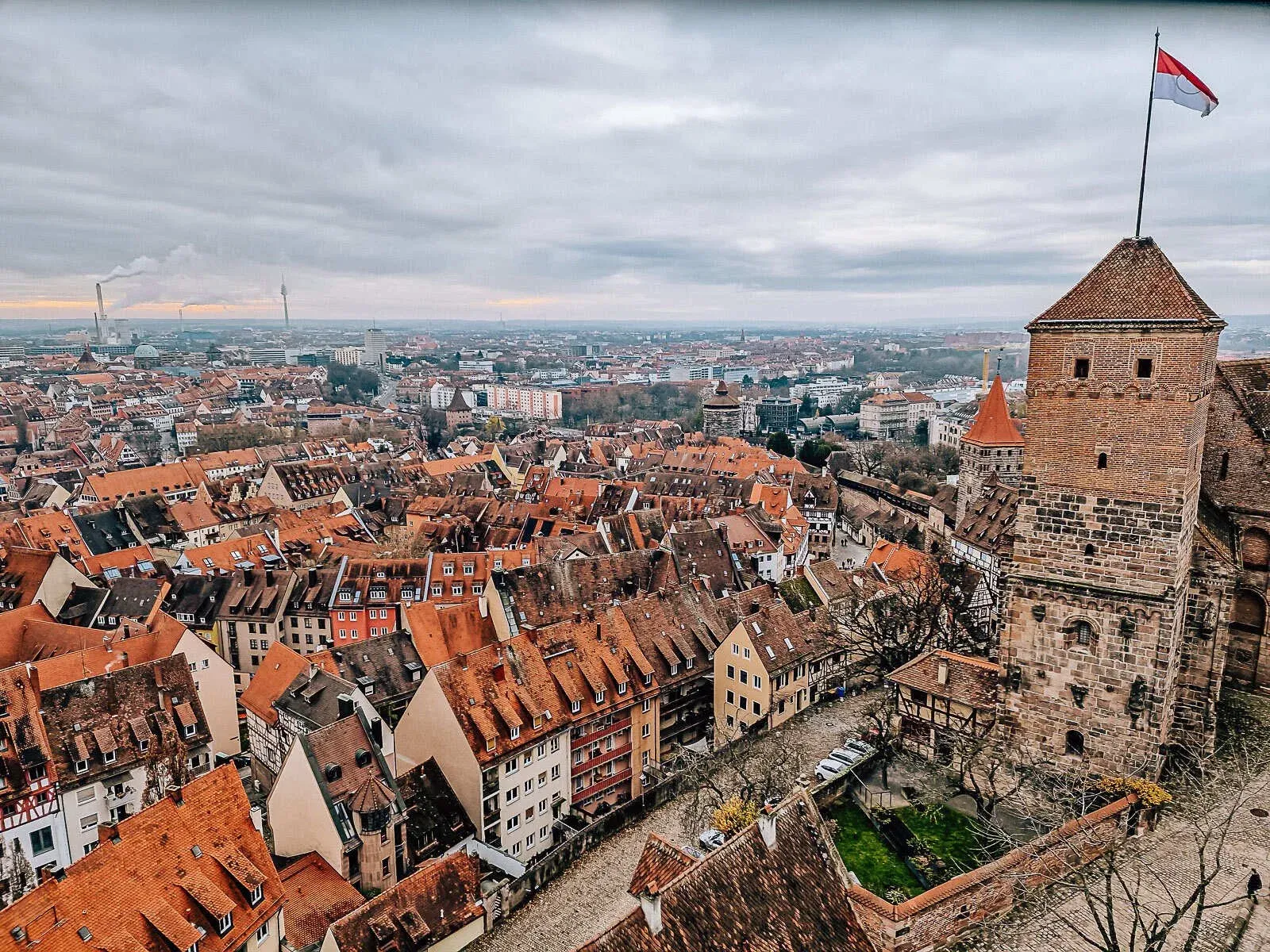
In Nuremberg, the distance between a battlement and a dock is not measured in meters, but in civilization. It is enough to climb to the Imperial Castle to understand that this city was, long before it became one of the twentieth century’s wounds, a promise of historical continuity. From above, the old town unfolds like a meticulously composed miniature: red roofs pressed close together, Gothic spires, stone bridges, towers still watching over the skyline, and the Pegnitz running through it all with a deceptive calm, as though time here had learned to bend back upon itself without ever breaking.
But Nuremberg does not take long to undo that first impression. As one moves south, the landscape changes its language, its scale and almost its moral register. Stone ceases to protect and begins to impose itself; architecture abandons the human measure and becomes an instrument of intimidation. There, on the former Nazi Party rally grounds, the horizon is no longer made of bell towers and walls, but of outsized surfaces, wounded terraces and ruins that still retain something of their old vocation for domination. The Zeppelinfeld remains like an open scar: not only the physical remnant of a political stage set, but proof that there was once a time when architecture was used to transform a crowd into faith, obedience and spectacle.
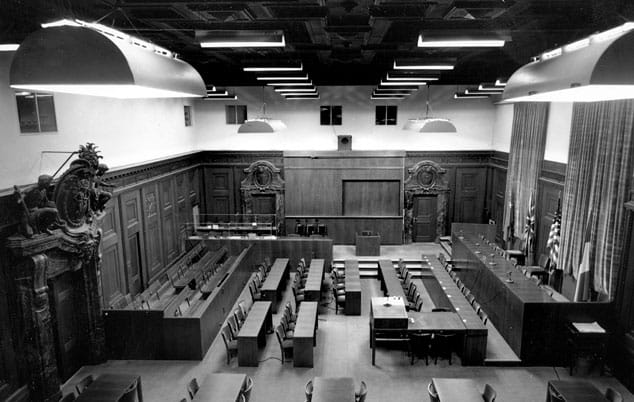
Then comes the Palace of Justice, and with it another tone, another temperature, another form of authority. In Courtroom 600 the wood softens the echo, compels the voice downward and restores language to its exact weight. There are no torches now, no mass choreographies, no exaltation. There are documents, witnesses, simultaneous translations, dense silences, individual responsibility. Where power had once presented itself as collective destiny, a radical question began to take shape: what happens when the law decides to confront the crimes of the state? Few cities allow one, in the space of a single day, to travel from political myth to law, from the liturgy of fanaticism to the always incomplete yet decisive labor of justice.
A city before horror
Long before its name became bound to torchlit parades, racial laws and defendants’ benches, Nuremberg was already a city invested with authority. Not merely an important city, but one of those rare European places where power seems to have settled layer upon layer until it became indistinguishable from the stone itself. A Free Imperial City of the Holy Roman Empire, frequent host of imperial diets and residences, guardian for centuries of the empire’s insignia, Nuremberg did not simply occupy a place on the German map: it occupied a place in Germany’s historical imagination. The Imperial Castle dominating the city’s silhouette was not only a monument; it was a visible assertion of legitimacy, continuity and rank.
That past made the city into something more than a medieval postcard of towers, walls and reddish roofs. It turned it into a petrified narrative. In its narrow streets, in the severity of its churches, in the solidity of its gates and in the austere language of its fortifications, there survived an idea of Germany that predated even the modern state: an idea of political lineage, symbolic centrality, authority sanctioned by history. Nuremberg was not only beautiful. It was useful to anyone seeking to appropriate the past and present himself as its natural heir.
And that was precisely what National Socialism understood. Hitler did not choose the city because he needed to invent a symbol, but because he knew how to recognize one that already existed and place it in his service. Nuremberg offered something no regime can manufacture from scratch, however vast its propaganda: historical depth. Its walls suggested permanence; its towers, ancient vigilance; its imperial past, an almost sacred continuity. In that mineral solemnity, Nazism thought it had found the perfect stage set in which to disguise itself as destiny. It did not want to look like a brutal rupture born of violence and resentment, but like the supposed logical culmination of a long, glorious and unified German story.
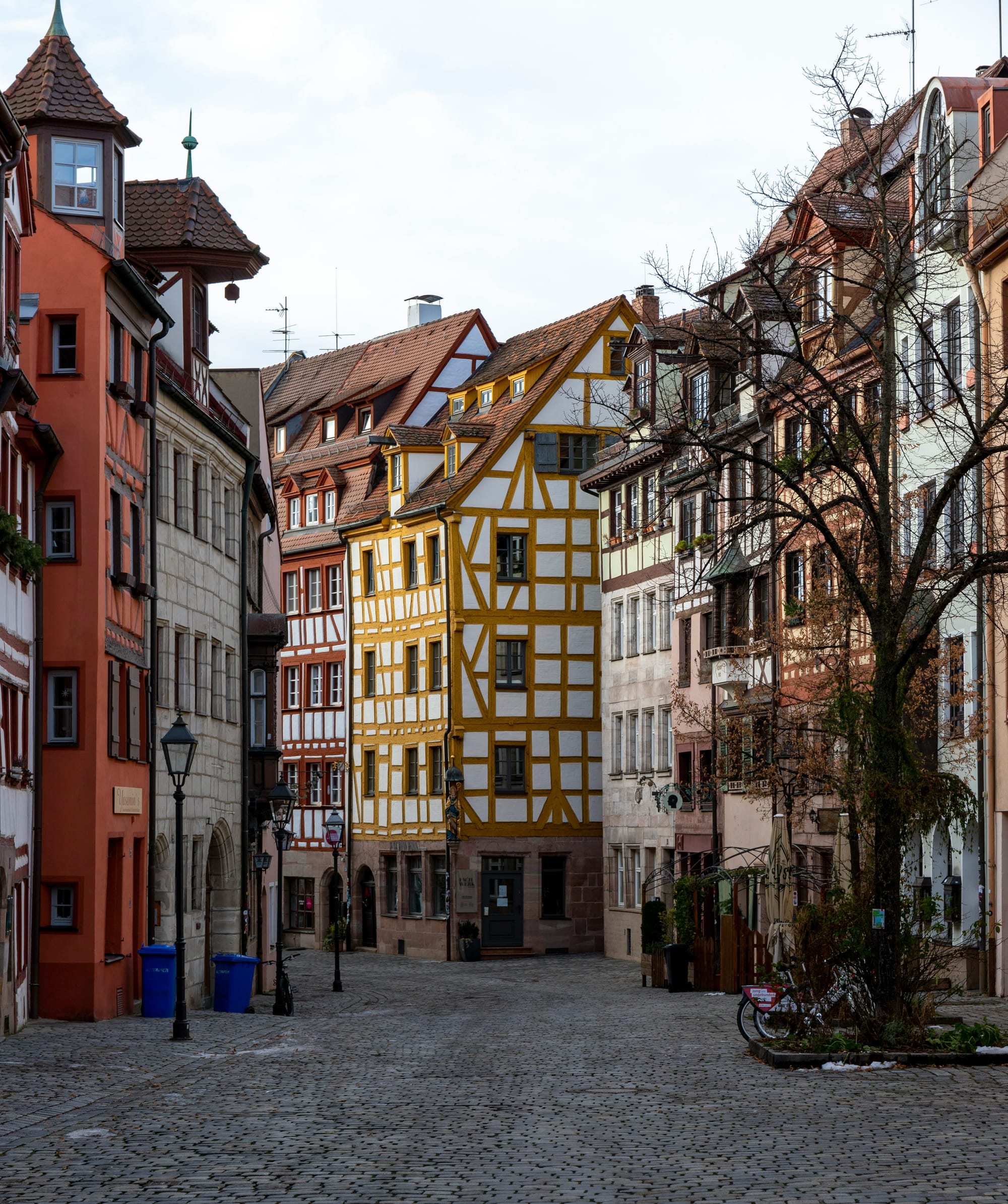
That is why, before it became the theatrical capital of fanaticism, Nuremberg was first a city plundered on the symbolic plane. Nazism did not create it: it occupied it in the realm of the imagination. It appropriated its prestige, its historical weight, its atmosphere of legitimate antiquity. And in doing so, it transformed a complex, plural and secular past into scenery for a totalitarian political fiction. There lies one of the city’s deepest paradoxes: that its earlier greatness was precisely what made it vulnerable to being used as an altar of delirium.
The theft of the symbol
The regime understood very early that totalitarianism cannot be sustained by police, censorship and fear alone. It also requires liturgy. It requires organized emotion, beauty in the service of power, settings capable of turning obedience into a shared experience. In 1933, when Hitler proclaimed Nuremberg the “City of the Reich Party Rallies,” he was not merely choosing a venue for annual meetings: he was consecrating a vast political theater. From then until 1938, the Nazi rallies held there were conceived as ceremonies of collective self-worship, immense performances of force designed to impress both those who took part in them and those who watched from outside.
There was nothing in those gatherings resembling debate, deliberation or dissent. They were not congresses in the political sense of the word, but liturgies of adhesion. Everything was calculated: the parades, the flags, the lighting, the routes, the arrangement of bodies, the synchronization of movements, even the waiting before Hitler’s appearance. Every gesture sought to produce a precise emotion: the sensation of belonging to something immense, orderly, invincible. Nazism understood that a crowd could not only be mobilized; it could be staged. And in Nuremberg it turned that intuition into one of its masterpieces.
The old imperial city, with its historical density and symbolic prestige, served as the backdrop to an ideological operation far more ambitious than propaganda alone. The aim was to present the Third Reich not as a violent eruption born of crisis, resentment and the demolition of democracy, but as the supposedly natural culmination of German history. The message was as simple as it was effective: we are not here to break with the past; we are here to embody it. The regime thus appropriated the city’s imperial memory to disguise as continuity what was in fact a radical, ferocious and exclusionary mutation.
Under that logic, Nuremberg ceased to be a city with a past and became a city at the service of a narrative. What mattered was no longer what it had been in all its complexity—its commercial tradition, its artisanal vitality, its historical contradictions—but what it could represent for the Reich’s political fiction. Nazism did not want merely to occupy the city; it wanted to rewrite it, to empty it of ambiguity and turn it into a useful allegory. It wanted to make it visual proof that Germany was not descending into barbarism, but supposedly returning to its destiny. That was the beginning of one of the most disturbing processes in Nuremberg’s history: the moment when a real city was replaced by its ideological version.
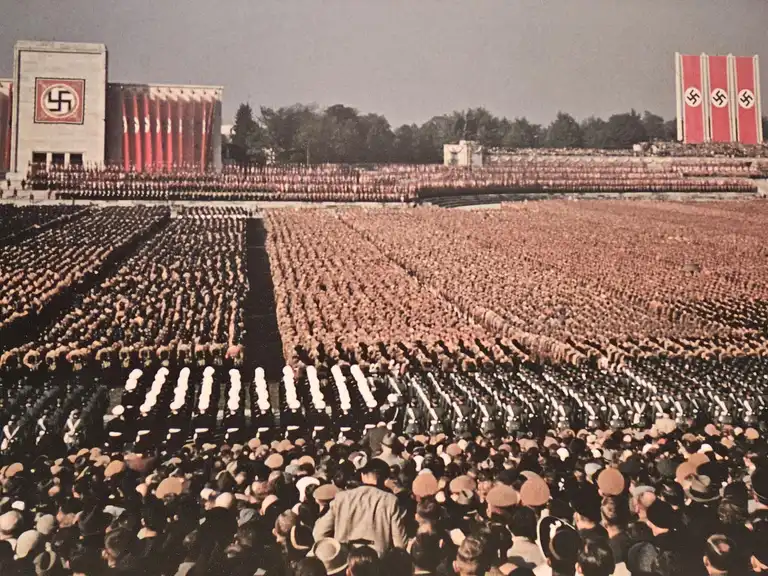
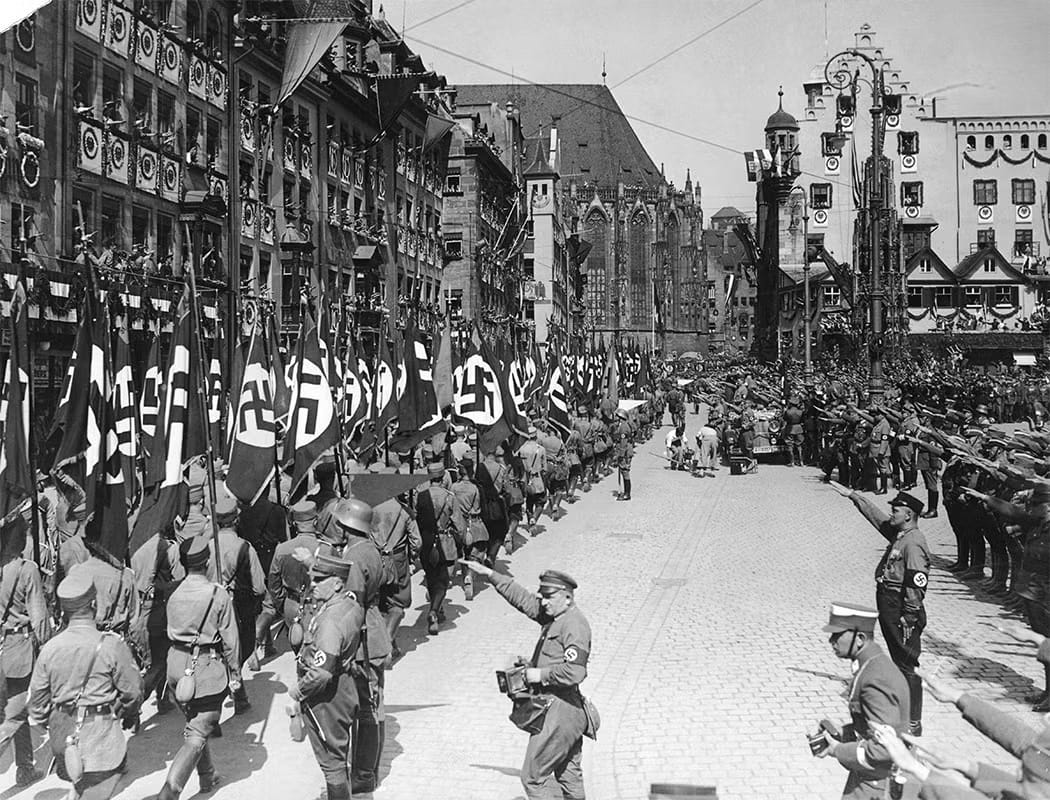
The regime occupied a symbol in Nuremberg.
The architecture of fanaticism
Architecture was the decisive instrument of that political fiction. Nazism understood something essential: to appear eternal, it was not enough to seize power; one had to build it a landscape. In the southeast of Nuremberg, the Party rally grounds unfolded as a geography of gigantism, conceived not only to host massive gatherings but to produce a specific emotion. The Great Road stretched its monumental axis for nearly two kilometers; the unfinished and oversized Kongresshalle deliberately evoked the imperial grandeur of Rome; and the Zeppelinfeld, perhaps the most emblematic space of the entire complex, offered the ideal setting for transforming politics into mass spectacle. This was not urban planning. It was ideological stagecraft on a colossal scale.
In that landscape, Albert Speer put stone at the service of awe. Nothing was designed for the individual, and nearly everything was intended to diminish him. The tribunes did not invite one to look; they imposed a direction of vision. The terraces did not welcome; they commanded. The symmetries, the straight lines, the obsessive repetition of volumes and the mineral hardness of the materials formed an aesthetic of submission. The mass was meant to feel itself part of a higher body, perfectly aligned, without fissures or deviation. Each attendee was, in the end, a replaceable element within a larger composition. Architecture ceased to serve human life and instead demanded discipline, silence and obedience from it.
This was perhaps Nazism’s most unsettling triumph in Nuremberg: making space itself seem to radiate authority. A visitor did not simply enter a venue, but a choreography that preceded any event. Everything was arranged to make him feel small before a force that was immense, inevitable, almost sacred. The aim was not only to impress, but to transform emotion into allegiance. Monumentality functioned as a pedagogy of power: it taught obedience before a single speech had even begun.
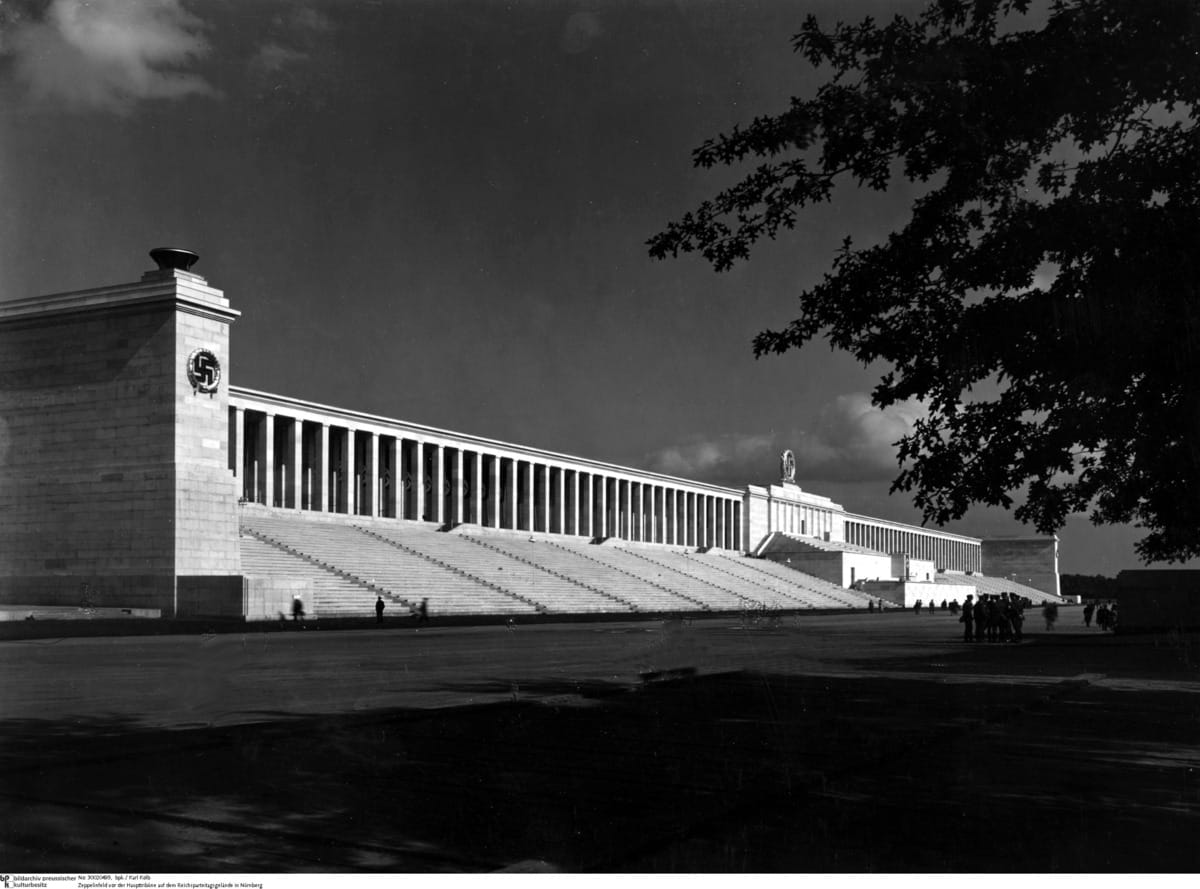
Architecture, which for centuries had served to protect, inhabit or celebrate, here underwent a moral change of function. It no longer offered shelter or beauty in the classical sense, nor even civic grandeur. It offered submission. It turned stone into a technology of obedience and space into an emotional machine in the service of fanaticism. In Nuremberg, Nazism did not merely erect buildings: it erected a way of seeing, marching and belonging. That is why its ruins remain more than material remnants. They are the visible skeleton of a totalitarian ambition.
When politics becomes spectacle
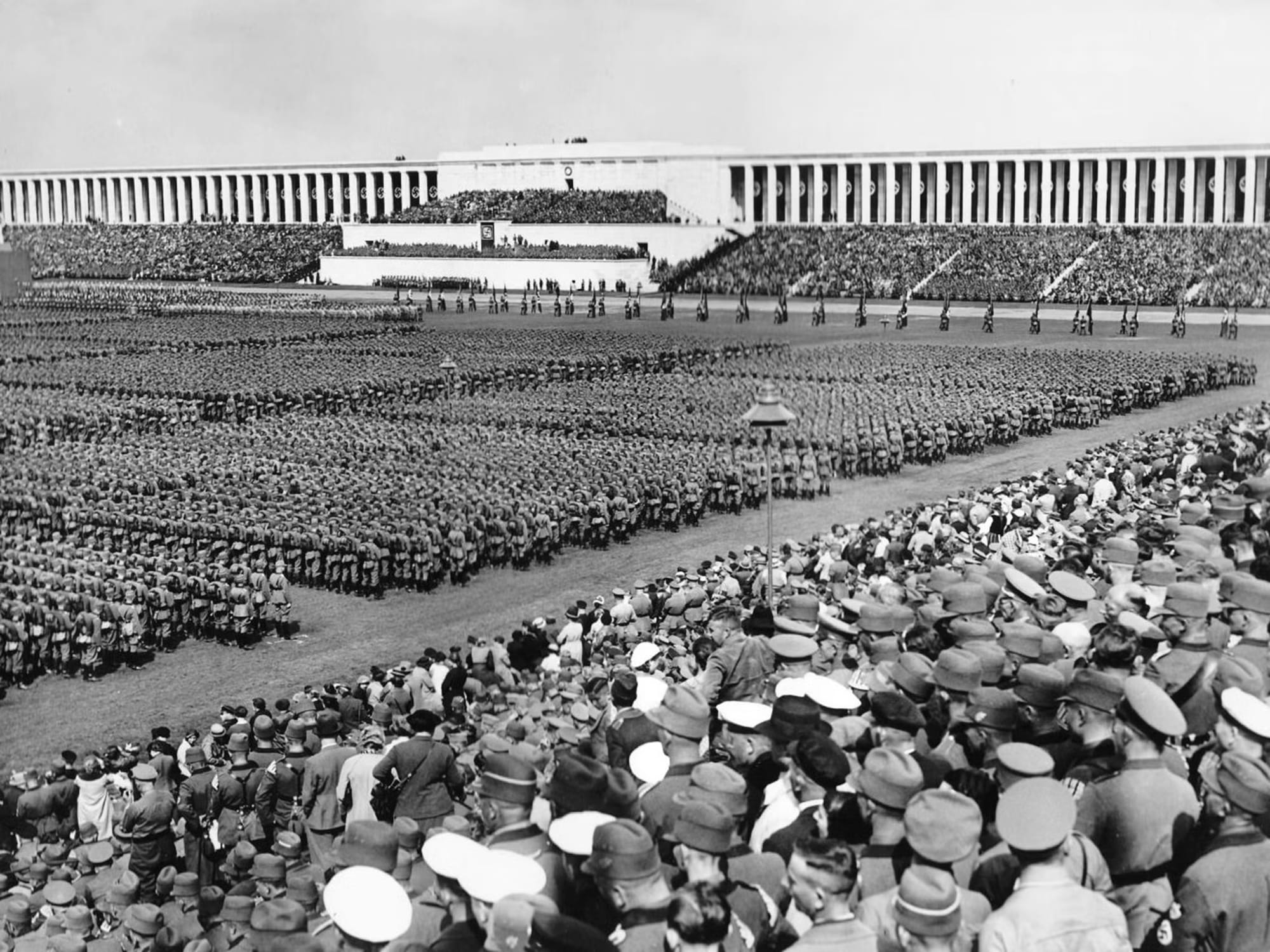
In that oversized setting, politics ceased to be a practice of government and became a choreography of masses. Endless parades, standards waving with ceremonial precision, torches cutting furrows of fire through the night, immaculate uniforms, human columns advancing with near-mechanical synchrony: everything was designed to produce an image before an idea, an emotion before a thought. In Nuremberg, Nazism did not seek to persuade; it sought to dazzle. The crowd was no longer merely an audience, nor a political subject either: it became part of the décor, living matter within a total staging in which every body occupied a precise place in the story of power.
It was Leni Riefenstahl who fixed that aesthetic forever in Triumph of the Will, the film that emerged from the 1934 rally, a work of formal audacity and political abjection that still forces one to ask how far beauty can be used as an instrument of manipulation. Her images elevated Hitler into an almost supernatural figure: a leader descending from the sky, viewed from below, cut against architecture, at once dissolved and magnified by the human tide acclaiming him. The film did not simply document an event; it reinvented it. It did not show power; it consecrated it. And in doing so, it transformed the mass rally into an experience of almost religious nature, where aesthetics replaced morality and emotion canceled any critical distance.
That was what was truly decisive about Nuremberg: not only what happened there, but the way it was made visible. The city became an immense studio for the production of the Nazi myth, a laboratory in which propaganda ceased to be an accessory of power and became one of its most sophisticated forms. Camera, lighting, music, the arrangement of bodies and the solemnity of architecture worked together to manufacture a visual truth more powerful than any speech. The regime understood earlier than almost anyone that in the age of the masses domination also passes through the image, and that a scene repeated often enough can begin to look like destiny.
The twentieth century learned in Nuremberg a disturbing lesson that has never quite stopped haunting it: how an image can prepare real obedience, how a camera can render fanaticism seductive and turn submission into beauty. There, among terraces, flags and lenses, politics became spectacle, and spectacle began to behave like a form of government.
Hatred turned into law
It was no accident either that the legal surname of exclusion came to bear the city’s name. In September 1935, during the so-called “Rally of Freedom,” the Reichstag was convened in Nuremberg to approve the legislation that would turn antisemitism into part of the state’s legal structure. The so-called Nuremberg Laws were not a secondary episode in the Nazi rise, nor merely an administrative offshoot of its ideology. They were a turning point: the moment when the regime’s racial obsession ceased to express itself only through speeches, slogans and propaganda campaigns and acquired instead the cold, impersonal and apparently respectable solidity of law.
From that moment on, hatred no longer needed to appear as outburst, threat or street fury. It could speak the language of forms, legal categories, definitions of citizenship and belonging. Exclusion ceased to be merely a political practice and became a minutely constructed legal machine. The regime drew a line between those who could still belong to the nation and those expelled from it—not always physically yet, but morally, civilly and juridically. First they were stripped of the status of citizens; later, in time, the rest would follow. As so often in the history of persecution, the most extreme violence was prepared by an earlier form of violence, less visible and more bureaucratic: classification.
There lies one of Nuremberg’s most uncomfortable truths. The city was not only the great ceremonial stage of Nazism, the place where its aesthetics of power were performed before the masses. It was also the place where that worldview acquired legal form, where prejudice became system and discrimination became state procedure. Antisemitism ceased to be an ideological passion and presented itself instead as a normative order. That transformation was decisive, because it allowed exclusion to be carried out not as an excess, but as a supposed administrative normality.
Perhaps that is one of the city’s most disturbing lessons. Barbarism does not always enter shouting. It does not always burst in with uproar, nor announce itself in the disfigured face of immediate violence. Sometimes it arrives with a seal, a signature, technical language and the appearance of legality. Sometimes it sits at a table, drafts articles, defines categories and turns dispossession into procedure. In Nuremberg, Nazism did not only learn how to display itself: it also learned how to legislate itself. And in that passage from rally to legal bulletin there already lay, still embryonic but unmistakable, the logic of the disaster that would come after.
The city in ruins
Then came destruction, and with it a form of truth that no regime can control forever. Between Allied bombing and the final battles of the war, Nuremberg was reduced to a landscape of rubble. The old town, for centuries presented as an emblem of German continuity and later used by Nazism as the backdrop for its political liturgy, suffered catastrophic damage. The city the regime had elevated into the symbolic altar of the Reich ended as broken masonry, smoke, façades torn open like wounds, and streets where no trace remained of that choreographed solemnity. The geometry of power collapsed in flames.
There is something deeply revealing in that fall. The place that had served to glorify permanence, strength and the supposed inevitability of the Reich suddenly showed itself as vulnerable as every project founded on violence. The very stones that had sought to speak the language of eternity were exposed to the fragility of total war. The city Nazism had instrumentalized as a symbol of historical continuity was brutally returned to its material condition: a city of brick, wood and flesh, vulnerable to burning like any other. Under the bombs, propaganda lost its aura as well.
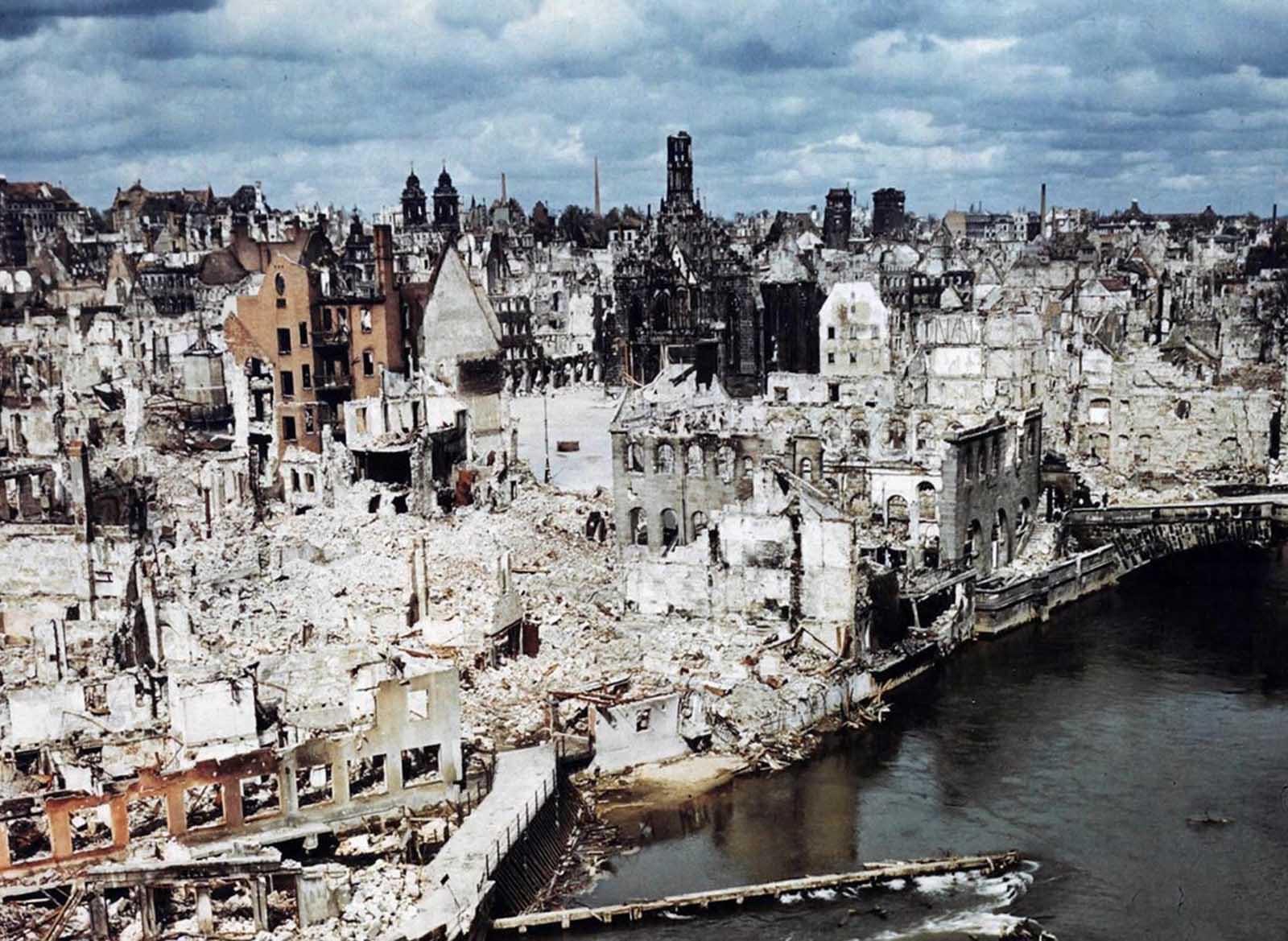
But Nuremberg’s ruin was not only physical. It was also moral and symbolic. The set collapsed, and with it something more: the pretension that that monstrous order could last a thousand years. In the city’s remains there was an involuntary image of the Nazi lie. All that monumentality, all that stagecraft of absolute power, had promised greatness and left only devastation. What remained was not the eternal Reich but a broken city, an exhausted population and a new silence heavier than the roar of the rallies.
And yet Nuremberg’s paradox begins precisely there, among the ruins. For that destruction did not close the city’s history; it forced it to rebuild itself upon a different consciousness. Today, when one walks through the reconstructed center beneath the appearance of medieval continuity, one is also walking through a landscape remade after fire. What seems intact was, to a great extent, rebuilt; what seems ancient carries within it the memory of having been destroyed. Nuremberg’s beauty is not innocent. It has something of survival and something of warning. As if every restored façade, every recomposed tower and every rebuilt bridge silently remembered that even the most solid cities can be dragged into the abyss when history is placed in the service of delirium.
The second life of the same stage
And yet out of those ruins another scene emerged, almost as if the city itself had been dragged, without any possible transition, from delirium into reckoning. When the Allies decided to try the principal Nazi leaders, they chose Nuremberg for a combination of reasons already charged with historical meaning. There was a practical reason: the Palace of Justice had remained relatively intact despite the general devastation and also had an adjoining prison capable of holding the accused. But there was a much deeper symbolic reason as well. The city that had served as the regime’s altar, the same city in which Nazism had theatricalized its myth of greatness, was about to become the place where that myth would be put on trial, dismantled document by document, crime by crime, name by name.
The choice of Nuremberg thus had the precision of a political and moral gesture. The same ground that had borne the weight of marches, slogans and the stagecraft of fanaticism now carried a judicial proceeding intended to fix responsibility. Where the regime had wanted to present itself as the natural culmination of German history, its hierarchs now had to sit and listen to the painstaking enumeration of their acts. The city ceased to be scenery for the exaltation of power and became the stage of its challenge. It was not sufficient reparation—none could have been after such catastrophe—but it was a reversal dense with meaning: the place of liturgy was transformed into the place of judgment.
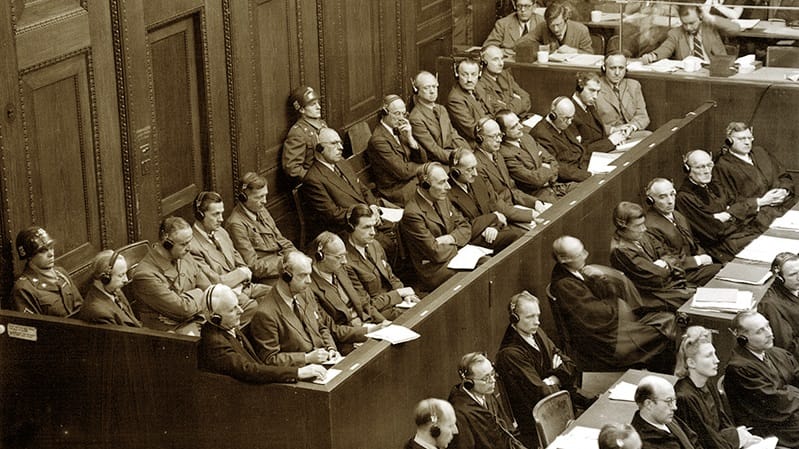
Between 20 November 1945 and 1 October 1946, Courtroom 600 ceased to be merely a German courtroom and became a chamber watched by the entire world. There appeared some of the principal political, military and administrative figures of the Third Reich; there testimony was heard, films screened, documents read, words translated from one language into another so that truth might cross borders. The room, sober and almost austere, was very far from the monumentality with which Nazism had wanted to represent itself. And yet it possessed another kind of gravity: the kind that arises when power, for once, is forced to answer.
In that space, the tone of the century changed. The world moved from the roar of the crowd to the precise, tense and often insufficient language of law. Insufficient, because no legal category could fully encompass the scale of the horror; tense, because the trial was not free of contradictions, political interests or historical limits; precise, because it was there, nonetheless, that something essential was attempted: to establish that crimes committed in the name of the state could not vanish into the abstraction of history or dissolve into bureaucratic obedience. In Courtroom 600, the voice of the century ceased to sound like a slogan and began to sound like interrogation. That was Nuremberg’s second life: to pass from being the theater of obedience to becoming the place where the world, perhaps for the first time in full awareness, tried to put power itself in the dock.
The invention of a moral grammar
It is often said that modern international justice was born in Nuremberg. The phrase may sound sweeping, even overly solemn, but it contains a truth difficult to dispute. Not because the city solved once and for all the problem of how to judge political evil, nor because that tribunal was perfect, uncontested or immune to the contradictions of its time, but because in that devastated city something was attempted that had scarcely existed with such ambition before: the idea that even the highest power, when it has turned crime into system, can be called to account before an authority claiming to stand above mere military victory.
In the principal trial of the International Military Tribunal appeared some of the central names of the Nazi regime. Afterward would come twelve further proceedings, also in Nuremberg, against doctors who had turned science into an instrument of torture, against judges who had prostituted the law until it became the accomplice of persecution, against industrialists who profited from slave labor, and against military commanders and extermination officials who had placed administrative machinery at the service of death. The breadth of those proceedings revealed something decisive: Nazism had not been merely a sum of exceptional monsters, but a system sustained by a network of obediences, profits, complicities and professional expertise.
Nuremberg in four dates
➢ 1933 — Hitler declares Nuremberg the “City of the Reich Party Rallies”
➢ 1935 — The Nuremberg Laws turn racial exclusion into state law
➢ 1945–1946 — The International Military Tribunal is held in Courtroom 600
➢ 1946–1949 — Twelve subsequent trials expand the legal reckoning
But Nuremberg’s importance does not lie only in the number of defendants or the severity of the sentences. Its true legacy lies in the language it fixed. There, with unprecedented force, expressions were articulated that would thereafter become part of the moral and legal vocabulary of the contemporary world: crimes against peace, war crimes, crimes against humanity. These were not merely legal labels. They were a new way of naming what had too often remained dispersed among diplomatic rhetoric, state sovereignty or the brute force of victors. To name was already to begin delimiting, making visible, preventing certain acts from dissolving into the abstract fog of war.
There was also an even deeper innovation: the assertion that individuals, and not only states, could be held criminally responsible under international law. That altered a long-established tradition according to which the history of wars was written between governments, armies and borders while personal responsibility blurred into structures of command. Nuremberg broke, however imperfectly, that old alibi. A minister, a marshal, a propagandist, a senior official or an organizer of deportations could no longer simply hide behind the state apparatus. Reason of state ceased to be an absolute refuge.
— Robert H. Jackson
There, too, another fundamental principle took precise form: obeying orders was not enough to erase guilt. Many of the accused tried to present themselves as minor cogs in a gigantic machine, disciplined men trapped within a higher mechanism. But the tribunal held, for all its limits, that there are orders whose monstrosity does not permit obedience to become absolution. That idea, so simple in appearance and so difficult in practice, would become one of Nuremberg’s most enduring legacies: the notion that moral and legal responsibility does not disappear merely because crime has been administered from above.
That is why Nuremberg still matters. Because, faced with the abyss, the world chose not only immediate punishment or the emotional release of revenge, but something more fragile, slower and also more ambitious: a form of reason. An incomplete reason, debatable, traversed by the politics of the victors, yes—but reason all the same. Documents against slogans. Testimony against myth. Legal categories against the temptation to regard horror as so immense that it could no longer be judged. In that almost obstinate insistence on naming, proving and delimiting lies Nuremberg’s great contribution: the attempt to give the twentieth century a moral grammar by which the world might at least begin to distinguish between power and crime, state and barbarism, history and responsibility.
Imperfect justice, necessary justice
There were, of course, shadows in that juridical dawn. It would be naive to present Nuremberg as a pure, uncontested justice free of contradiction. From the outset there were serious objections: the charge of retroactivity in some counts, the inevitable selectivity of a tribunal that judged the defeated while leaving other wartime violences outside its reach, the moral and political asymmetry that always accompanies justice exercised by victors over the vanquished. None of that can be dismissed lightly. Nuremberg was traversed by politics, by the balance of forces created by military victory, and by the limitations of an age still struggling to name, with imperfect tools, crimes of unprecedented scale.
In that sense, the tribunal was not an immaculate point of arrival, but a precarious construction raised amid ruins. Judges and prosecutors did not operate in a serene world, but in a devastated Europe, with millions dead, cities destroyed, camps newly liberated, and a continent already beginning to fracture under the tensions of the postwar order. The justice attempted there could not be antiseptic or abstract. It was born under pressure, conditioned by diplomatic urgency, national interests, and by the need—political as much as moral—to offer some answer to catastrophe. And yet precisely for that reason it retains its historical density: because it did not arise in a theoretical laboratory, but in the place where the world had to decide what to do with a crime that seemed to overflow every available category.
To reduce Nuremberg solely to the critique of “victors’ justice,” however, would be a form of retrospective comfort. It would be an elegant way of emphasizing its defects in order to evade its audacity. For the tribunal was imperfect, yes, but it also inaugurated something decisive. It opened a door that had not previously existed in that form: the possibility that state, military and bureaucratic power might no longer hide completely behind the flag, the office, the chain of command or obedience. It introduced into contemporary history an uncomfortable idea for every apparatus of power: that neither sovereignty nor victory nor the structure of the state is by itself enough to erase individual responsibility.
That was its real novelty, and also its real discomfort. It did not prevent the atrocities that would come after; it did not block new wars, genocides or ethnic cleansings. The world after Nuremberg was not an innocent world, nor a saved world. But it was a world in which perpetrators lost one of their best alibis. From then on, it became less easy to present certain crimes as simple acts of state, inevitable excesses of war, or deeds diluted by obedience to orders. Nuremberg did not cancel future barbarism, but it left it more exposed. It stripped away part of its verbal impunity. It forced it, at least, to confront a language capable of naming it and a justice capable of attempting to judge it.
To rebuild is not to forget
Over the years, Nuremberg understood that it was not enough simply to raise façades again or recompose the line of its towers. Cities, too, must decide what to do with the meaning of their ruins. And that was perhaps one of its most difficult decisions: to understand that material reconstruction would have value only if it were accompanied by a moral reconstruction of the gaze. The issue was not merely to preserve stones, but to determine what story those stones would sustain from then on. For that reason, Nuremberg’s memory does not limit itself to displaying relics of terror or placing the past behind glass. It has tried to turn the places most burdened with shadow into spaces of documentation, learning and confrontation with history.
The former Nazi rally grounds, originally conceived to glorify collective obedience, have been resignified as a place of study and warning. The Palace of Justice, where the Reich’s hierarchs heard the enumeration of their crimes, now houses the Memorium of the Nuremberg Trials and thus extends the historical life of Courtroom 600 beyond the judicial event itself. Even the city’s public identity has tried to answer that past with a civic vocation anchored in the defense of human rights, as if Nuremberg had accepted that it could not choose what it had been, but could choose how it wished to remember it and explain it to others.
That gesture matters, and greatly. For there are cities that cosmetically conceal their wound, soften it until it becomes décor, or discreetly remove it from the center of their story so as not to discomfort visitors—or themselves—too much. And there are others that accept incorporating the fracture into their public consciousness, even knowing that to do so means renouncing a certain comfort. Nuremberg belongs to the second category. It has not erased all its contradictions—no city can—but it has accepted that its historical truth resides not only in the restored beauty of its center, but also in the discomfort of what happened at its edges and, for a time, at its symbolic heart.
That is why its present landscape possesses such singular force. The reconstructed medieval old town and the monumental ruins of Nazism do not cancel each other out; they look at each other. One recalls the depth of a city far older than the twentieth century; the other prevents that antiquity from becoming innocent. Between them a silent, almost pedagogical tension is established, one that defines the contemporary experience of Nuremberg. Here restoration does not function as amnesia, but as coexistence with what cannot be repaired. In this city, rebuilding has not meant returning to a time before horror, as though everything could begin again intact. It has meant something more demanding: learning to live with memory without allowing memory to be buried beneath beauty.
What Nuremberg still says today
Perhaps that is why Nuremberg has not been sealed off in the past. It remains a contemporary city not because the evil staged there can be repeated in identical fashion, with the same uniforms, the same symbols or the same architecture of fanaticism, but because the questions it left behind remain open, uncomfortable, alive. What happens when the law, instead of protecting, places itself at the service of exclusion? How does an archive become shared memory, an image become evidence, a testimony become public truth? In what way can justice arrive after horror without degrading into revenge? And what are we to do with places where propaganda was so powerful that even today something of its echo seems to cling to the stone?
Nuremberg continues to address the present because it speaks not only about what happened there, but about mechanisms that have not disappeared. It speaks of the temptation to clothe violence in legal language. It speaks of the ease with which a society can grow accustomed to the liturgies of power when they present themselves as order, unity or destiny. It also speaks of the difficulty of judging the responsible when crime has been administered from offices, ministries, barracks and bureaucracies—when barbarism ceases to resemble an irrational outburst and takes on the tidy form of a system. What Nuremberg laid bare was not only an era, but a structure of political and moral behavior that the world has never fully dismantled.
Eighty years later, the vocabulary fixed in that city still orders the international debate about impunity. Every time the world argues over aggression, war crimes, crimes against humanity, superior orders, command responsibility or the limits of state sovereignty, Nuremberg reappears, even if only silently, behind the arguments. It reappears in courts, in human-rights reports, in journalistic investigations, in satellite images documenting bombardments, in digital archives trying to preserve evidence before oblivion or manipulation arrives. In a sense, the city has become a moral and legal reference point that continues to operate even when it is not named.
That may be its deepest legacy: having ceased to belong only to German history and having become part of the political conscience of the contemporary world. Nuremberg is no longer merely the place where the twentieth century displayed one of its darkest forms of organized power. It is also the place from which we still continue to ask how one should respond—with law, with memory and with truth—when power turns into crime. That is why its inheritance does not sit still in museums or sleep in archives. It continues to work in the present, demanding something uncomfortable but essential: that humanity not merely remember its worst ruins, but learn to recognize in time the mechanisms that made them possible.
The place where the twentieth century looked at itself in the mirror
In the end, that is what makes Nuremberg an extraordinary city, and one difficult to forget: not only that it concentrated two decisive moments of the twentieth century, but that both occurred on the same ground, almost as if history had wanted to force it to stage, in a single setting, the fall into the abyss and the uncertain effort to emerge from it. Here the crowd learned to acclaim the executioner with ceremonial fervor; here, later, the world tried to seat that executioner before reason, strip him of his aura, tear him out of myth and return him to the rough terrain of facts, evidence and responsibility.
In Nuremberg, stone first served to magnify obedience. The tribunes, the monumental avenues, the grandstands and the ordered masses taught an age that power could present itself as beauty, destiny and unanimity. Later, in that same city, other walls and another architecture housed an idea still fragile, debatable, incomplete, yet decisive: that no power, however high it rises, should stand entirely beyond the reach of the law. Between those two scenes lies much of the moral drama of the last century.
Few cities have been treated with such cruelty by history. Few, too, have tried to answer it with such lucidity. For Nuremberg did not remain fixed solely as a symbol of fanaticism, nor resign itself to becoming a museum of its own disgrace. In time, it managed to turn that burden into a form of consciousness. And there lies its true singularity: not only in having witnessed horror, but in having helped formulate a response to it.
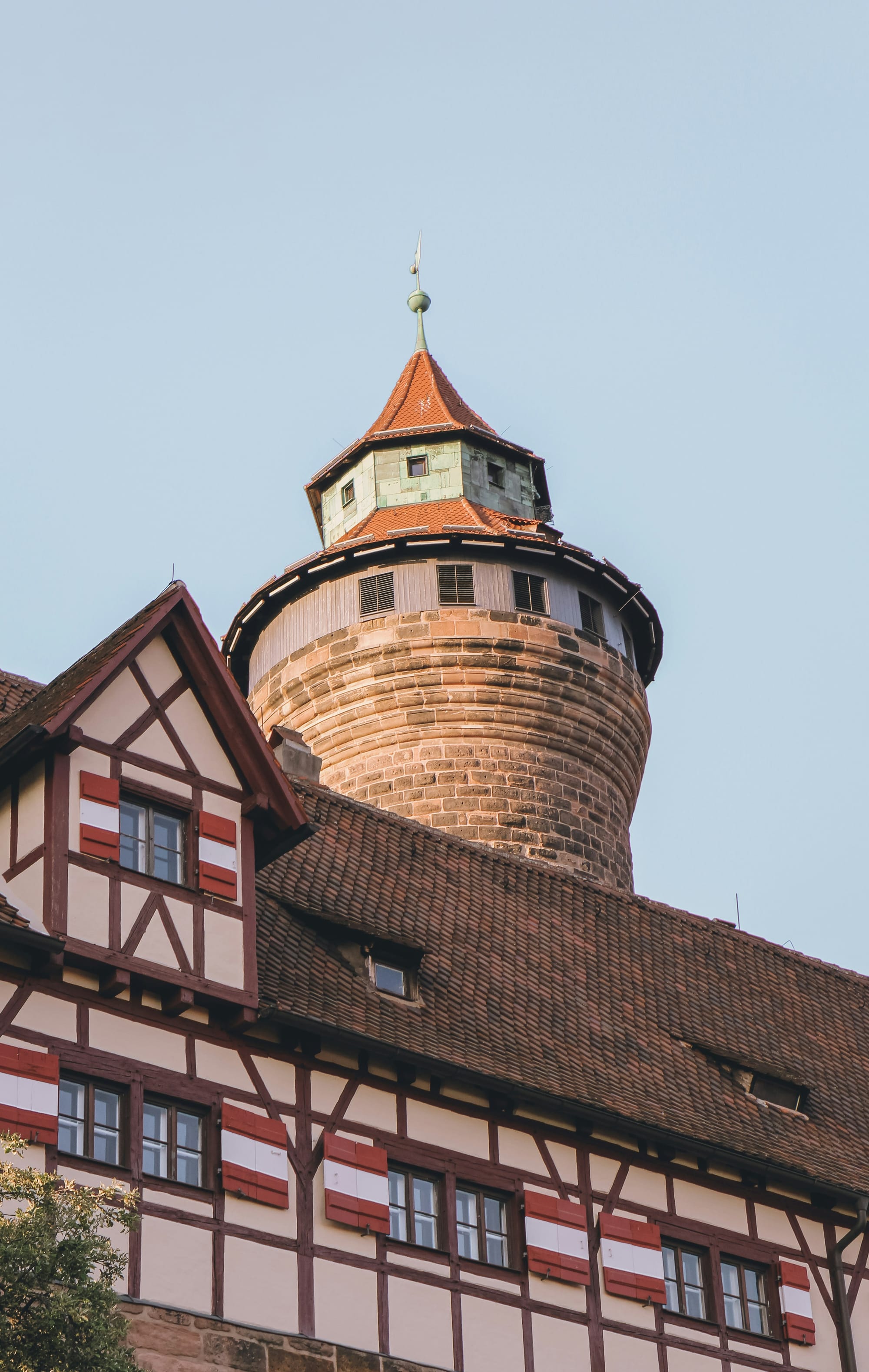
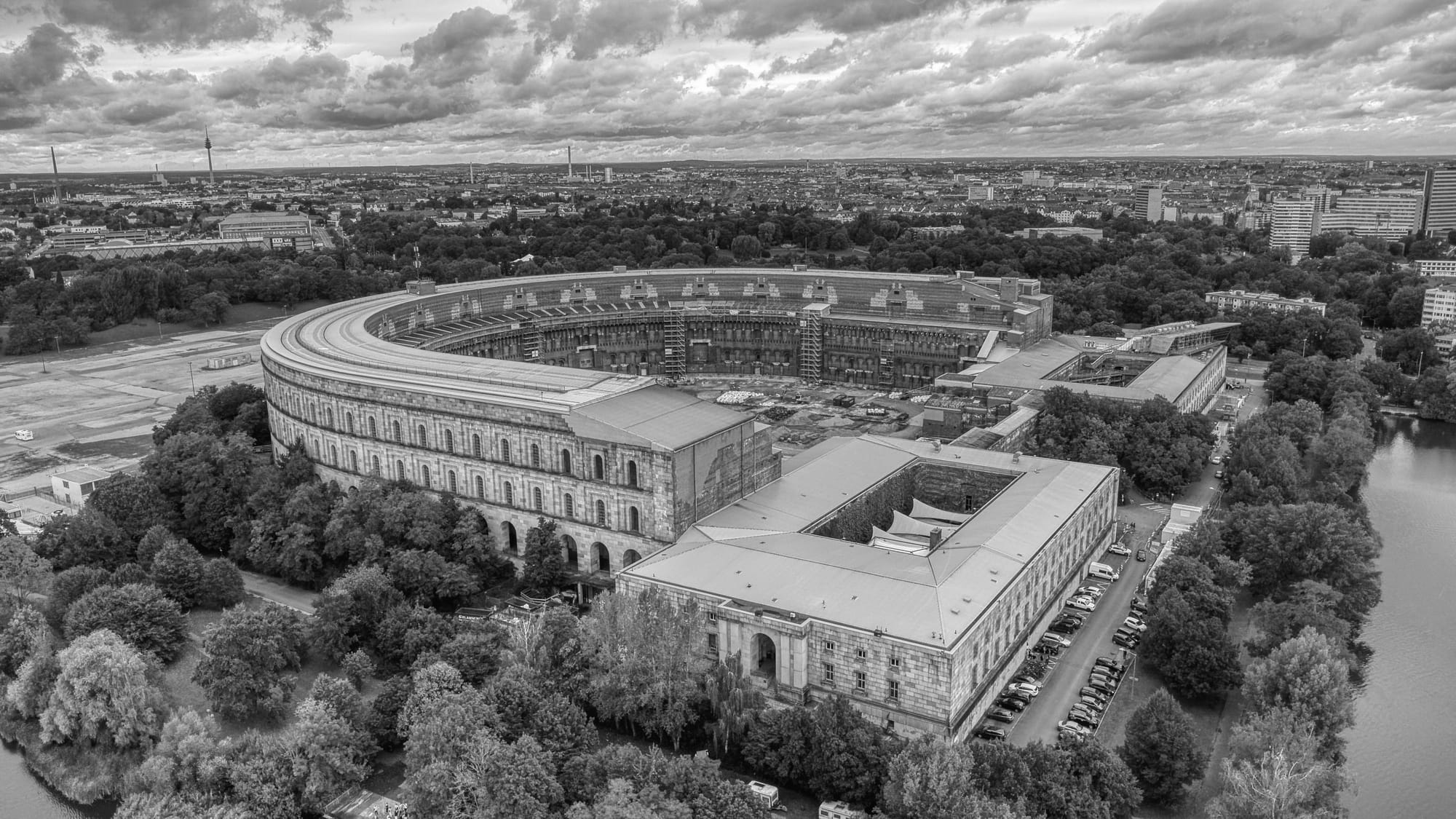
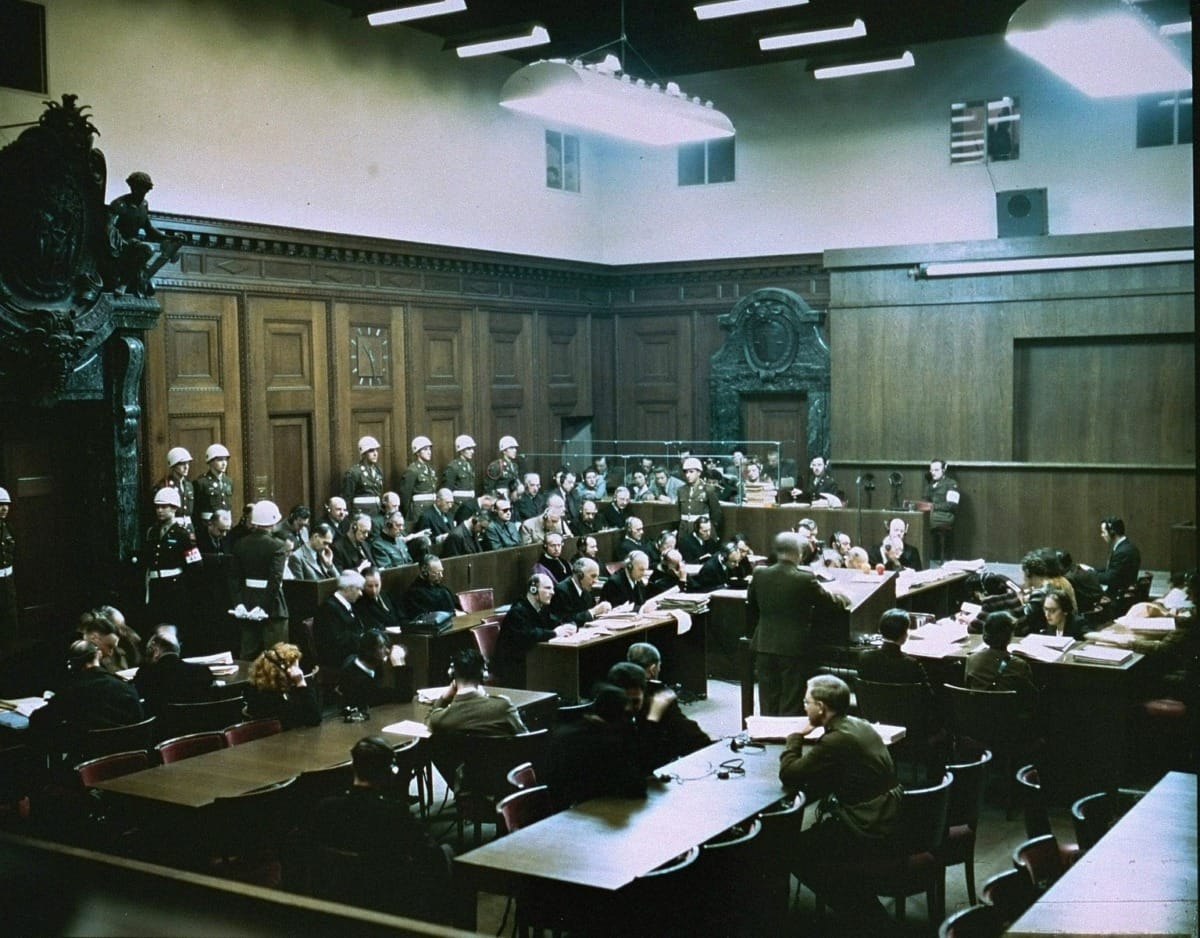
One city, three landscapes: empire, fanaticism, judgment.
That is why Nuremberg is far more than a city associated with one of the darkest faces of the twentieth century. It is also the place where that century tried, perhaps for the first time with full awareness of the magnitude of its crimes, to invent a language with which to confront itself. A place where barbarism was spectacle, ruin and then case file; where history stopped speaking in the name of eternal victors and began, if only for a moment, to speak in the name of responsibility. And perhaps that is its deepest lesson: that even after devastation, even after delirium, a city can still remain the place where humanity looks at itself in the mirror and decides what to do with what it sees.